. 2011 Aug;85(2):303-8.
doi: 10.4269/ajtmh.2011.11-0181.

Warming oceans, phytoplankton, and river discharge: implications for cholera outbreaks

Affiliations

Warming oceans, phytoplankton, and river discharge: implications for cholera outbreaks

Antarpreet S Jutla et al. Am J Trop Med Hyg. 2011 Aug.

Erratum in

  • Am J Trop Med Hyg. 2011 Sep;85(3):582

Abstract

Phytoplankton abundance is inversely related to sea surface temperature (SST). However, a positive relationship is observed between SST and phytoplankton abundance in coastal waters of Bay of Bengal. This has led to an assertion that in a warming climate, rise in SST may increase phytoplankton blooms and, therefore, cholera outbreaks. Here, we explain why a positive SST-phytoplankton relationship exists in the Bay of Bengal and the implications of such a relationship on cholera dynamics. We found clear evidence of two independent physical drivers for phytoplankton abundance. The first one is the widely accepted phytoplankton blooming produced by the upwelling of cold, nutrient-rich deep ocean waters. The second, which explains the Bay of Bengal findings, is coastal phytoplankton blooming during high river discharges with terrestrial nutrients. Causal mechanisms should be understood when associating SST with phytoplankton and subsequent cholera outbreaks in regions where freshwater discharge are a predominant mechanism for phytoplankton production.


Figures
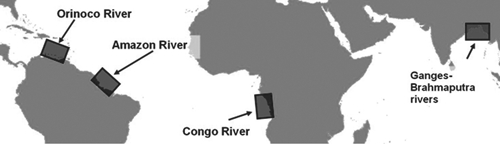
Figure 1.
Figure 1.
Location of four major river basins: Ganges and Brahmaputra rivers discharge into the Bay of Bengal, Orinoco river drains into Atlantic Ocean, Congo River drains into the Atlantic Ocean, and Amazon River drains into the Atlantic Ocean.
Figure 2.
Figure 2.
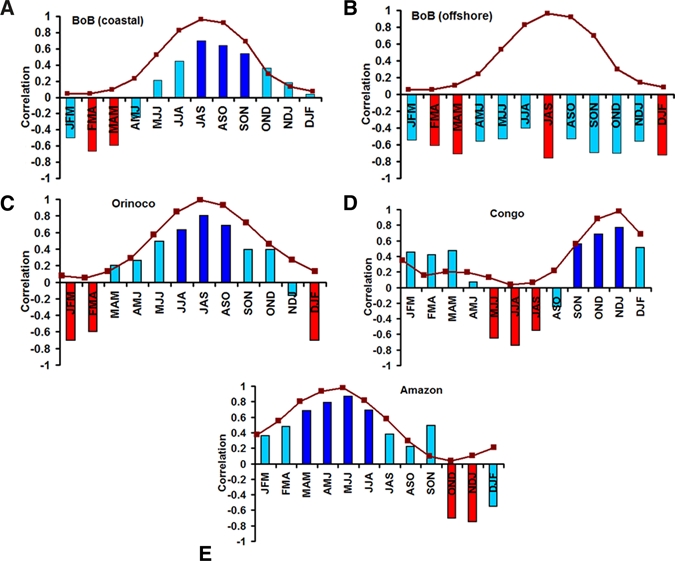
Seasonal correlation between sea surface temperature (SST) and chlorophyll from 1997 to 2010 (A) Bay of Bengal (coastal), (B) Bay of Bengal (offshore), (C) Orinoco, (D) Congo, and (E) Amazon. Deep blue and red bars represent statistically significant correlation (using Kendall Tau test P < 0.05). Brown line, superimposed on the correlation plots, is the seasonal river discharge, scaled between 0 and 1, from respective river basins. J, F, M …D represents January, February, March… December, respectively. JFM, FMA is the mean of three consecutive months.
Figure 3.
Figure 3.
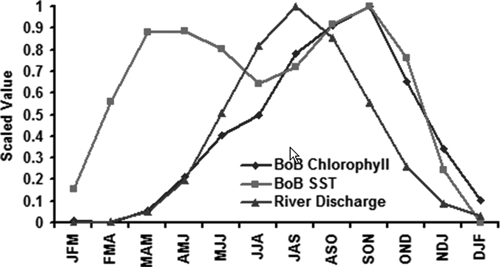
Three-month chlorophyll, sea surface temperature (SST), and river discharge at the mouth of the river for coastal Bay of Bengal. All values have been scaled from 0 to 1.
Figure 4.
Figure 4.
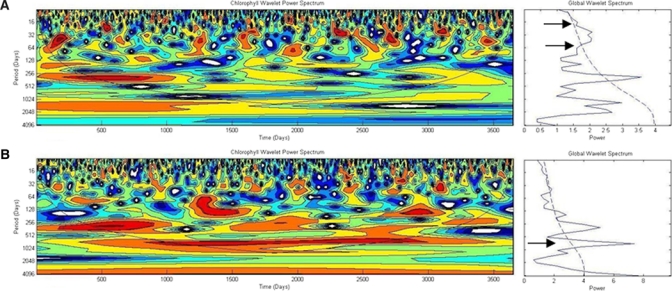
Wavelet power spectrum analysis for (A) daily coastal chlorophyll, and (B) offshore chlorophyll time series. A 5-day running mean was applied to the daily time series to remove missing values. Climatological daily values were inserted for missing chlorophyll values after a 5-day running mean was applied.
Figure 5.
Figure 5.
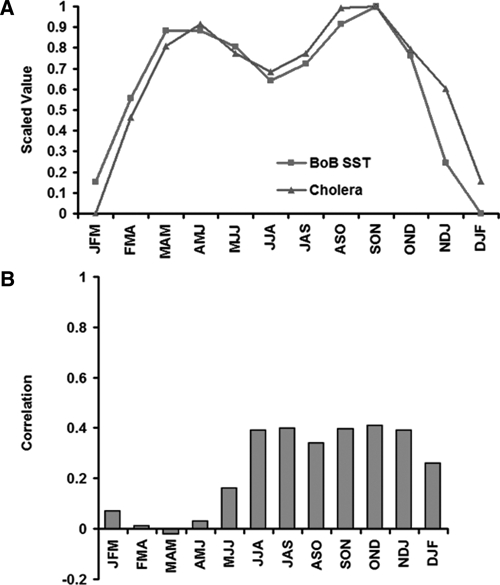
(A) Climatology of cholera and coastal Bay of Bengal sea surface temperature (SST). (B) Seasonal correlation of coastal Bay of Bengal SSTs with concurrent seasonal cholera outbreaks.

References

    1. Colwell RR, Huq A. Marine ecosystems and cholera. Hydrobiologia. 2001;460:141–145.
    1. Reidl J, Klose KE. Vibrio cholerae and cholera: out of the water and into the host. FEMS Microbiol Rev. 2002;26:125–139. - PubMed
    1. Lobitz BM, Beck LR, Huq A, Wood B, Fuchs G, Faruque ASG, Colwell RR. Climate and infectious disease: use of remote sensing for detection of Vibrio cholerae by indirect measurement. Proc Natl Acad Sci USA. 2000;97:1438–1443. - PMC - PubMed
    1. Jutla AS, Akanda AS, Islam S. Tracking cholera in coastal regions using satellite observations. J Am Water Resour Assoc. 2010;46:651–662. - PMC - PubMed
    1. Solanki HU, Dwivedi RM, Nayark SR. Synergistic analysis of SeaWiFS chlorophyll concentration and NOAA-AVHRR SST feature for exploring marine living resources. Int J Remote Sens. 2001;22:3877–3882.

Publication types