


A normal platelet count may not be enough: the impact of admission platelet count on mortality and transfusion in severely injured trauma patients
- PMID: 21814101
- PMCID: PMC4374734
- DOI: 10.1097/TA.0b013e318227f67c
A normal platelet count may not be enough: the impact of admission platelet count on mortality and transfusion in severely injured trauma patients
Abstract
Background: Platelets play a central role in hemostasis after trauma. However, the platelet count of most trauma patients does not fall below the normal range (100-450 × 10(9)/L), and as a result, admission platelet count has not been adequately investigated as a predictor of outcome. The purpose of this study was to examine the relationship between admission platelet count and outcomes after trauma.
Methods: A retrospective cohort study of 389 massively transfused trauma patients. Regression methods and the Kruskal-Wallis test were used to test the association between admission platelet count and 24-hour mortality and units of packed red blood cells (PRBCs) transfused.
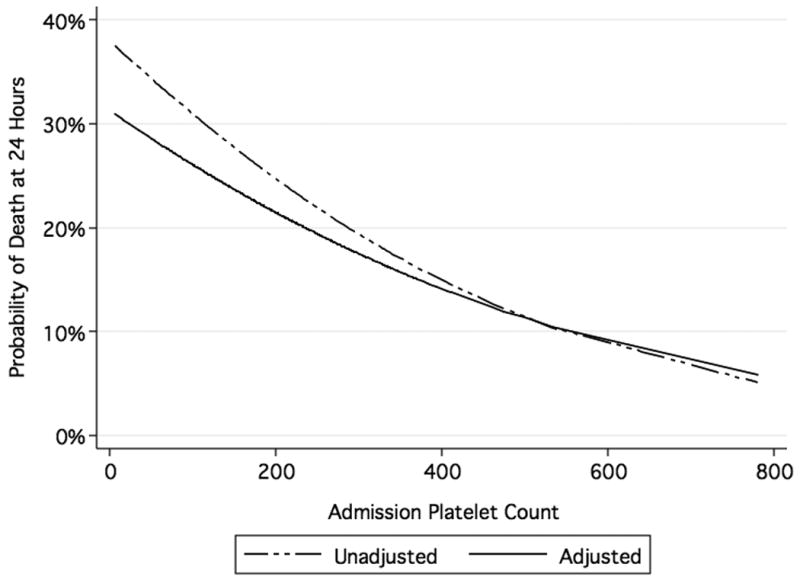
Results: For every 50 × 10(9)/L increase in admission platelet count, the odds of death decreased 17% at 6 hours (p = 0.03; 95% confidence interval [CI], 0.70-0.99) and 14% at 24 hours (p = 0.02; 95% CI, 0.75-0.98). The probability of death at 24 hours decreased with increasing platelet count. For every 50 × 10(9)/L increase in platelet count, patients received 0.7 fewer units of blood within the first 6 hours (p = 0.01; 95% CI, -1.3 to -0.14) and one less unit of blood within the first 24 hours (p = 0.002; 95% CI, -1.6 to -0.36). The mean number of units of PRBCs transfused within the first 6 hours and 24 hours decreased with increasing platelet count.
Conclusions: Admission platelet count was inversely correlated with 24-hour mortality and transfusion of PRBCs. A normal platelet count may be insufficient after severe trauma, and as a result, these patients may benefit from a lower platelet transfusion threshold. Future studies of platelet number and function after injury are needed.
Figures
References
-
- Holcomb JB, Wade CE, Michalek JE, et al. Increased plasma and platelet to red blood cell ratios improves outcome in 466 massively transfused civilian trauma patients. Ann Surg. 2008;248:447–458. - PubMed
-
- Como JJ, Dutton RP, Scalea TM, et al. Blood transfusion rates in the care of acute trauma. Transfusion. 2004;44:809–813. - PubMed
-
- Cinat ME, Wallace WC, Nastanski F, et al. Improved survival following massive transfusion in patients who have undergone trauma. Arch Surg. 1999;134:964–968. discussion 968-970. - PubMed
-
- Borgman MA, Spinella PC, Perkins JG, et al. The ratio of blood products transfused affects mortality in patients receiving massive transfusions at a combat support hospital. J Trauma. 2007;63:805–813. - PubMed
Publication types
MeSH terms
Grants and funding
LinkOut - more resources
Full Text Sources
Medical
