


doi: 10.1351/pac200880050929.
Nickel-Catalyzed Coupling Reactions of Alkenes
Affiliations
- PMID: 21814295
- PMCID: PMC3148197
- DOI: 10.1351/pac200880050929
Item in Clipboard
Nickel-Catalyzed Coupling Reactions of Alkenes
Pure Appl Chem.
2008.
Abstract
Several reactions of simple, unactivated alkenes with electrophiles under nickel(0) catalysis are discussed. The coupling of olefins with aldehydes and silyl triflates provides allylic or homoallylic alcohol derivatives, depending on the supporting ligands and, to a lesser extent, the substrates employed. Reaction of alkenes with isocyanates yields N-alkyl acrylamides. In these methods, alkenes act as the functional equivalents of alkenyl- and allylmetal reagents.
Figures
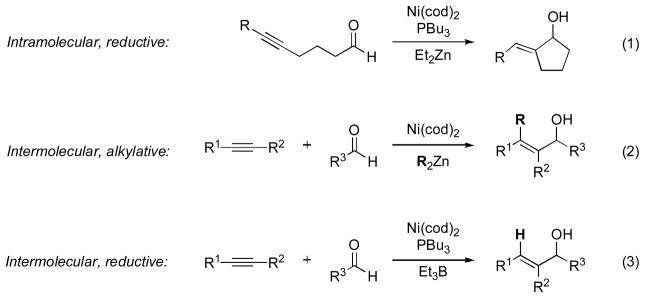
Alkyne–aldehyde reductive coupling.

Enantioselective, nickel(0)-catalyzed reductive coupling of alkynes and aldehydes.
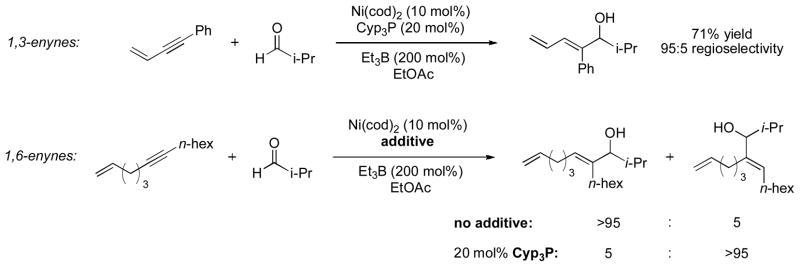
Regioselectivity in the reductive coupling of enynes and aldehydes.
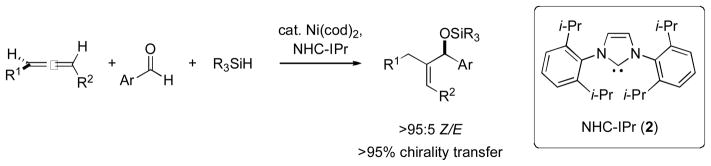
Enantioselective and regioselective nickel-catalyzed coupling of allenes, aldehydes, and silanes.
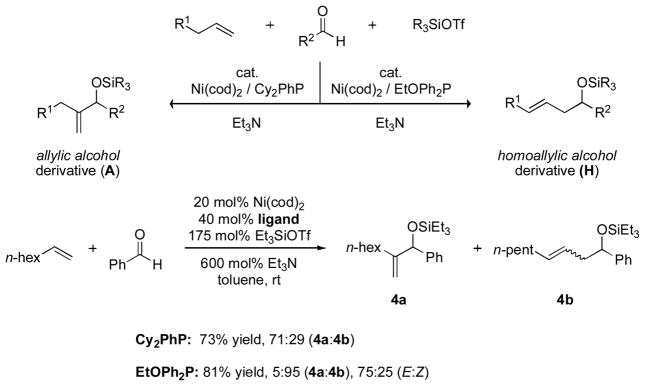
Nickel-catalyzed coupling of alpha olefins, aldehydes, and silyl triflates leads to two types of product.
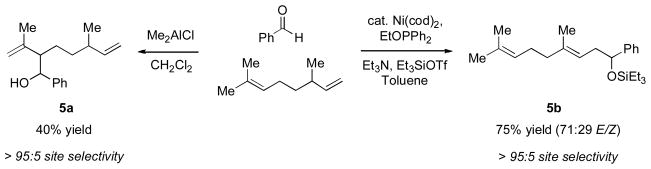
Coupling of β-citronellene and benzaldehyde reveals a distinct reactivity pattern in the nickel-catalyzed reaction relative to a traditional Lewis acid-catalyzed carbonyl-ene reaction.
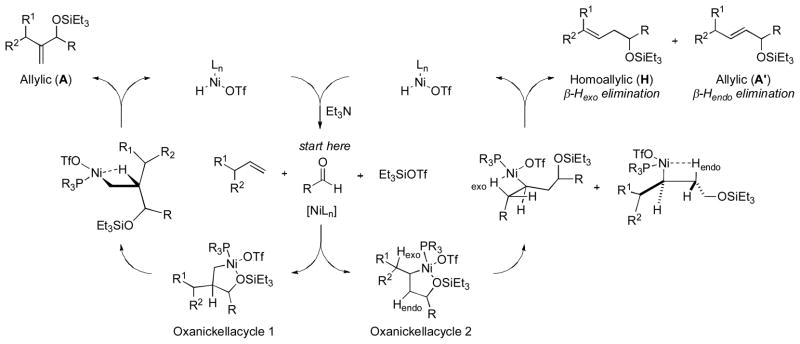
Proposed mechanism for nickel-catalyzed coupling of alkene, aldehyde, and silyl triflate.

High selectivity for the allylic product in dual IPr/(PhO)3P system.
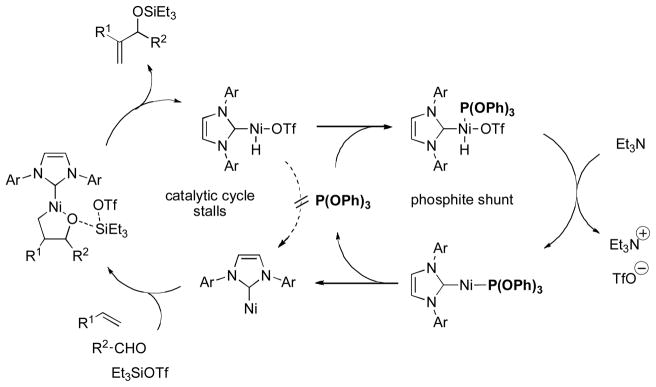
Proposed mechanism for coupling of alkenes and aldehydes catalyzed by [Ni(IPr){P(OPh)3}].
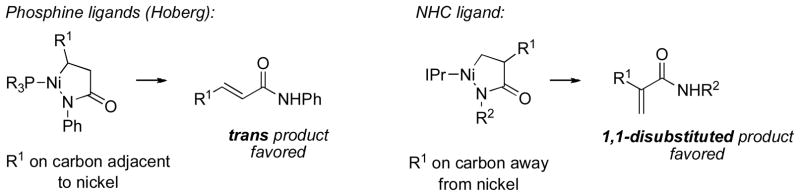
Proposed regioselectivity of nickellacycle formation in the catalytic coupling reaction of alkenes and isocyanates.
References
-
- Lappin GR, Sauer JD. Alpha Olefins Applications Handbook. Marcel Dekker; New York: 1989.
-
- Oblinger E, Montgomery J. J Am Chem Soc. 1997;119:9065.
-
- Huang WS, Chan J, Jamison TF. Org Lett. 2000;2:4221. - PubMed
-
- Miller KM, Huang WS, Jamison TF. J Am Chem Soc. 2003;125:3442. - PubMed
- Van Dyke AR, Miller KM, Jamison TF. Org Synth. 2007;84:111.
Grants and funding
LinkOut - more resources
Full Text Sources