. 2011 Jul;7(7):e1002165.
doi: 10.1371/journal.pgen.1002165. Epub 2011 Jul 21.

A functional variant at a prostate cancer predisposition locus at 8q24 is associated with PVT1 expression

Affiliations

A functional variant at a prostate cancer predisposition locus at 8q24 is associated with PVT1 expression

Kerstin B Meyer et al. PLoS Genet. 2011 Jul.

Abstract

Genetic mapping studies have identified multiple cancer susceptibility regions at chromosome 8q24, upstream of the MYC oncogene. MYC has been widely presumed as the regulated target gene, but definitive evidence functionally linking these cancer regions with MYC has been difficult to obtain. Here we examined candidate functional variants of a haplotype block at 8q24 encompassing the two independent risk alleles for prostate and breast cancer, rs620861 and rs13281615. We used the mapping of DNase I hypersensitive sites as a tool to prioritise regions for further functional analysis. This approach identified rs378854, which is in complete linkage disequilibrium (LD) with rs620861, as a novel functional prostate cancer-specific genetic variant. We demonstrate that the risk allele (G) of rs378854 reduces binding of the transcription factor YY1 in vitro. This factor is known to repress global transcription in prostate cancer and is a candidate tumour suppressor. Additional experiments showed that the YY1 binding site is occupied in vivo in prostate cancer, but not breast cancer cells, consistent with the observed cancer-specific effects of this single nucleotide polymorphism (SNP). Using chromatin conformation capture (3C) experiments, we found that the region surrounding rs378854 interacts with the MYC and PVT1 promoters. Moreover, expression of the PVT1 oncogene in normal prostate tissue increased with the presence of the risk allele of rs378854, while expression of MYC was not affected. In conclusion, we identified a new functional prostate cancer risk variant at the 8q24 locus, rs378854 allele G, that reduces binding of the YY1 protein and is associated with increased expression of PVT1 located 0.5 Mb downstream.


Conflict of interest statement

The authors have declared that no competing interests exist.

Figures
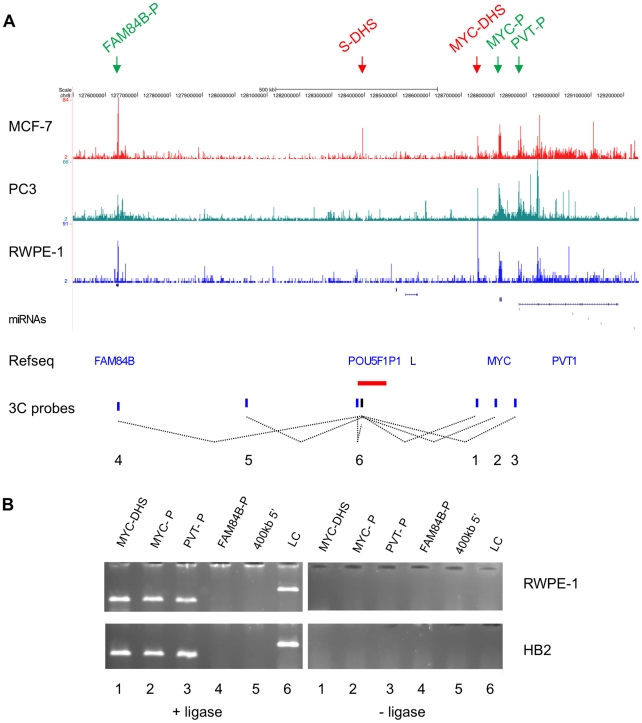
Figure 1
Figure 1. Chromatin conformation at the 8q24 locus.
(A) DNase-seq track for the breast cancer cell line MCF-7, the prostate cancer cell line PC3 and the normal-like prostate cell line RWPE-1 displayed on the UCSC genome browser for a 1.7 MB region (chr8: 127,550,000-129,250,000) surrounding the 8q24 cancer susceptibility region, where peaks indicate regions of increased sensitivity to digestions with DNase I. Reads were adjusted for the total number of reads in each experiment. DHSs and promoters used in subsequent analysis are marked by arrows. RefSeq genes are shown, with L being LOC727677. The prostate and breast cancer susceptibility region is depicted by a horizontal red bar. Dotted lines show interactions tested in the chromatin conformation capture experiment shown in (B). (B) Chromatin conformation capture (3C) experiment using the S-DHS as bait in the HB2 breast and the RWPE-1 prostate cell lines. Target sequences are indicated above the lanes. A target sequence just upstream of the EcoRI site 5′ to the bait EcoRI site was used as ligation control (LC). Negative controls for each ligation reaction were cut but unligated DNA fragments. The numbers below the panel refer to interactions shown in (A).
Figure 2
Figure 2. Protein DNA interactions at the sequences overlapping rs378854.
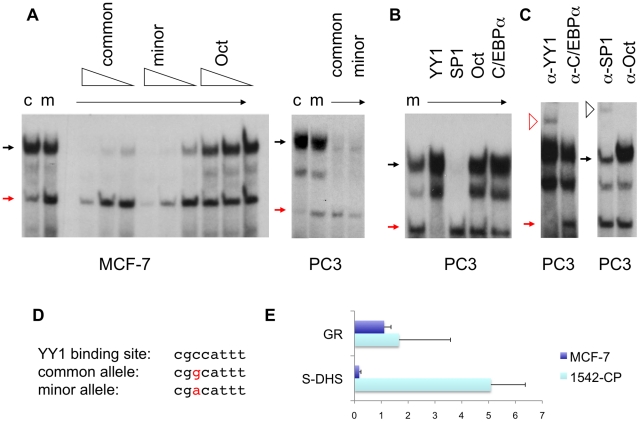
(A) Electrophoretic mobility shift assays (EMSA) were carried out with oligonucleotides containing the common (c) and minor (m) alleles of rs378854 and nuclear extracts from the breast cancer cell line MCF-7 and the prostate cancer cell line PC3. Competitor oligonucleotides were present at 100-, 30- and 10-fold excess for MCF-7 and 30-fold excess for PC3 and are indicated above the lanes. The red and black closed arrows denote the YY1 and SP1 complexes, respectively. (B) EMSAs of the oligonucleotide containing the minor allele were carried out with PC3 nuclear extract and 30-fold excess of competitor oligonucleotides as shown. (C) Supershift of the complex using polyclonal antibody against YY1, SP1, Oct-1 and C/EBPα with PC3 nuclear extracts. The red and black open arrows denote the YY1 and SP1 supershift complexes. (D) An alignment of the two alleles with a YY1 binding site is shown. (E) Chromatin immunoprecipitation assay showing the fold-enrichment of the S-DHS and the positive control (glucocorticoid receptor, GR) sequences relative to a negative control (S-DHS-ve) after immunoprecipitation with YY1 antibody in MCF-7 breast 1542-CP prostate cancer cells.
Figure 3
Figure 3. Relative transcriptional activation by the common and minor alleles of rs378854.
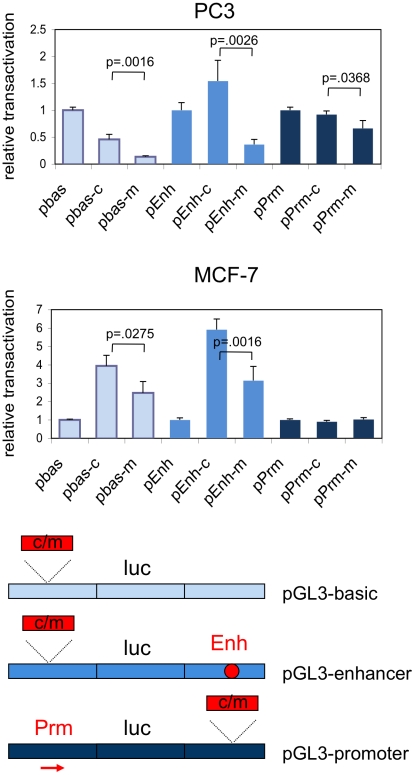
The 395 bp fragment overlapping the S-DHS was cloned into pGL3-basic (pbas), pGL3-enhancer (pEnh) and pGL3-promoter (pPrm) and transcriptional activation of the reporter luciferase gene by the two alleles (common and minor) assayed in the PC3 prostate cancer and the MCF-7 breast cancer cell lines. Activation by the insert is given relative to the parental vector. Averages of six independent transfections are shown and the standard deviation for each data set is given in the bar chart. Where significant, p-values are given for a Student's t-test comparing the values obtained with common versus the minor allele in each vector background.
Figure 4
Figure 4. Association of PVT1 gene expression with rs378854 genotype in 59 normal prostate samples.
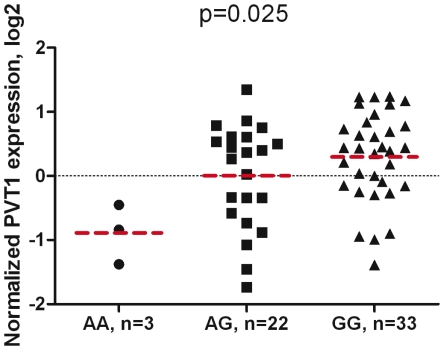
P-values are for univariate linear regression analysis of PVT1 expression in relation to 0, 1 and 2 risk allele (G) of rs378854, adjusted for race. Expression values are shown on log2 scale relative to a mean value of all samples. Expression is lowest in carriers of non-risk AA genotypes and highest in carriers of risk GG genotypes. Mean expression values of each group are shown as bars.
Figure 5
Figure 5. Schematic representation of the mode of action of rs378854.
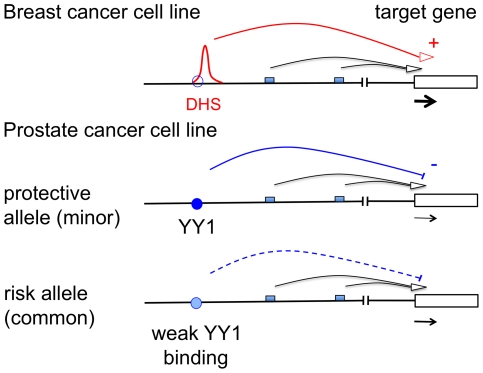
In a breast cancer cell line rs378854 is not bound by YY1 (site shown as empty blue circle) and the DHS present in this region is likely to act as a transcriptional regulator. In contrast, in a prostate cancer cell line YY1 binds (filled blue circle) and represses transcription of a target gene. The level of repression is influenced by the presence of the SNP in the YY1 binding site. Small boxes represent multiple other regulatory elements known to exist in the region.

References

    1. Ghoussaini M, Song H, Koessler T, Al Olama AA, Kote-Jarai Z, et al. Multiple loci with different cancer specificities within the 8q24 gene desert. J Natl Cancer Inst. 2008;100:962–966. - PMC - PubMed
    1. Easton DF, Pooley KA, Dunning AM, Pharoah PD, Thompson D, et al. Genome-wide association study identifies novel breast cancer susceptibility loci. Nature. 2007;447:1087–1093. - PMC - PubMed
    1. Al Olama AA, Kote-Jarai Z, Giles GG, Guy M, Morrison J, et al. Multiple loci on 8q24 associated with prostate cancer susceptibility. Nat Genet. 2009;41:1058–1060. - PubMed
    1. Kiemeney LA, Thorlacius S, Sulem P, Geller F, Aben KK, et al. Sequence variant on 8q24 confers susceptibility to urinary bladder cancer. Nat Genet. 2008;40:1307–1312. - PMC - PubMed
    1. Crowther-Swanepoel D, Broderick P, Di Bernardo MC, Dobbins SE, Torres M, et al. Common variants at 2q37.3, 8q24.21, 15q21.3 and 16q24.1 influence chronic lymphocytic leukemia risk. Nat Genet. 2010;42:132–136. - PMC - PubMed

Publication types

MeSH terms