


Autosomal dominant inheritance of a predisposition to thoracic aortic aneurysms and dissections and intracranial saccular aneurysms
- PMID: 21815248
- PMCID: PMC3739441
- DOI: 10.1002/ajmg.a.34050
Autosomal dominant inheritance of a predisposition to thoracic aortic aneurysms and dissections and intracranial saccular aneurysms
Abstract
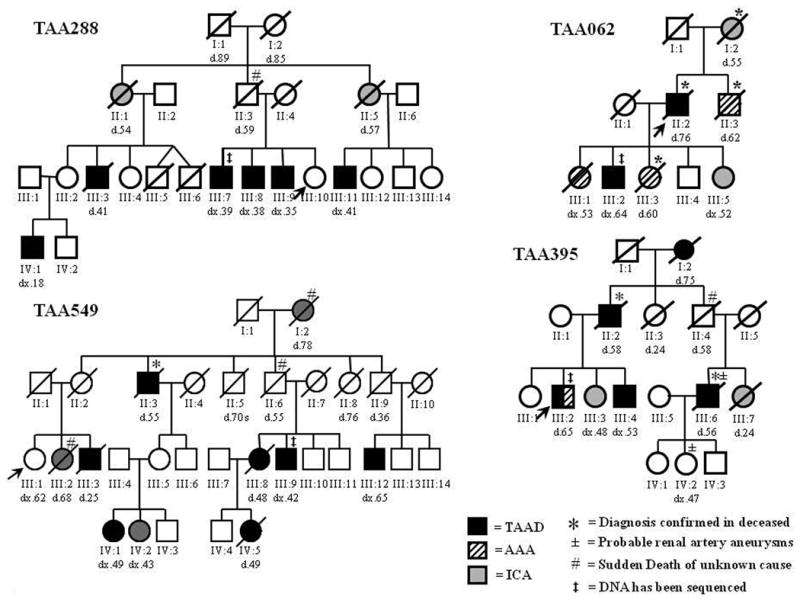
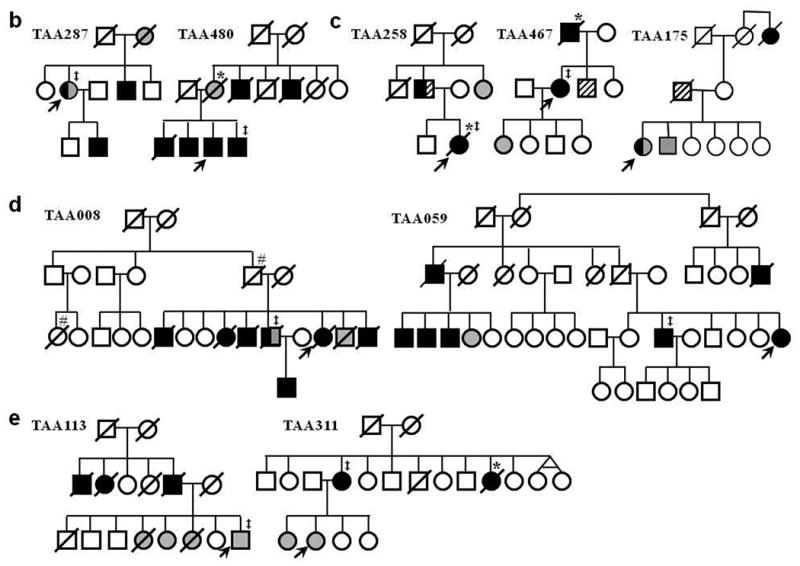
A genetic predisposition for thoracic aortic aneurysms and dissections (TAAD) can be inherited in an autosomal dominant manner with decreased penetrance and variable expression. Four genes identified to date for familial TAAD account for approximately 20% of the heritable predisposition. In a cohort of 514 families with two or more members with presumed autosomal dominant TAAD, 48 (9.3%) families have one or more members who were at 50% risk to inherit the presumptive gene causing TAAD had an intracranial vascular event. In these families, gender is significantly associated with disease presentation (P < 0.001), with intracranial events being more common in women (65.4%) while TAAD events occurred more in men (64.2%,). Twenty-nine of these families had intracranial aneurysms (ICA) that could not be designated as saccular or fusiform due to incomplete data. TGFBR1, TGFBR2, and ACTA2 mutations were found in 4 families with TAAD and predominantly fusiform ICAs. In 15 families, of which 14 tested negative for 3 known TAAD genes, 17 family members who were at risk for inheriting TAAD had saccular ICAs. In 2 families, women who harbored the genetic mutation causing TAAD had ICAs. In 2 additional families, intracranial, thoracic and abdominal aortic aneurysms were observed. This study documents the autosomal dominant inheritance of TAADs with saccular ICAs, a previously recognized association that has not been adequately characterized as heritable. In these families, routine cerebral and aortic imaging for at risk members could prevent cerebral hemorrhages and aortic dissections.
Copyright © 2011 Wiley-Liss, Inc.
Figures
References
-
- De BM, Perusse L, Cantin L, Bouchard JM, Mathieu J. A study of inbreeding and kinship in intracranial aneurysms in the Saguenay Lac-Saint-Jean region (Quebec, Canada) Ann Hum Genet. 1996;60:99–104. - PubMed
-
- Foroud T, Sauerbeck L, Brown R, Anderson C, Woo D, Kleindorfer D, Flaherty ML, Deka R, Hornung R, Meissner I, Bailey-Wilson JE, Rouleau G, Connolly ES, Lai D, Koller DL, Huston J, III, Broderick JP. Genome screen to detect linkage to intracranial aneurysm susceptibility genes: the Familial Intracranial Aneurysm (FIA) study. Stroke. 2008;39:1434–1440. - PMC - PubMed
-
- Guo D, Hasham S, Kuang SQ, Vaughan CJ, Boerwinkle E, Chen H, Abuelo D, Dietz HC, Basson CT, Shete SS, Milewicz DM. Familial thoracic aortic aneurysms and dissections: genetic heterogeneity with a major locus mapping to 5q13-14. Circulation. 2001;103:2461–2468. - PubMed
-
- Guo DC, Pannu H, Papke CL, Yu RK, Avidan N, Bourgeois S, Estrera AL, Safi HJ, Sparks E, Amor D, Ades L, McConnell V, Willoughby CE, Abuelo D, Willing M, Lewis RA, Kim DH, Scherer S, Tung PP, Ahn C, Buja LM, Raman CS, Shete S, Milewicz DM. Mutations in smooth muscle alpha-actin (ACTA2) lead to thoracic aortic aneurysms and dissections. Nat Genet. 2007;39:1488–1493. - PubMed
-
- Guo DC, Papke CL, Tran-Fadulu V, Regalado ES, Avidan N, Johnson RJ, Kim DH, Pannu H, Willing MC, Sparks E, Pyeritz RE, Singh MN, Dalman RL, Grotta JC, Marian AJ, Boerwinkle EA, Frazier LQ, LeMaire SA, Coselli JS, Estrera AL, Safi HJ, Veeraraghavan S, Muzny DM, Wheeler DA, Willerson JT, Yu RK, Shete SS, Scherer SE, Raman CS, Buja LM, Milewicz DM. Mutations in smooth muscle alpha-actin (ACTA2) cause coronary artery disease, stroke, and moyamoya disease, along with thoracic aortic disease. Am J Hum Genet. 2009;84:617–627. - PMC - PubMed
Publication types
MeSH terms
Substances
Grants and funding
LinkOut - more resources
Full Text Sources
Other Literature Sources
Medical
Miscellaneous
