


Chemical constituents of the new endophytic fungus Mycosphaerella sp. nov. and their anti-parasitic activity
- PMID: 21815421
- PMCID: PMC3375898
Chemical constituents of the new endophytic fungus Mycosphaerella sp. nov. and their anti-parasitic activity
Abstract
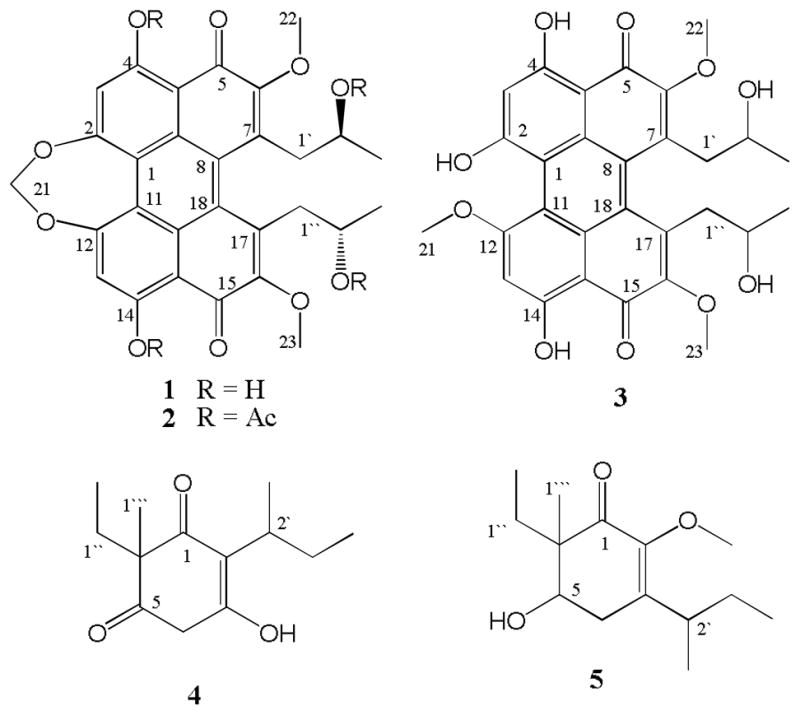
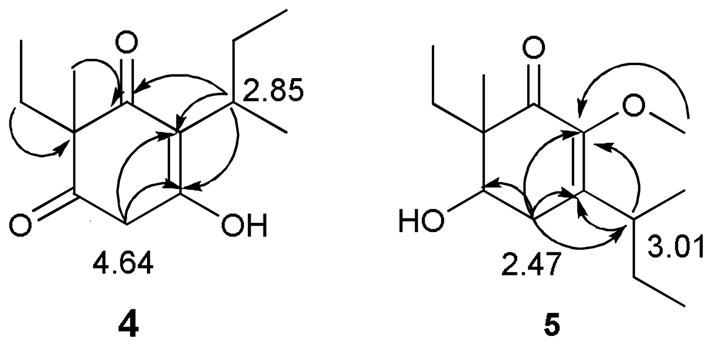
Chemical investigation of a new endophytic fungus, Mycosphaerella sp. nov. strain F2140, associated with the foliage of the plant Psychotria horizontalis (Rubiaceae) in Panama, resulted in the isolation of cercosporin (1) and a new cercosporin analog (3) as the major components. The structures of minor compounds in the extract were elucidated by detailed spectroscopic analysis as 2-(2-butyl)-6-ethyl-3-hydroxy-6-methylcyclohex-2-ene-1,5-dione (4), 3-(2-butyl)-6-ethyl-5-hydroxy-2-methoxy-6-methyl-cyclohex-2-enone (5), and an isomer of 5 (6). To study the influence of the hydroxy groups on the anti-parasitic activity of cercosporin, compound 1 was acetylated to obtain derivative 2. The isolated compounds 1- 6 were tested in vitro to determine their anti-parasitic activity against the causal agents of malaria (Plasmodium falciparum), leishmaniasis (Leishmania donovani), and Chagas disease (Trypanosoma cruzi). Cytotoxicity and potential anticancer activity of these compounds were evaluated using mammalian Vero cells and MCF7 cancer cell lines, respectively. Compounds 1 and 2 displayed high potency against L. donovani (IC50 0.46 and 0.64 microM), T. cruzi (IC50 1.08 and 0.78 microM), P. falciparum (IC50 1.03 and 2.99 microM), and MCF7 cancer cell lines (IC50 4.68 and 3.56 microM). Compounds 3-6 were not active in these assays at a concentration of 10 microg/mL.
Figures
References
-
- Kursar TA, Caballero-George CG, Capson TL, Cubilla-Rios L, Gerwick WH, Ibanez A, Linington RG, McPhail KL, Ortega-Barria E, Romero LI, Solis PN, Coley PD. Securing economic benefits and promoting conservation through bioprospecting. Bioscience. 2006;56:1005–1012.
- Kursar TA, Caballero-George CC, Capson TL, Cubilla-Rios L, Gerwick WH, Heller MV, Ibanez A, Linington RG, McPhail KL, Ortega-Barria E, Romero LI, Coley PD. Linking bioprospecting with sustainable development and conservation: the Panama case. Biodiversity and Conservation. 2007;16:2789–2800.
- Jimenez-Romero C, Torres-Mendoza D, Ureña-Gonzales LD, Ortega-Barria E, McPhail KL, Gerwick WH, Cubilla-Rios L. Hydroxy-alkenylresorcinols fromStylogyne turbacensis. Journal of Natural Products. 2007;70:1249–1252. - PubMed
- Montenegro H, Gonzalez J, Ortega-Barria E, Cubilla-Rios L. Antiprotozoal activity of flavonoid glycosides isolated fromClimedia sericea and Mosquitoxylon jamaicense. Pharmaceutical Biology. 2007;45:376–380.
- Linington RG, Clark BR, Trimble EE, Almanza A, Ureña LD, Kyle DE, Gerwick WH. Antimalarial peptides from marine cyanobacteria: Isolation and structural elucidation of gallinamide A. Journal of Natural Products. 2007;72:14–17. - PMC - PubMed
- Medina RA, Goeger DE, Hills P, Mooberry SL, Huang N, Romero LI, Ortega-Barria E, Gerwick WH, McPhail KL. Coibamide A, a potent antiproliferative cyclic depsipeptide from the Panamanian marine cyanobacterium. Leptolyngbya sp Journal of American Chemical Society. 2008;130:6324–6325. - PMC - PubMed
- Jimenez-Romero C, Ortega-Barria E, Arnold AE, Cubilla-Rios L. Activity against. Plasmodium falciparum of lactones isolated from the endophytic fungus Xylaria sp. Pharmaceutical Biology. 2008;46:700–703.
- Martinez-Luis S, Della-Tonga G, Coley PD, Kursar TA, Gerwick WH, Cubilla-Rios L. Antileishmanial constituents of the Panamanian endophytic fungusEdenia sp. Journal of Natural Products. 2008;71:2011–2014. - PMC - PubMed
-
- Kuyama S, Tamura T. Cercosporin. A pigment of cercosporina kikuchii matsumoto et tomoyasu i Cultivation of fungus, isolation and purification of pigment. Journal of American Chemical Society. 1957;79:5725–5726.
- Assante G, Locci R, Camarda L, Merlini L, Nasini G. Screening of the genus. Cercospora for secondary metabolites. Phytochemistry. 1977;16:243–247.
- Kuyama S, Tamura T. Cercosporin. A pigment of cercosporina kikuchii matsumoto et tomoyasu ii Physical and chemical properties of cercosporin and its derivatives. Jouranl of American Chemical Society. 1957;79:5726–5729.
- Yamazaki S, Ogawa T. The chemistry and stereochemistry of cercosporin. Agricultural and Biological Chemistry. 1972;36:1707–1718.
-
- Bringmann G, Gunther C, Ochse M, Schupp O, Tasler S. Axially chiral biaryls, a multi-facetted class of stereochemically, biosynthetically, and pharmacologically intriguing secondary metabolites. Progress in Chemistry of Organic Natural Products. 2001;82:1–249. - PubMed
-
- Daub ME. Cercosporin, a photosensitizing toxin from Cercospora species. Phytopathology. 1982;72:370–374.
Publication types
MeSH terms
Substances
Grants and funding
LinkOut - more resources
Full Text Sources