


Inducing iPSCs to escape the dish
- PMID: 21816362
- PMCID: PMC3500137
- DOI: 10.1016/j.stem.2011.07.006
Inducing iPSCs to escape the dish
Abstract
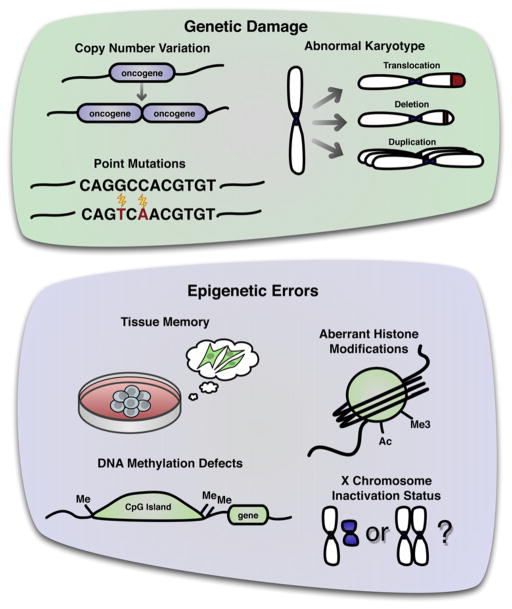
Induced pluripotent stem cells (iPSCs) hold great promise for autologous cell therapies, but significant roadblocks remain to translating iPSCs to the bedside. For example, concerns about the presumed autologous transplantation potential of iPSCs have been raised by a recent paper demonstrating that iPSC-derived teratomas were rejected by syngeneic hosts. Additionally, the reprogramming process can alter genomic and epigenomic states, so a key goal at this point is to determine the clinical relevance of these changes and minimize those that prove to be deleterious. Finally, thus far few studies have examined the efficacy and tumorigenicity of iPSCs in clinically relevant transplantation scenarios, an essential requirement for the FDA. We discuss potential solutions to these hurdles to provide a roadmap for iPSCs to "jump the dish" and become useful therapies.
Copyright © 2011 Elsevier Inc. All rights reserved.
Figures
References
-
- Armstrong L, Tilgner K, Saretzki G, Atkinson SP, Stojkovic M, Moreno R, Przyborski S, Lako M. Human induced pluripotent stem cell lines show stress defense mechanisms and mitochondrial regulation similar to those of human embryonic stem cells. Stem Cells. 2010;28:661–673. - PubMed
-
- Baker DEC, Harrison NJ, Maltby E, Smith K, Moore HD, Shaw PJ, Heath PR, Holden H, Andrews PW. Adaptation to culture of human embryonic stem cells and oncogenesis in vivo. Nat Biotechnol. 2007;25:207–215. - PubMed
-
- Barroso-delJesus A, Lucena-Aguilar G, Sanchez L, Ligero G, Gutierrez-Aranda I, Menendez P. The Nodal inhibitor Lefty is negatively modulated by the microRNA miR-302 in human embryonic stem cells. FASEB J. 2011;25:1497–1508. - PubMed
Publication types
MeSH terms
Grants and funding
LinkOut - more resources
Full Text Sources
