Randomized Controlled Trial
. 2011;6(7):e22627.
doi: 10.1371/journal.pone.0022627. Epub 2011 Jul 27.

The effect of repetitive transcranial magnetic stimulation on gamma oscillatory activity in schizophrenia

Affiliations
Randomized Controlled Trial

The effect of repetitive transcranial magnetic stimulation on gamma oscillatory activity in schizophrenia

Mera S Barr et al. PLoS One. 2011.

Abstract

Background: Gamma (γ) oscillations (30-50 Hz) have been shown to be excessive in patients with schizophrenia (SCZ) during working memory (WM). WM is a cognitive process that involves the online maintenance and manipulation of information that is mediated largely by the dorsolateral prefrontal cortex (DLPFC). Repetitive transcranial magnetic stimulation (rTMS) represents a non-invasive method to stimulate the cortex that has been shown to enhance cognition and γ oscillatory activity during WM.

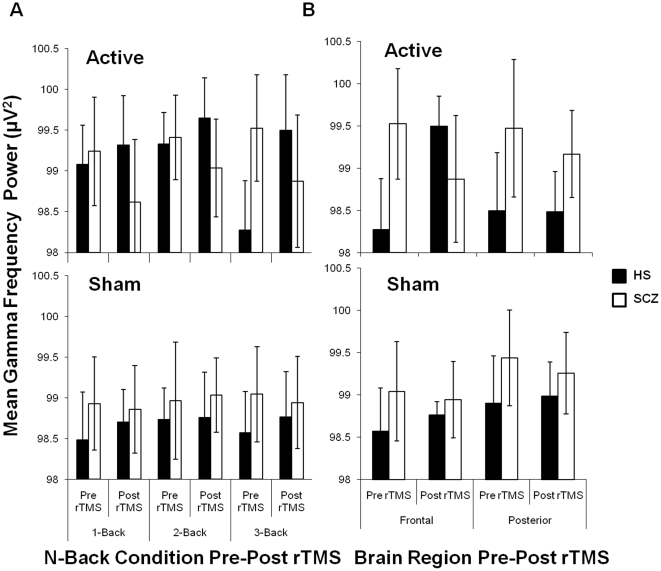
Methodology and principal findings: We examined the effect of 20 Hz rTMS over the DLPFC on γ oscillatory activity elicited during the N-back task in 24 patients with SCZ compared to 22 healthy subjects. Prior to rTMS, patients with SCZ elicited excessive γ oscillatory activity compared to healthy subjects across WM load. Active rTMS resulted in the reduction of frontal γ oscillatory activity in patients with SCZ, while potentiating activity in healthy subjects in the 3-back, the most difficult condition. Further, these effects on γ oscillatory activity were found to be specific to the frontal brain region and were absent in the parieto-occipital brain region.

Conclusions and significance: We suggest that this opposing effect of rTMS on γ oscillatory activity in patients with SCZ versus healthy subjects may be related to homeostatic plasticity leading to differential effects of rTMS on γ oscillatory activity depending on baseline differences. These findings provide important insights into the neurophysiological mechanisms underlying WM deficits in SCZ and demonstrated that rTMS can modulate γ oscillatory activity that may be a possible avenue for cognitive potentiation in this disorder.


Conflict of interest statement

Competing Interests: MSB has received a studentship award from the Ontario Mental Health Foundation and is also a graduate student of the University of Toronto. FF has received a doctoral award from the Canadian Institutes of Health Research (CIHR) and is also a graduate student of the University of Toronto. TA is employed by the Centre for Addiction and Mental Health. RC was awarded a CIHR grant (MOP 62917), CIHR Industry Partnered (Medtronic Inc) Investigator Award and is employed by the Toronto Research Institute and by the University of Toronto. PBF has received a National Health and Medical Research Council (NHMRC) Practitioner Fellowship and a Constance and Stephen Lieber through a National Alliance for Research on Schizophrenia and Depression (NARSAD) Lieber Young Investigator award. PBF has also received external funding from Neuronetics Inc and is employed by the Alfred Psychiatry Research Centre, a joint research centre of Monash University and the Alfred Hospital in Melbourne. ZJD has received a CIHR Clinician Scientist Award, an operating grant from the Ontario Mental Health Foundation, a Constance and Stephen Lieber through a National Alliance for Research on Schizophrenia and Depression (NARSAD) Lieber Young Investigator award, and external funding from Neuronetics Inc and Aspect Medical Inc and travel support through Pfizer Inc. ZJD is also employed by the Centre for Addiction and Mental Health and by the University of Toronto. The authors confirm that this does not alter their adherence to all the PLoS ONE policies on sharing data and materials..

Figures

Figure 1
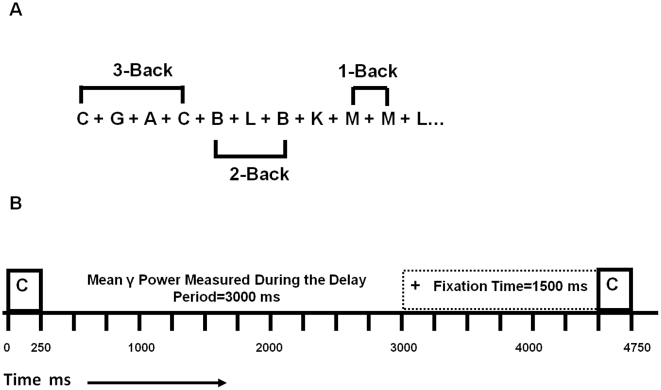
Figure 1. A representation of the 1-, 2- and 3-back conditions that were completed in a randomized order by patients with schizophrenia (SCZ) and healthy subjects (HS) pre-post rTMS.
Subjects were required to push one button (target) if the current letter was identical to the letter presented “N” trials back; otherwise the participants pushed a different button (non-target). Correct responses for target (TC) and non-target (NTC) were included in the data analysis (A). The timing of one trial from the presentation of a one letter separated by a (+) sign followed by a subsequent letter for a total time of 3000 msec (B).
Figure 2
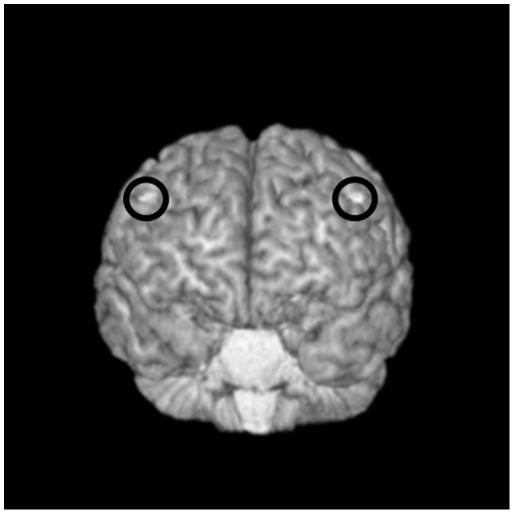
Figure 2. Targeting the Dorsolateral Prefrontal Cortex (DLPFC) for rTMS stimulation.
Transverse view from a single subject with exposed cortex and overlap of Brodmann areas 9 & 46, highlighted (white) on a T1-weighted 3D MRI. Using MRI-to-MiniBird co-registration, the centre of the TMS coil was held over this region.
Figure 3
Figure 3. Mean log transformed gamma oscillatory power (γ; 30–50 Hz; uV2) for target correct (TC) and non-target correct (NTC) responses during the N-back task pre-post rTMS in healthy subjects (HS; N = 22) versus patients with schizophrenia (SCZ; N = 24) (A).
Mean log transformed γ oscillatory power (uV2) for target correct (TC) and non-target correct (NTC) responses during the 3-back condition measured from the frontal and parieto-occipitalbrain regions pre-post rTMS in patients with schizophrenia (SCZ; N = 24) and healthy subjects (HS; N = 22) (B). Bars represent (±) 1 standard deviation.
Figure 4
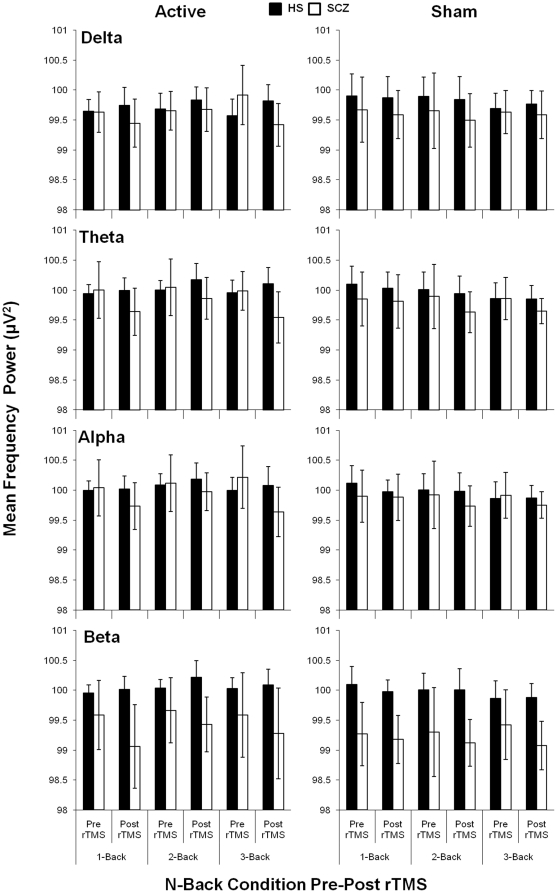
Figure 4. Mean log transformed oscillatory power (uV2) for target correct (TC) and non-target correct (NTC) responses during the N-back task pre-post rTMS in healthy subjects (HS; N = 22) versus patients with schizophrenia (SCZ; N = 24) across delta (δ; 1–3.5 Hz), theta (θ; 4–7 Hz), alpha (α; 8–12 Hz), and beta (β; 12.5–28 Hz) frequency ranges.
Bars represent (±) 1 standard deviation.

References

    1. Baddeley A. Working memory. Oxford: Claredon Press; 1986.
    1. Basar-Eroglu C, Brand A, Hildebrandt H, Karolina Kedzior K, Mathes B, et al. Working memory related gamma oscillations in schizophrenia patients. Int J Psychophysiol. 2007;64:39–45. - PubMed
    1. Barr MS, Farzan F, Rusjan PM, Chen R, Fitzgerald PB, et al. Potentiation of gamma oscillatory activity through repetitive transcranial magnetic stimulation of the dorsolateral prefrontal cortex. Neuropsychopharmacology. 2009;34:2359–2367. - PubMed
    1. Weinberger DR, Berman KF, Zec RF. Physiologic dysfunction of dorsolateral prefrontal cortex in schizophrenia. I. Regional cerebral blood flow evidence. Arch Gen Psychiatry. 1986;43:114–124. - PubMed
    1. Barr MS, Farzan F, Tran LC, Chen R, Fitzgerald PB, et al. Evidence for excessive frontal evoked gamma oscillatory activity in schizophrenia during working memory. Schizophr Res. 2010;121:146–152. - PubMed

Publication types

MeSH terms

Substances