


Gene-vitamin D interactions on food sensitization: a prospective birth cohort study
- PMID: 21819409
- PMCID: PMC3189275
- DOI: 10.1111/j.1398-9995.2011.02681.x
Gene-vitamin D interactions on food sensitization: a prospective birth cohort study
Abstract
Background: It has been hypothesized that vitamin D deficiency (VDD) contributes to the development of food sensitization (FS) and then food allergy. However, the epidemiological evidence is conflicting. We aim to examine whether cord blood VDD is associated with FS and whether such association can be modified by genetic variants in a prospective birth cohort.
Methods: This study included 649 children who were enrolled at birth and followed from birth onward at the Boston Medical Center. We defined VDD as cord blood 25(OH)D < 11 ng/ml, and FS as specific IgE ≥ 0.35 kUA/l to any of eight common food allergens in early childhood. We genotyped potentially functional single-nucleotide polymorphisms (SNPs) in 11 genes known to be involved in regulating IgE and 25(OH)D concentrations. Logistic regressions were used to test the effects of VDD on FS individually and jointly with SNPs.
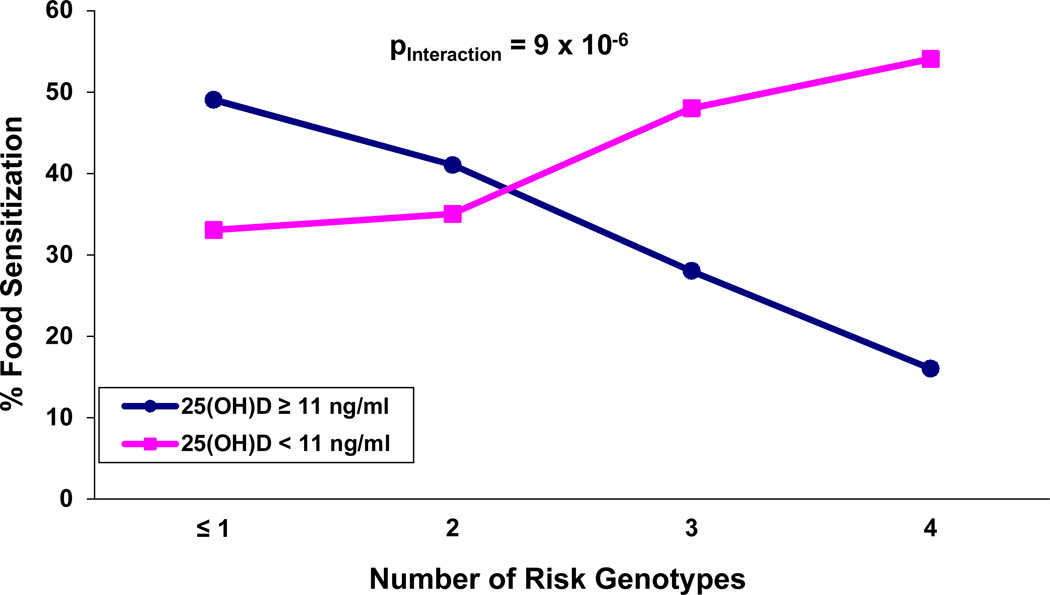
Results: Among the 649 children, 44% had VDD and 37% had FS. When examined alone, VDD was not associated with FS. When examined jointly with SNPs, a significant interaction between IL4 gene polymorphism (rs2243250) and VDD (p(interaction) = 0.003, p(FDR) = 0.10) was found: VDD increased the risk of FS among children carrying CC/CT genotypes (OR = 1.79, 95%CI: 1.15-2.77). Similar but weaker interactions were observed for SNPs in MS4A2 (rs512555), FCER1G (rs2070901), and CYP24A1 (rs2762934). When all four SNPs were simultaneously considered, a strong gene-VDD interaction was evident (p(interaction) = 9 × 10(-6) ).
Conclusions: Our data demonstrate that VDD may increase the risk of FS among individuals with certain genotypes, providing evidence of gene-vitamin D interaction on FS.
© 2011 John Wiley & Sons A/S.
Conflict of interest statement
None of the authors have a conflict of interest pertaining to this work.
Figures
References
-
- Sicherer SH, Sampson HA. Food allergy. J Allergy Clin Immunol. 2010;125(2) Suppl 2:S116–S125. - PubMed
-
- Lack G. Epidemiologic risks for food allergy. J Allergy Clin Immunol. 2008;121(6):1331–1336. - PubMed
-
- Holick MF. Sunlight and vitamin D for bone health and prevention of autoimmune diseases, cancers, and cardiovascular disease. Am J Clin Nutr. 2004;80(6) Suppl:1678S–1688S. - PubMed
-
- Holick MF. Vitamin D deficiency. N Engl J Med. 2007;357(3):266–281. - PubMed
Publication types
MeSH terms
Substances
Grants and funding
- KL2 RR025740/RR/NCRR NIH HHS/United States
- R21AI088609/AI/NIAID NIH HHS/United States
- U01 AI090727/AI/NIAID NIH HHS/United States
- UL1 RR025741/RR/NCRR NIH HHS/United States
- K23HL093023/HL/NHLBI NIH HHS/United States
- R01 HD041702/HD/NICHD NIH HHS/United States
- R21 ES011666/ES/NIEHS NIH HHS/United States
- R21 AI087888/AI/NIAID NIH HHS/United States
- R21AI087888/AI/NIAID NIH HHS/United States
- U01AI090727/AI/NIAID NIH HHS/United States
- R21 AI088609/AI/NIAID NIH HHS/United States
- R21AI079872/AI/NIAID NIH HHS/United States
- K23 HL093023/HL/NHLBI NIH HHS/United States
- R21 AI079872/AI/NIAID NIH HHS/United States
- KL2RR025740/RR/NCRR NIH HHS/United States
LinkOut - more resources
Full Text Sources
Medical
Miscellaneous
