


Use of a two-stage insulin infusion study to assess the relationship between insulin suppression of lipolysis and insulin-mediated glucose uptake in overweight/obese, nondiabetic women
- PMID: 21820141
- PMCID: PMC6035746
- DOI: 10.1016/j.metabol.2011.05.008
Use of a two-stage insulin infusion study to assess the relationship between insulin suppression of lipolysis and insulin-mediated glucose uptake in overweight/obese, nondiabetic women
Abstract
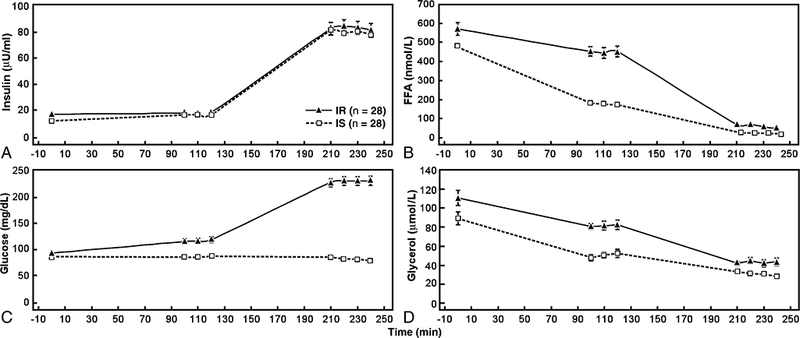
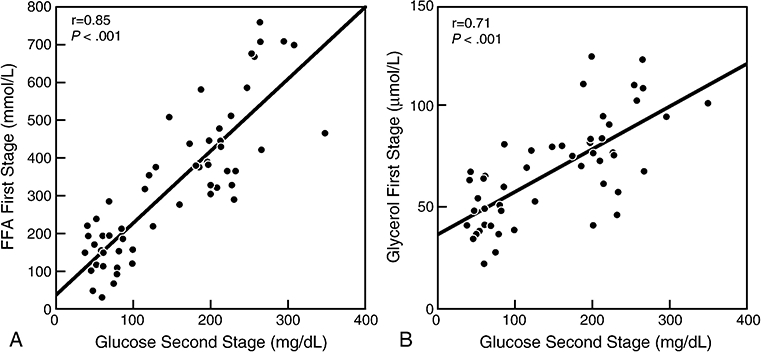
Differences in insulin regulation of free fatty acids (FFAs) are not readily apparent at the same insulin concentrations used to differentiate relative insulin-mediated glucose disposal. Resistance to insulin-mediated glucose disposal and higher daylong FFA concentrations occur more commonly in obese individuals. However, the relationship between the ability of insulin to suppress FFA release from adipose tissue and stimulate glucose disposal in muscle has not been clearly defined in this population. The current study was initiated to test the hypothesis that these 2 facets of insulin action are related, with greater defects in insulin-mediated glucose disposal associated with less effective insulin inhibition of FFA release from adipose tissue. Subjects included 56 healthy nondiabetic overweight/moderately obese women classified as insulin resistant or insulin sensitive based on whole-body glucose disposal. All underwent a modified 240-minute 2-stage insulin infusion with basal (∼15 µU/mL) and physiologically elevated (∼80 µU/mL) steady-state insulin concentrations. Plasma glucose, insulin, FFA, and glycerol were measured throughout. Whereas plasma glucose differed most during physiological hyperinsulinemia in insulin-resistant vs insulin-sensitive subjects, plasma FFA/glycerol differed most during basal insulin concentrations. The FFA concentrations during the basal insulin steady state correlated highly (r = 0.85, P < .001) with glucose concentrations during the hyperinsulinemic steady state. Overweight/moderately obese women exhibit dramatic differences in the ability of insulin to suppress plasma FFA, which correlate highly with differences in insulin-mediated glucose disposal. Variability in insulin regulation of FFA is most apparent at basal insulin concentrations, whereas differences in glucose disposal are most apparent during physiologic hyperinsulinemia. Both can be quantified using a simple 2-stage insulin infusion study, with first-stage FFA concentrations and second-stage glucose concentrations being most informative.
Copyright © 2011 Elsevier Inc. All rights reserved.
Figures
References
-
- Howard BV, Savage PJ, Nagulesparan B, Bennion LJ, Unger RH, Bennett PH, Evidence for marked sensitivity to the anti-lipolytic action of insulin in obese maturity-onset-diabetes. Metabolism, 28 (1979):744–750. - PubMed
-
- Rizza RA, Mandarino LJ, Gerich JE, Dose response characteristics for effects of insulin on production on utilization of glucose in man, Am J Physiol 240 (1981): E630–E639. - PubMed
-
- Swislocki ALM, Chen Y-DI, Golay A, Chang M-O, Reaven GM, Insulin suppression of plasma-free fatty acid concentration in normal individuals, and patients with type 2 diabetes, Diabetologia 30 (1987): 622–626. - PubMed
Publication types
MeSH terms
Substances
Grants and funding
LinkOut - more resources
Full Text Sources
Medical
