FGF-21 as a biomarker for muscle-manifesting mitochondrial respiratory chain deficiencies: a diagnostic study
- PMID: 21820356
- PMCID: PMC7568343
- DOI: 10.1016/S1474-4422(11)70155-7
FGF-21 as a biomarker for muscle-manifesting mitochondrial respiratory chain deficiencies: a diagnostic study
Abstract
Background: Muscle biopsy is the gold standard for diagnosis of mitochondrial disorders because of the lack of sensitive biomarkers in serum. Fibroblast growth factor 21 (FGF-21) is a growth factor with regulatory roles in lipid metabolism and the starvation response, and concentrations are raised in skeletal muscle and serum in mice with mitochondrial respiratory chain deficiencies. We investigated in a retrospective diagnostic study whether FGF-21 could be a biomarker for human mitochondrial disorders.
Methods: We assessed samples from adults and children with mitochondrial disorders or non-mitochondrial neurological disorders (disease controls) from seven study centres in Europe and the USA, and recruited healthy volunteers (healthy controls), matched for age where possible, from the same centres. We used ELISA to measure FGF-21 concentrations in serum or plasma samples (abnormal values were defined as >200 pg/mL). We compared these concentrations with values for lactate, pyruvate, lactate-to-pyruvate ratio, and creatine kinase in serum or plasma and calculated sensitivity, specificity, and positive and negative predictive values for all biomarkers.
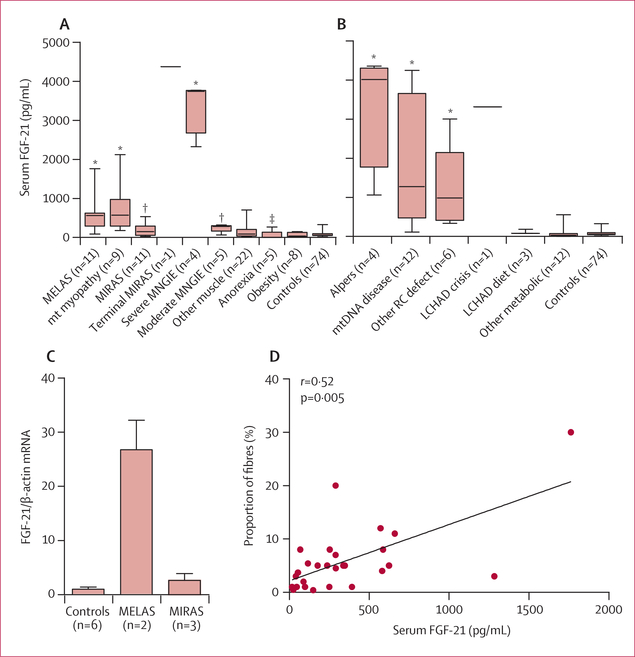
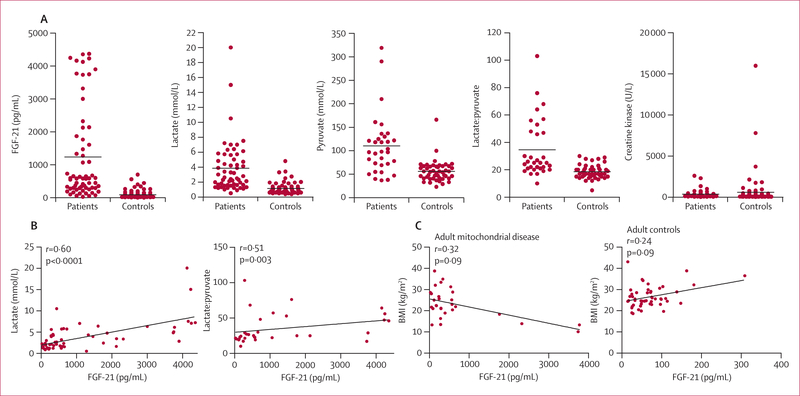
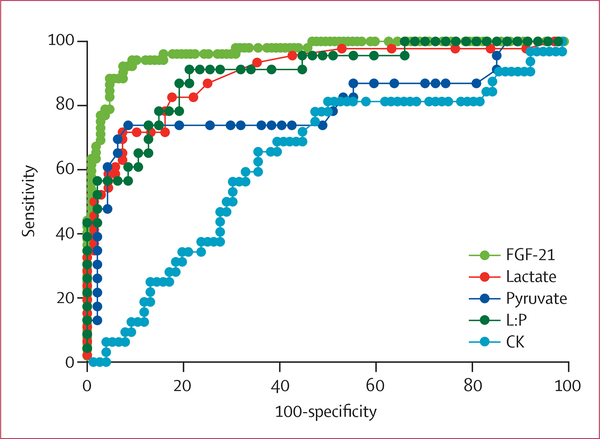
Findings: We analysed serum or plasma from 67 patients (41 adults and 26 children) with mitochondrial disorders, 34 disease controls (22 adults and 12 children), and 74 healthy controls. Mean FGF-21 concentrations in serum were 820 (SD 1151) pg/mL in adult and 1983 (1550) pg/mL in child patients with respiratory chain deficiencies and 76 (58) pg/mL in healthy controls. FGF-21 concentrations were high in patients with mitochondrial disorders affecting skeletal muscle but not in disease controls, including those with dystrophies. In patients with abnormal FGF-21 concentrations in serum, the odds ratio of having a muscle-manifesting mitochondrial disease was 132·0 (95% CI 38·7-450·3). For the identification of muscle-manifesting mitochondrial disease, the sensitivity was 92·3% (95% CI 81·5-97·9%) and specificity was 91·7% (84·8-96·1%). The positive and negative predictive values for FGF-21 were 84·2% (95% CI 72·1-92·5%) and 96·1 (90·4-98·9%). The accuracy of FGF-21 to correctly identify muscle-manifesting respiratory chain disorders was better than that for all conventional biomarkers. The area under the receiver-operating-characteristic curve for FGF-21 was 0·95; by comparison, the values for other biomarkers were 0·83 lactate (p=0·037, 0·83 for pyruvate (p=0·015), 0·72 for the lactate-to-pyruvate ratio (p=0·0002), and 0·77 for creatine kinase (p=0·013).
Interpretation: Measurement of FGF-21 concentrations in serum identified primary muscle-manifesting respiratory chain deficiencies in adults and children and might be feasible as a first-line diagnostic test for these disorders to reduce the need for muscle biopsy.
Funding: Sigrid Jusélius Foundation, Jane and Aatos Erkko Foundation, Molecular Medicine Institute of Finland, University of Helsinki, Helsinki University Central Hospital, Academy of Finland, Novo Nordisk, Arvo and Lea Ylppö Foundation.
Copyright © 2011 Elsevier Ltd. All rights reserved.
Conflict of interest statement
Conflicts of interest
AS and HT have submitted an international patent application for serum diagnostics of mitochondrial disease. KHP has been paid to give lectures for Eli Lilly, Abbott, and Novo Nordisk. JS is the Chief Executive Officer of Khondrion, a spin-off company of the Radboud University Nijmegen Medical Centre. The other authors declare that they have no conflicts of interest.
Figures
Comment in
-
A new biomarker for mitochondrial disease.Lancet Neurol. 2011 Sep;10(9):777-8. doi: 10.1016/S1474-4422(11)70172-7. Epub 2011 Aug 3. Lancet Neurol. 2011. PMID: 21820357 No abstract available.
References
-
- Schaefer AM, McFarland R, Blakely EL, et al. Prevalence of mitochondrial DNA disease in adults. Ann Neurol 2008; 63: 35–39. - PubMed
-
- Skladal D, Halliday J, Thorburn DR. Minimum birth prevalence of mitochondrial respiratory chain disorders in children. Brain 2003; 126: 1905–12. - PubMed
-
- Di Donato S Multisystem manifestations of mitochondrial disorders. J Neurol 2009; 256: 693–710. - PubMed
-
- Smeitink JA, Zeviani M, Turnbull DM, Jacobs HT. Mitochondrial medicine: a metabolic perspective on the pathology of oxidative phosphorylation disorders. Cell Metab 2006; 3: 9–13. - PubMed
Publication types
MeSH terms
Substances
Grants and funding
LinkOut - more resources
Full Text Sources
Other Literature Sources
Medical