Review
. 2011 Sep;32(9):443-50.
doi: 10.1016/j.it.2011.07.002. Epub 2011 Aug 5.

Interferon-lambda and therapy for chronic hepatitis C virus infection

Affiliations
Review

Interferon-lambda and therapy for chronic hepatitis C virus infection

Raymond P Donnelly et al. Trends Immunol. 2011 Sep.

Abstract

Interferon (IFN)-α, a type-I IFN, is widely used to treat chronic hepatitis C virus infection, but the broad expression of IFN-α receptors often leads to adverse reactions in many organs. Here, we examine IFN-λ, a type-III IFN, as a therapeutic alternative to IFN-α. Like IFN-α, IFN-λ also induces antiviral activity in hepatocytes, but might induce fewer adverse reactions because its receptor is largely restricted to cells of epithelial origin. We also discuss the recent discovery of single nucleotide polymorphisms (SNPs) near the human IFN-λ3 gene, IL28B, that correlate strongly with the ability to achieve a sustained virological response to therapy with pegylated IFN-α plus ribavirin in patients with chronic hepatitis C.


Figures

Figure 1
Figure 1
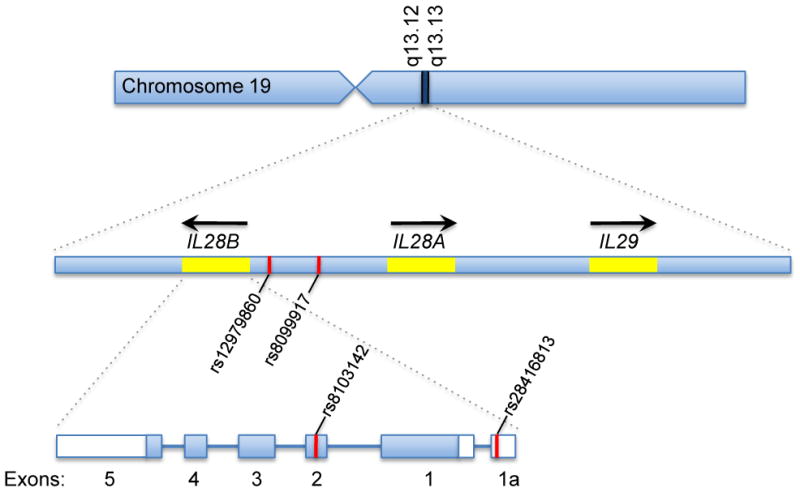
Genomic organization of the IFN-λ genes (IL28B, IL28A and IL29) and locations of key single nucleotide polymorphisms (SNPs). These genes are located on chromosome 19 in the region between q13.12 and q13.13. IL28A and IL28B lie adjacent to each other, but are transcribed in opposite directions. Several of the SNPs identified in the original GWAS studies, including rs12979860 and rs8099917, are located in the intergenic region between IL28A and IL28B [54-56]. Other SNPs such as rs8103142 and rs28416813 are located within the IL28B gene itself. SNP rs 8103142 is located in the coding region of exon 2 and results in a single amino acid change from lysine to arginine at position 70 (K70R); however, this mutation does not appear to induce any significant changes in the potency or bioactivity of the corresponding protein.
Figure 2
Figure 2
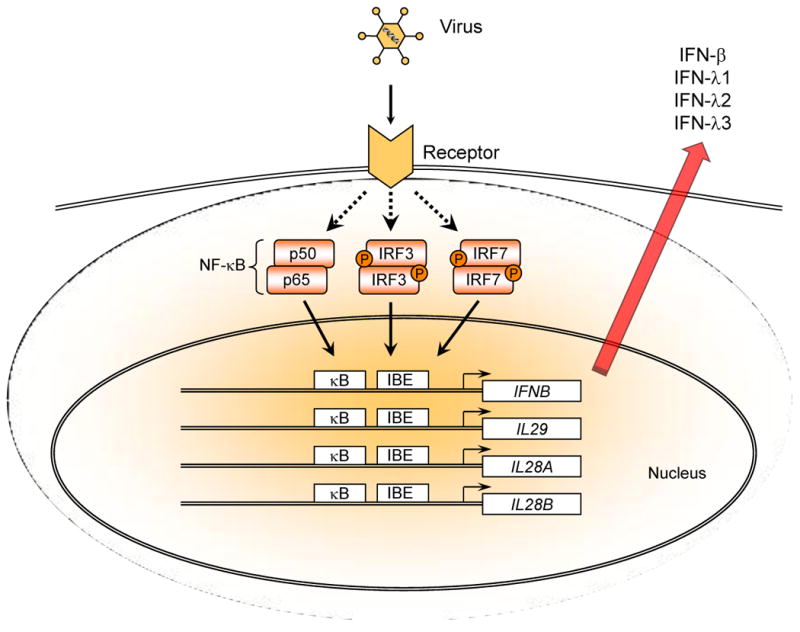
Viral infection induces co-expression of type-I (IFN-α/β) and type-III (IFN-λ) IFNs. Viruses, including HCV, induce co-expression of type-I and type-III IFNs by triggering activation of the Toll-like receptor-3 (TLR3) and/or RIG-I-like receptor (RLR) signaling pathways. This in turn results in the activation of several key transcription factors, including IRF3, IRF7 and NF-κB. IRF3 and IRF7 are activated by serine phosphorylation, and form homodimers or heterodimers which then translocate to the nucleus where they bind to specific DNA sequences known as “IRF-binding elements” (IBE) in the promoters of a number of genes, including the IFN-α, -β and -λ genes. Viral infection also induces simultaneous activation and nuclear translocation of NF-κB. The coordinated binding of NF-κB to κB elements together with the binding of IRF3 and/or IRF7 to cognate IBEs catalyzes transcription of the IFN-α, IFN-β and IFN-λ, (IL28A, IL28B and IL29) genes.
Figure 3
Figure 3
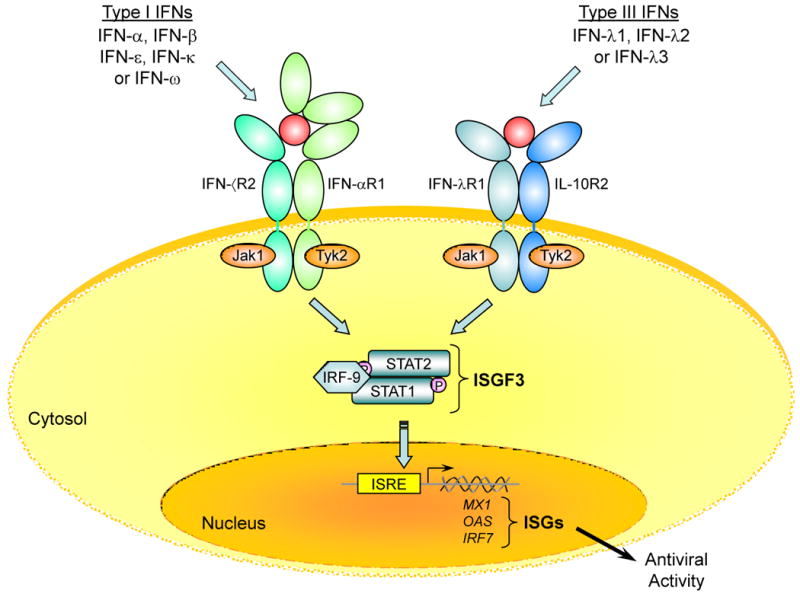
IFN-α (type-I IFN) and IFN-λ (type-III IFN) signal through distinct receptor complexes, but activate the same intracellular signaling pathway. IFN-α binds to a cell surface receptor complex composed two trans-membrane proteins: IFNAR1 and IFNAR2. IFN-λ binds to a distinct receptor complex composed of the IFN-λR1 (IL-28RA) and IL-10R2 chains. The binding of IFN-α or IFN-λ to their cognate receptors induces a common signaling cascade that results in the activation of STAT1 and STAT2 which together with IRF-9 (p48) form ISGF3 transcription factor complexes. The newly formed ISGF3 complexes then translocate from the cytosol to the nucleus where they bind to IFN-stimulated response elements (ISRE) in the promoters of IFN-stimulated genes (ISGs) such as MX1, OAS1 and IRF7. The proteins encoded by these genes in turn mediate the antiviral activity of the type-I and type-III IFNs.

References

    1. de Weerd NA, et al. Type I interferon receptors: biochemistry and biological functions. J Biol Chem. 2007;282(28):20053–20057. - PubMed
    1. Müller U, et al. Functional role of type I and type II interferons in antiviral defense. Science. 1994;264(5167):1918–1921. - PubMed
    1. Hwang SY, et al. A null mutation in the gene encoding a type I interferon receptor component eliminates antiproliferative and antiviral responses to interferons alpha and beta and alters macrophage responses. Proc Natl Acad Sci USA. 1995;92(24):11284–11288. - PMC - PubMed
    1. Kotenko SV, et al. IFN-lambdas mediate antiviral protection through a distinct class II cytokine receptor complex. Nat Immunol. 2003;4(1):69–77. - PubMed
    1. Sheppard P, et al. IL-28, IL-29 and their class II cytokine receptor IL-28R. Nat Immunol. 2003;4(1):63–68. - PubMed

Publication types

MeSH terms