


Curcumin treatment suppresses IKKβ kinase activity of salivary cells of patients with head and neck cancer: a pilot study
- PMID: 21821700
- PMCID: PMC3176971
- DOI: 10.1158/1078-0432.CCR-11-1272
Curcumin treatment suppresses IKKβ kinase activity of salivary cells of patients with head and neck cancer: a pilot study
Abstract
Purpose: To determine whether curcumin would inhibit IκB kinase β (IKKβ) kinase activity and suppress expression of proinflammatory cytokines in head and neck squamous cell carcinoma cancer (HNSCC) patients.
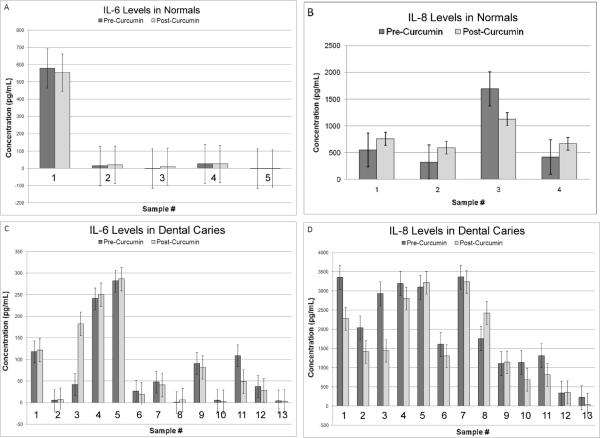
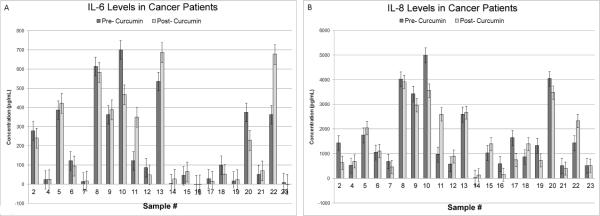
Experimental design: Saliva was collected before and after subjects chewed curcumin tablets. Protein was extracted and IKKβ kinase activity measured. Interleukin (IL)-6 and IL-8 levels in the salivary supernatants were measured by ELISA. IL-6, IL-8, and other interleukin were also measured independently with ELISA to confirm the inhibitory effect of curcumin on expression and secretion of salivary cytokines.
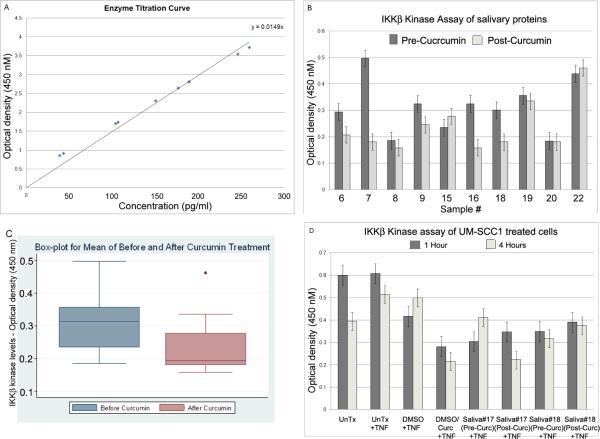
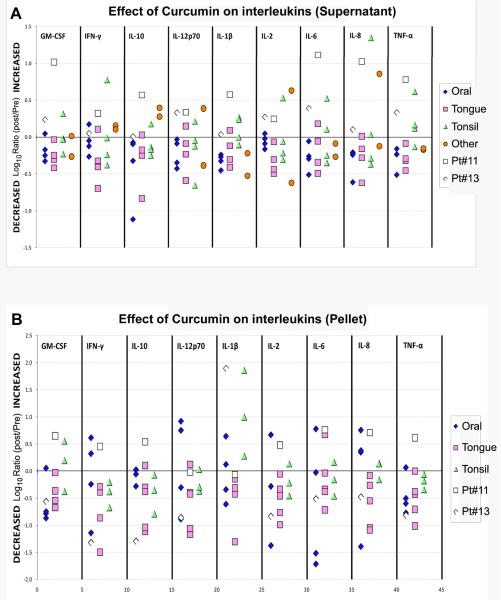
Results: Curcumin treatment led to a reduction in IKKβ kinase activity in the salivary cells of HNSCC patients (P < 0.05). Treatment of UM-SCC1 cells with curcumin as well as with post-curcumin salivary supernatant showed a reduction of IKKβ kinase activity. Significant reduction of IL-8 levels (P < 0.05) was seen in post-curcumin samples from patients with dental caries. Although there was reduced IL-8 expression in 8 of 21 post-curcumin samples of HNSCC patients, the data did not reach statistical significance. Saliva samples from HNSCC patients were also analyzed in a blinded fashion for expression of cytokines. IL-10, IFN-γ, IL-12p70, and IL-2 clustered together, and granulocyte macrophage colony stimulating factor and TNF-α clustered together. Log₁₀ ratio analysis showed decrease in expression of all nine cytokines in both the salivary supernatant and salivary cells of curcumin-treated samples.
Conclusions: Curcumin inhibited IKKβ kinase activity in the saliva of HNSCC patients, and this inhibition correlated with reduced expression of a number of cytokines. IKKβ kinase could be a useful biomarker for detecting the effect of curcumin in head and neck cancer.
©2011 AACR.
Figures
References
-
- Mignogna MD, Fedele S, Russo LL. The world cancer report and the burden of oral cancer. Eur J Cancer Prev. 2004;13:139–142. - PubMed
-
- Jemal A, Siegel R, Xu J, Ward E. Cancer statistics, 2010. CA Cancer J Clin. 2010;60:277–300. - PubMed
-
- Ries LAG, Young JL, Keel GE, Eisner MP, Lin YD, Horner M-J. SEER Survival Monograph: Cancer Survival Among Adults: U.S. SEER Program, 1988-2001, Patient and Tumor Characteristics. National Cancer Institute. 2007:7–22. 07-6215.
-
- Argiris A, Brockstein BE, Haraf DJ, Stenson KM, Mittal BB, Kies MS, Rosen FR, Jovanovic B, Vokes EE. Competing causes of death and second primary tumors in patients with locoregionally advanced head and neck cancer treated with chemoradiotherapy. Clin Cancer Res. 2004;10:1956–1962. - PubMed
-
- Aggarwal S, Takada Y, Singh S, Myers JN, Aggarwal BB. Inhibition of growth and survival of human head and neck squamous cell carcinoma cells by curcumin via modulation of nuclear factor-kappaB signaling. Int J Cancer. 2004;111:679–692. - PubMed
Publication types
MeSH terms
Substances
Grants and funding
LinkOut - more resources
Full Text Sources
Medical
