. 2011 Sep 29;118(13):3725-33.
doi: 10.1182/blood-2010-09-311076. Epub 2011 Aug 5.

Siglec-9 is a novel leukocyte ligand for vascular adhesion protein-1 and can be used in PET imaging of inflammation and cancer

Affiliations

Siglec-9 is a novel leukocyte ligand for vascular adhesion protein-1 and can be used in PET imaging of inflammation and cancer

Kristiina Aalto et al. Blood. .

Abstract

Leukocyte migration to sites of inflammation is regulated by several endothelial adhesion molecules. Vascular adhesion protein-1 (VAP-1) is unique among the homing-associated molecules as it is both an enzyme that oxidizes primary amines and an adhesin. Although granulocytes can bind to endothelium via a VAP-1-dependent manner, the counter-receptor(s) on this leukocyte population is(are) not known. Here we used a phage display approach and identified Siglec-9 as a candidate ligand on granulocytes. The binding between Siglec-9 and VAP-1 was confirmed by in vitro and ex vivo adhesion assays. The interaction sites between VAP-1 and Siglec-9 were identified by molecular modeling and confirmed by further binding assays with mutated proteins. Although the binding takes place in the enzymatic groove of VAP-1, it is only partially dependent on the enzymatic activity of VAP-1. In positron emission tomography, the ⁶⁸Gallium-labeled peptide of Siglec-9 specifically detected VAP-1 in vasculature at sites of inflammation and cancer. Thus, the peptide binding to the enzymatic groove of VAP-1 can be used for imaging conditions, such as inflammation and cancer.


Figures

Figure 1
Figure 1. Siglec-9 interacts with VAP-1
(A) The amino acid sequence of the enriched phage clone, the corresponding region of Siglec-9 and the adhesion of the phage peptide to recombinant VAP-1 (rVAP-1 100 ng/well) measured using EIA. The results are mean ± SEM from three separate experiments and triplicate wells in each experiment. (B) Binding of the Siglec-9 peptide (Sig-9 pept marked red in A) to CHO-VAP-1 transfectants and CHO-mock controls. The results are presented as relative fluorescence intensity and are mean ± SEM from two separate experiments each having triplicate wells. (C) Binding of CFSE labeled Siglec-9 transfectants to CHO cells expressing VAP-1 and mock controls. The results are mean ± SEM of fluorescent intensities measured by fluorometer from seven separate experiments each having duplicate wells. **P < 0.01; ***P < 0.001.
Figure 2
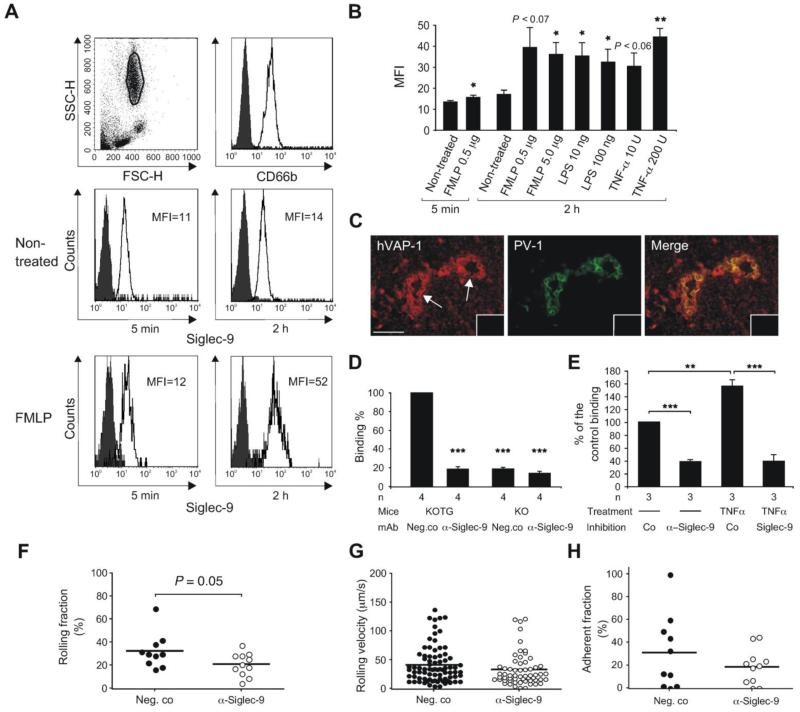
Figure 2. Siglec-9 positive leukocytes bind to vessels using VAP-1
(A) Expression of Siglec-9 on granulocytes used for ex vivo binding assays. FACS histograms of CD66b and Siglec-9 expression are shown with and without incubation in FMLP containing medium. Histograms with the negative control antibody are black. (B) Combined results of the induction experiments (mean ± SEM, n = 4) with FMLP, LPS and TNF-α (values indicated /mL). (C) Expression of human VAP-1 (hVAP-1) is detected with biotinylated Jg.2-10 (red, left panel). Expression of PV-1 positive vessels in mesenteric lymph node vasculature of KOTG is detected by Meca-32 antibody (green, middle panel). High endothelial venules are pointed out by arrow. The merge of the panels is on the right. Stainings with a negative control antibody are shown in the insets. Scale bar 50 μm. (D) Ex vivo frozen section binding assays were used to analyze granulocyte binding to vessels in mesenteric lymph nodes obtained from VAP-1 KO and VAP-1 KOTG mice. The function of Siglec-9 was blocked by incubating the cells with anti-Siglec-9 antibody prior to the assay. (E) Granulocyte binding to inflamed synovial vessels. The granulocytes were pre-treated with TNF-α and with anti-Siglec-9 and control antibodies as indicated. In D and E the results are shown as percentage of control binding (number of KOTG vessel-bound or synovial vessel-bound granulocytes incubated with a non-blocking control mAb is defined as 100%) (mean ± SEM). (F-H) Intravital analyses. Human granulocytes were fluorescently labeled with TAMRA and pre-treated either with control antibody or anti-Siglec-9 mAb. Subsequently, the cells were injected into VAP-1 KOTG mice and their interaction with the inflamed vessel wall was analyzed using intravital microscopy, (F) The graph indicates the percentage of rolling cells, calculated from the total number of cells appearing during the observation period. (G) The plots show the velocity of rolling cells. Each dot represents the mean rolling velocity of a single cell. (H) The graph indicates the percentage of the cells that arrest on the venular wall for ≥ 30 s, calculated from the total number of rolling cells. In all three graphs the horizontal lines indicate mean values. The number of mice/venules/PMN bolus injections were 3/6/10 for control mAb and 3/8/11 for anti-Siglec-9 mAb (F-H). *P < 0.05; **P < 0.01; ***P < 0.001, SSC-H = side scatter, FSC-H = forward scatter, MFI = mean fluorescence intensity after subtracting the MFI obtained from the stainings with the negative control antibody.
Figure 3
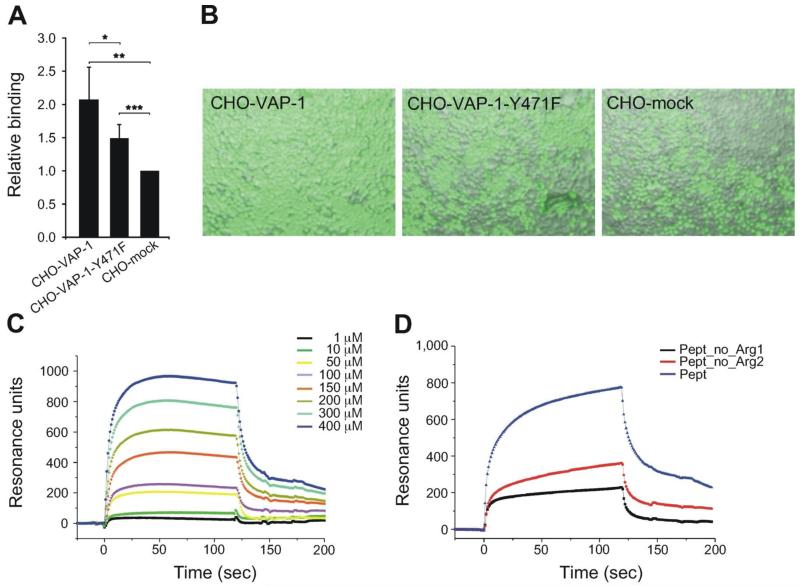
Figure 3. Interaction between Siglec-9 and VAP-1 involves both enzyme activity dependent and independent mechanisms
(A) Binding of CFSE labelled CHO-Siglec-9 transfectants to CHO cells expressing wild type VAP-1 (CHO-VAP-1), or the enzymatically inactive VAP-1 (CHO-VAP-1Y471F) and to mock transfected controls (CHO-mock). Binding is expressed as relative binding (mean ± SD, n = 5). *P < 0.05; **P < 0,01; ***P < 0.001. (B) Fluorescence microscopy images of the binding are shown as indicated. (C) Surface plasmon resonance analyses of the cyclic wild type Siglec-9-like peptide at different concentrations (0-400 μM). (D) An example of surface plasmon resonance analyses with the wild type and the mutated Siglec-9-like peptides. Three experiments were performed with comparable results. Arg 1 = Arg 284 and Arg 2 = Arg 290, Pept = wild type peptide.
Figure 4
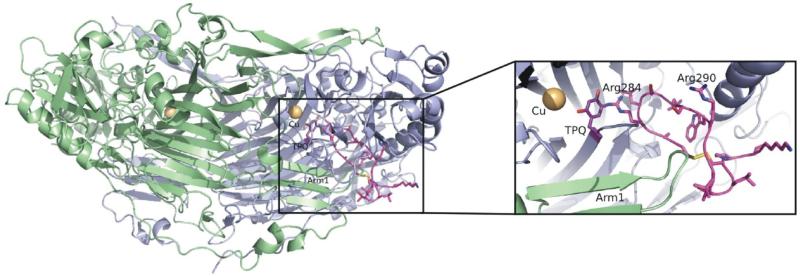
Figure 4
Interaction of VAP-1 with the cyclic peptide CARLSLSWRGLTLCPSK (residues 283-297) of Siglec-9 The 3-dimensional structure of VAP-1 (monomer A, green; and monomer B, blue) with the peptide (pink) derived from Siglec-9 docked into the active site of the monomer B. The close up view shows that the docked peptide fits well into the active site of VAP-1. Arg284 and Arg290 in the docked peptide are labelled and Arg284 is covalently bound to topaquinone (TPQ; purple), which is in the active conformation. The figure was created with PYMOL Molecular Graphics System (DeLano Scientific).
Figure 5
Figure 5. Siglec-9 peptide detects inflammation in PET
A representative whole-body coronal PET image of a rat intravenously injected with a 68Ga-DOTA-peptide. Radioactivity uptake is clearly seen at the site of inflammation (I) but not in the surrounding muscle. In the PET image also the heart (H), the liver (L) and the urinary tract (kidney (K) and bladder (B)) are seen. Mean time-activity curves of three animals from the site of inflammation, muscle, liver, bladder, plasma and heart as well as standardized uptake values (SUV) obtained by PET imaging and ex vivo measurements 60 min post injection are presented on the right.
Figure 6
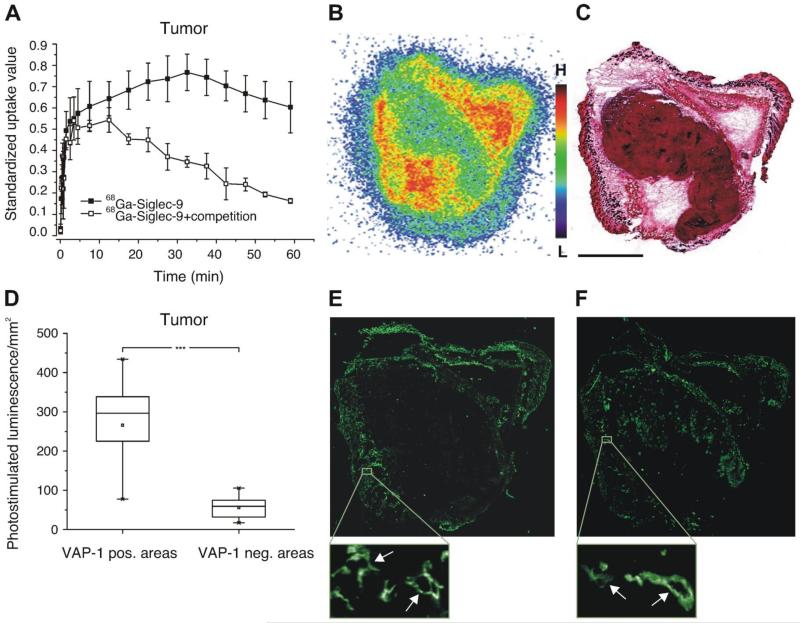
Figure 6. Siglec-9 peptide specifically targets VAP-1 in tumors
(A) Mean time-activity curves of 68Ga-DOTA-peptide in a tumor xenograft obtained from PET imaging of wild-type mice (WT, black squares) and after competition with excess of the unlabeled peptide (open squares). (B) A representative image of autoradiography i.e. distribution of radioactivity in a tissue section and (C) hematoxylin-eosin staining of the section. (D) Combined results from autoradiography analyses of 68Ga-DOTA-peptide distribution in melanoma xenografts of four mice at 15 min after i.v. injection presented as photostimulated luminescence (mean ± SD). Radioactivity was analyzed in VAP-1 negative and positive areas. (E) Immunohistochemical staining of the section of the same tumor as in b and c with anti-mouse VAP-1 antibody and (F) with anti-PV-1 antibody showing the blood vessels. Scale bar 2.5 mm for the whole tumor sections. In zoom-in insets individual VAP-1 and PV-1 positive tumor vessels are shown (arrows).

References

    1. Butcher EC. Leukocyte-endothelial cell recognition: three (or more) steps to specificity and diversity. Cell. 1991;67(6):1033–1036. - PubMed
    1. Zarbock A, Ley K. Mechanisms and consequences of neutrophil interaction with the endothelium. Am J Pathol. 2008;172(1):1–7. - PMC - PubMed
    1. Salmi M, Jalkanen S. Cell-surface enzymes in control of leukocyte trafficking. Nat Rev Immunol. 2005;5(10):760–771. - PubMed
    1. Lalor PF, Sun PJ, Weston CJ, Martin-Santos A, Wakelam MJ, Adams DH. Activation of vascular adhesion protein-1 on liver endothelium results in an NF-kappaB-dependent increase in lymphocyte adhesion. Hepatology. 2007;45(2):465–474. - PubMed
    1. Jalkanen S, Karikoski M, Mercier N, et al. The oxidase activity of vascular adhesion protein-1 (VAP-1) induces endothelial E- and P-selectins and leukocyte binding. Blood. 2007;110(6):1864–1870. - PubMed

Publication types

MeSH terms