Identification and characterization of two adenosine phosphorylase activities in Mycobacterium smegmatis
- PMID: 21821769
- PMCID: PMC3187226
- DOI: 10.1128/JB.05394-11
Identification and characterization of two adenosine phosphorylase activities in Mycobacterium smegmatis
Abstract
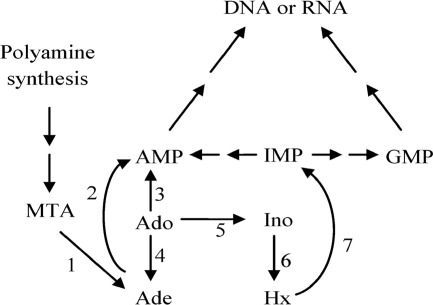
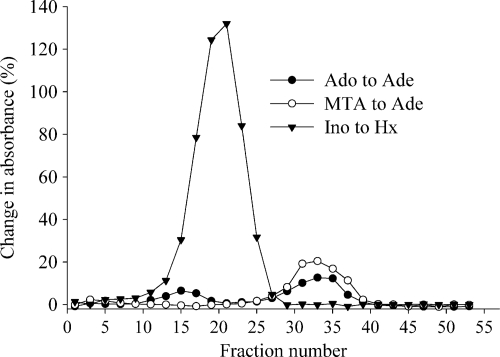
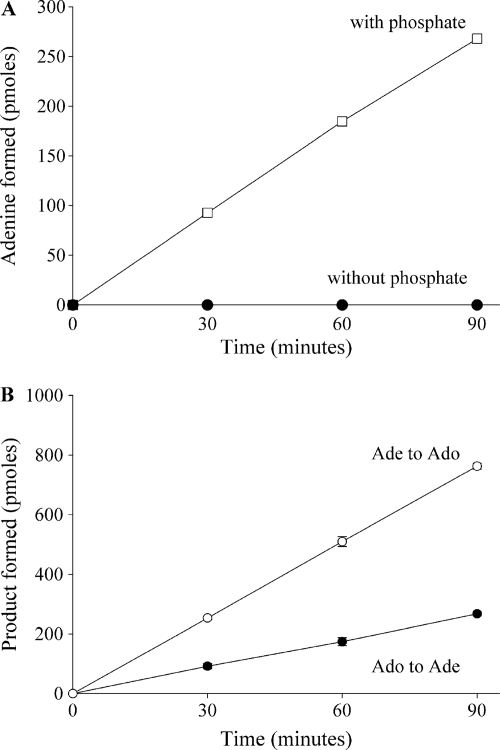
Purine nucleoside phosphorylase (PNP) is an important enzyme in purine metabolism and cleaves purine nucleosides to their respective bases. Mycobacterial PNP is specific for 6-oxopurines and cannot account for the adenosine (Ado) cleavage activity that has been detected in M. tuberculosis and M. smegmatis cultures. In the current work, two Ado cleavage activities were identified from M. smegmatis cell extracts. The first activity was biochemically determined to be a phosphorylase that could reversibly catalyze adenosine + phosphate ↔ adenine + alpha-D-ribose-1-phosphate. Our purification scheme led to a 30-fold purification of this activity, with the removal of more than 99.9% of total protein. While Ado was the preferred substrate, inosine and guanosine were also cleaved, with 43% and 32% of the Ado activity, respectively. Our data suggest that M. smegmatis expresses two PNPs: a previously described trimeric PNP that can cleave inosine and guanosine only and a second, novel PNP (Ado-PNP) that can cleave Ado, inosine, and guanosine. Ado-PNP had an apparent K(m) (K(m) ( app)) of 98 ± 6 μM (with Ado) and a native molecular mass of 125 ± 7 kDa. The second Ado cleavage activity was identified as 5'-methylthioadenosine phosphorylase (MTAP) based on its biochemical properties and mass spectrometry analysis. Our study marks the first report of the existence of MTAP in any bacterium. Since human cells do not readily convert Ado to Ade, an understanding of the substrate preferences of these enzymes could lead to the identification of Ado analogs that could be selectively activated to toxic products in mycobacteria.
Figures
References
-
- Albers E. 2009. Metabolic characteristics and importance of the universal methionine salvage pathway recycling methionine from 5′-methylthioadenosine. IUBMB Life 61:1132–1142 - PubMed
-
- Appleby T. C., Erion M. D., Ealick S. E. 1999. The structure of human 5′-deoxy-5′-methylthioadenosine phosphorylase at 1.7 A resolution provides insights into substrate binding and catalysis. Structure 7:629–641 - PubMed
-
- Appleby T. C., Mathews I. I., Porcelli M., Cacciapuoti G., Ealick S. E. 2001. Three-dimensional structure of a hyperthermophilic 5′-deoxy-5′-methylthioadenosine phosphorylase from Sulfolobus solfataricus. J. Biol. Chem. 276:39232–39242 - PubMed
-
- Barrow E. W., et al. 2003. Antimycobacterial activity of 2-methyl-adenosine. J. Antimicrob. Chemother. 52:801–808 - PubMed
-
- Basso L. A., et al. 2001. Purine nucleoside phosphorylase from Mycobacterium tuberculosis. Analysis of inhibition by a transition-state analogue and dissection by parts. Biochemistry 40:8196–8203 - PubMed
Publication types
MeSH terms
Substances
Grants and funding
LinkOut - more resources
Full Text Sources
Molecular Biology Databases
Miscellaneous