. 2011 Aug 7;13(9):1084-91.
doi: 10.1038/ncb2304.

The T-box transcription factor Eomesodermin acts upstream of Mesp1 to specify cardiac mesoderm during mouse gastrulation

Affiliations

The T-box transcription factor Eomesodermin acts upstream of Mesp1 to specify cardiac mesoderm during mouse gastrulation

Ita Costello et al. Nat Cell Biol. .

Abstract

Instructive programmes guiding cell-fate decisions in the developing mouse embryo are controlled by a few so-termed master regulators. Genetic studies demonstrate that the T-box transcription factor Eomesodermin (Eomes) is essential for epithelial-to-mesenchymal transition, mesoderm migration and specification of definitive endoderm during gastrulation. Here we report that Eomes expression within the primitive streak marks the earliest cardiac mesoderm and promotes formation of cardiovascular progenitors by directly activating the bHLH (basic-helix-loop-helix) transcription factor gene Mesp1 upstream of the core cardiac transcriptional machinery. In marked contrast to Eomes/Nodal signalling interactions that cooperatively regulate anterior-posterior axis patterning and allocation of the definitive endoderm cell lineage, formation of cardiac progenitors requires only low levels of Nodal activity accomplished through a Foxh1/Smad4-independent mechanism. Collectively, our experiments demonstrate that Eomes governs discrete context-dependent transcriptional programmes that sequentially specify cardiac and definitive endoderm progenitors during gastrulation.


Figures
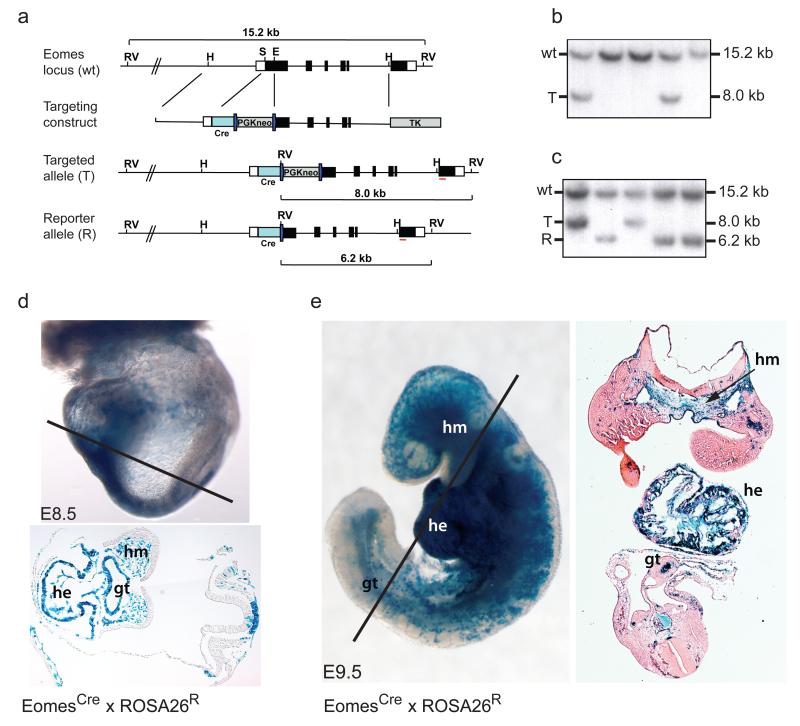
Figure 1
Figure 1
Fate mapping EomesCre expressing cells reveals selective contributions to DE and cardiovascular cell lineages. (a) Targeting strategy used to generate the EomesCre reporter allele. Cre recombinase coding sequences were inserted into Exon1 of the Eomes locus. RV, EcoRV; H, HpaI; S, SphI; E, EagI; Cre, Cre recombinase. (b) ES clones were screened by Southern blot on EcoRV digested DNA using a 3′ probe (red line in a) to detect wildtype (wt) and targeted (T) alleles. (c) Correctly targeted ES cells were transiently transfected with Cre to excise the PGK-neo selection cassette and generate the reporter allele (R), as shown by Southern blot. (d, e) Fate mapping experiments demonstrate that descendants of EomesCre expressing cells contribute to the myocardium and endocardium of the heart (he), the head mesenchyme (hm), vasculature and the endoderm of the primary gut tube (gt), but rarely colonize other mesoderm tissues formed from paraxial and lateral plate mesoderm. Sections were counterstained with eosin to highlight non-labelled cells.
Figure 2
Figure 2
Eomes functional loss disrupts specification of cardiovascular progenitors. (a) Whole-mount in situ hybridisation analysis of cardiac mesoderm (Myl7, Wnt2, Nkx2.5) and vascular (Agtrl1, Rasgrp3, Klhl6) markers in control and EomesN/CA;Sox2.Cre mutant embryos. Eomes mutants entirely lack expression of cardiac marker genes and show significantly reduced expression of vascular markers. In contrast in wild type embryos vascular markers broadly delineate the embryonic and extra-embryonic vasculature at E8.5-9.5. (b) Schematic diagram illustrating the protocol for generation of chimeric embryos. Eomes-null ES cells were introduced into wild type ROSA26LacZ blastocysts. (c, d) Histological sections of two independent LacZ stained E9.5 chimeric embryos were counterstained with Eosin to identify Eomes mutant cell populations (pink). The myocardium and endocardium of the heart (he) and endoderm of the gut tube (gt) are exclusively comprised of LacZ positive wild type cells. Relatively few Eomes null cells colonize the head mesenchyme (hm), whereas the majority of other tissues are comprised of mixed populations of Eomes null and wild-type cells. Scale bar is 500 μm.
Figure 3
Figure 3
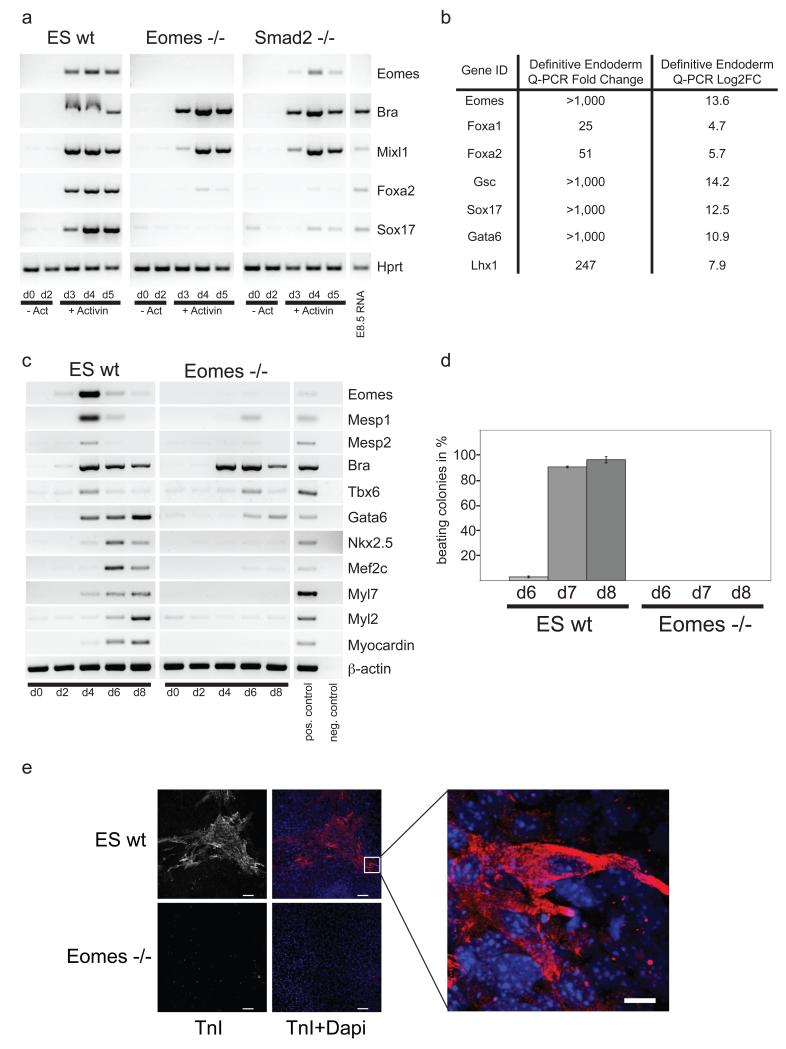
Eomes null ES cells fail to give rise to cardiomyocytes. (a) Wild-type, Eomes−/− and Smad2−/− ES cells were cultured in the presence of high-doses of ActivinA. Semi-quantitative RT-PCR analysis shows that Eomes−/− and Smad2−/−cultures strongly express mesoderm marker genes such as Brachyury and Mixl1, but lack expression of the DE marker genes, Foxa2 and Sox17. (b) Quantitative RT-PCR (qRT-PCR) analysis confirms the dramatically reduced DE marker transcript levels in Eomes−/−at day4 of ActivinA-induced differentiation. (c) Wild-type and Eomes mutant embryoid bodies (EBs) were induced to form cardiomyocytes in hanging drop cultures. Semi-quantitative RT-PCR analysis reveals that cardiac-specific transcription factors (Mesp1, Mesp2, Gata6, Nkx2.5, Mef2c and Myocardin), as well as structural proteins (Myl7, Myl2) are significantly down-regulated in Eomes null EBs while expression of the panmesodermal marker Brachyury is unaffected. (d) Clusters of beating cardiomyocytes are readily detectable in wild-type EB outgrowths but absent in Eomes null cultures at day 7. Error bars represent standard error of the mean (s.e.m.) of three independent experiments. (e) At day 8 TroponinI (TnI)-positive cardiomyocytes are detectable in wild type outgrowths but are entirely absent in Eomes mutant cultures. Higher magnification reveals characteristic cross striation of myofibrils. Scale bar, 100μm for the overview and 10μm for the higher magnification image.
Figure 4
Figure 4
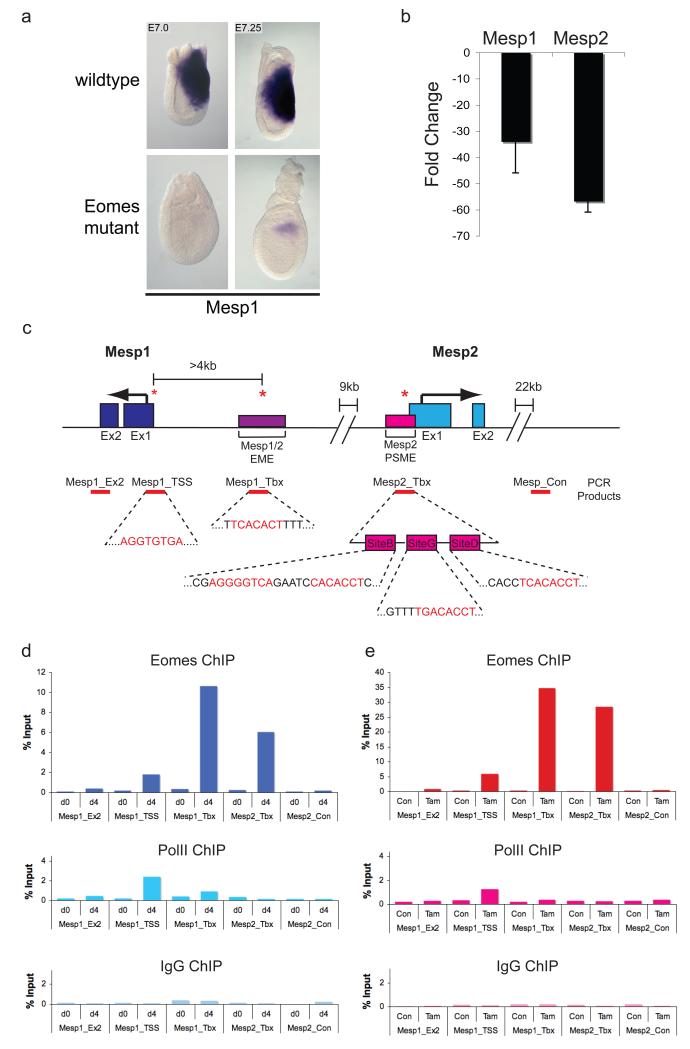
Eomes directly binds conserved T-box sites within the Mesp1 locus to activate expression. (a) Mesp1 robustly expressed in wild-type embryos at E7.0, is absent in EomesN/CA;Sox2Cre mutants. At slightly later stages (E7.25) EomesN/CA;Sox2Cre embryos occasionally show weak expression that likely reflects activity of Tbx6, known to be expressed in E7.5 Eomes mutants. (b) As judged by qRT-PCR Mesp1 and Mesp2 transcripts are dramatically reduced in E7.25 Eomes mutant embryos. Error bars represent standard deviation (s.d.), n= 5 per genotype. (c) Diagrammatic representation of cis-regulatory elements in the Mesp1/2 locus. The positions of previously identified T-box sites within the Mesp1/2 EME and Mesp2 PSME (nomenclature according to ref, ) and a novel putative T-box site identified near the Mesp1 TSS are indicated. The Mesp2 PSME contains 3 binding elements (Sites B, G, D) that contain T-box binding motifs. T-box consensus sequences are indicated in red. Red bars indicate areas amplified by qPCR after ChIP using different antibodies. Ex1, Exon1; Ex2, Exon2; EME, early mesoderm enhancer; PSME, pre-somitic mesoderm enhancer; TSS, transcriptional start site; Tbx, T-box site. (d) ChIP analysis of P19Cl6 cells treated for 4 days with DMSO using antibodies specific for Eomes, RNA-Polymerase II (PolII) or an IgG control. Specific enrichment for genomic loci containing T-box sites (Mesp1_TSS, Mesp1_Tbx, Mesp2_Tbx) was observed using the Eomes-specific antibody. The PolII antibody gave specific enrichment of the Mesp1_TSS, but not other tested regions of the Mesp1/2 locus. Specific binding to T-box sites (indicated by *) in the Mesp1/2 EME, the Mesp2 PSME and the Mesp1 TSS was detectable after 4 days, but not at day 0. d0, day 0; d4, day4 of DMSO differentiation of P19Cl6 cells. (e) Cells expressing a tamoxifen inducible Eomes fusion construct (P19EoER cells), also shows Eomes binding to these T-box sites at day 4 of tamoxifen treatment. Con, non-tamoxifen induced control P19EoER cells; Tam, day 4 tamoxifen treated P19EoER cells. The best representative plots of three independent experiments are shown.
Figure 5
Figure 5
Eomes and dose-dependent Nodal/Smad2/3 signalling levels control cardiac mesoderm and definitive endoderm specification during gastrulation. (a) Smad4 and Foxh1 are critical Nodal pathway components for transducing high levels of signalling, , . Mesp1 is expressed normally in E6.5 and 7.5 Foxh1 null embryos and in embryos lacking Smad4 in the epiblast only (Smad4Δ). Mesp1 expression is also efficiently induced in Lhx1 mutant embryos, which display DE and midline mesoderm defects. However the failure of A-P axis rotation results in induction of Mesp1 throughout the proximal epiblast. (b) Eomes activity regulates formation of both cardiac mesoderm and DE progenitors during gastrulation. Eomes+ epiblast cells confined to the posterior side of the embryo prior to overt streak formation are exposed to low levels of Nodal signalling. Eomes-dependent activation of Mesp1/2 marks the earliest cardiac progenitors induced in the forming PS. Mesp1/2 expression leads to activation of the Nodal antagonist Lefty2 and direct repression of DE genes. As cells begin to migrate away from the PS Mesp1/2 expression is down-regulated via a negative feedback loop, , . In contrast the Eomes expression domain extends distally and overlaps with increased Nodal signalling levels as the PS elongates. Eomes, acting cooperatively with Nodal/Smad4/FoxH1 dependent signals in the APS, induces DE. (c) At later stages from E7.5 onwards Tbx6 expression in the pre-somitic mesoderm activates a second wave of Mesp1/2 expression in the pre-somitic mesoderm via occupancy of the conserved T-box regulatory elements.

References

    1. Arnold SJ, Hofmann UK, Bikoff EK, Robertson EJ. Pivotal roles for eomesodermin during axis formation, epithelium-to-mesenchyme transition and endoderm specification in the mouse. Development. 2008;135:501–511. - PMC - PubMed
    1. Bondue A, et al. Mesp1 acts as a master regulator of multipotent cardiovascular progenitor specification. Cell Stem Cell. 2008;3:69–84. - PubMed
    1. David R, et al. MesP1 drives vertebrate cardiovascular differentiation through Dkk-1-mediated blockade of Wnt-signalling. Nat Cell Biol. 2008;10:338–345. - PubMed
    1. Lindsley RC, et al. Mesp1 coordinately regulates cardiovascular fate restriction and epithelial-mesenchymal transition in differentiating ESCs. Cell Stem Cell. 2008;3:55–68. - PMC - PubMed
    1. Vincent SD, Dunn NR, Hayashi S, Norris DP, Robertson EJ. Cell fate decisions within the mouse organizer are governed by graded Nodal signals. Genes Dev. 2003;17:1646–1662. - PMC - PubMed

Publication types

MeSH terms