


Impact of treatment approach on maternal and neonatal outcome in pregnant opioid-maintained women
- PMID: 21823171
- PMCID: PMC5494260
- DOI: 10.1002/hup.1224
Impact of treatment approach on maternal and neonatal outcome in pregnant opioid-maintained women
Abstract
Objective: The objective of this study is to compare maternal and neonatal outcome of opioid-dependent women maintained on buprenorphine or methadone throughout pregnancy in a randomized double-blind double-dummy clinical trial (CT) with a comparison group undergoing a structured standard protocol (SP) at the Medical University of Vienna, Austria.
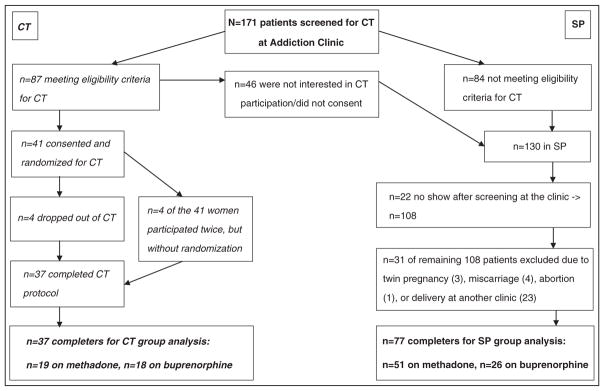
Methods: One hundred and fourteen subjects were included in the analysis, with 77 in SP (n = 51 methadone, n = 26 buprenorphine), and 37 in CT (n = 19 methadone, n = 18 buprenorphine), comparing maternal concomitant consumption during third trimester, demographic birth data, duration of treatment for neonatal abstinence syndrome (NAS), morphine dose for NAS treatment and length of hospital stay (LOS).
Results: Both study groups yielded healthy neonates with no significant demographic differences and equivalently low rates of positive maternal urine toxicologies. However, NAS parameters were significantly better in CT regarding total medication dose administered to neonates (p = 0.014) and LOS (p = 0.015). Superior results were achieved in buprenorphine compared with methadone-exposed neonates regarding gestational age at birth (p = 0.003), birth weight (p = 0.011), total morphine dose administered (p = 0.008), NAS treatment duration (p = 0.008) and LOS (p = 0.001).
Conclusions: Comparably favorable outcome for mothers and infants and efficacy and safety of opioid medications were shown in both treatment approaches. Neonatal care could benefit from transferring successful CT procedures into clinical practice.
Copyright © 2011 John Wiley & Sons, Ltd.
Conflict of interest statement
CONFLICT OF INTEREST
Travel support to present data at conferences has been provided by Mundipharma, Reckitt Benckiser, Lannacher (GL Pharma), Roche and Schering Plough.
Figures
References
-
- American Academy of Pediatrics Committee on Drugs. Neonatal withdrawal. Pediatrics. 1998;101:1079–1087. - PubMed
-
- American Psychiatric Association. Diagnostic and Statistical Manual of Mental Disorders—DSM-IV. 4. American Psychiatric Association; Washington, DC: 1994.
-
- Berghella V, Lim PJ, Hill MK, Cerpes J, Chennat J, Kaltenbach K. Maternal methadone dose and neonatal withdrawal. Am J Obstet Gynecol. 2003;189:312–317. - PubMed
-
- Cleary BJ, Donnelly J, Strawbridge J, Gallagher PJ, Fahey T, Clarke M, Murphy DJ. Methadone dose and neonatal abstinence syndrome—systematic review and meta-analysis. Addiction. 2010;105(12):2071–2084. - PubMed
-
- Dashe JS, Sheffield JS, Olscher DA, Todd SJ, Jackson GL, Wendel GD. Relationship between maternal methadone dosage and neonatal withdrawal. Obstet Gynecol. 2002;200:1244–1249. - PubMed
Publication types
MeSH terms
Substances
Grants and funding
LinkOut - more resources
Full Text Sources
Medical
