


Resilience in low-socioeconomic-status children with asthma: adaptations to stress
- PMID: 21824649
- PMCID: PMC3205307
- DOI: 10.1016/j.jaci.2011.06.040
Resilience in low-socioeconomic-status children with asthma: adaptations to stress
Abstract
Background: Low socioeconomic status (SES) is a strong predictor of many health problems, including asthma impairment; however, little is understood about why some patients defy this trend by exhibiting good asthma control despite living in adverse environments.
Objective: This study sought to test whether a psychological characteristic, the shift-and-persist strategy (dealing with stressors by reframing them more positively while at the same time persisting in optimistic thoughts about the future), protects low-SES children with asthma.
Methods: One hundred twenty-one children aged 9 to 18 years with a physician's diagnosis of asthma were recruited from medical practices and community advertisements (mean age, 12.6 years; 67% male; 61% white). Shift-and-persist scores and asthma inflammation (eosinophil counts and stimulated IL-4 cytokine production) were assessed at baseline, and asthma impairment (daily diary measures of rescue inhaler use and school absences) and daily peak flow were monitored at baseline and at a 6-month follow-up.
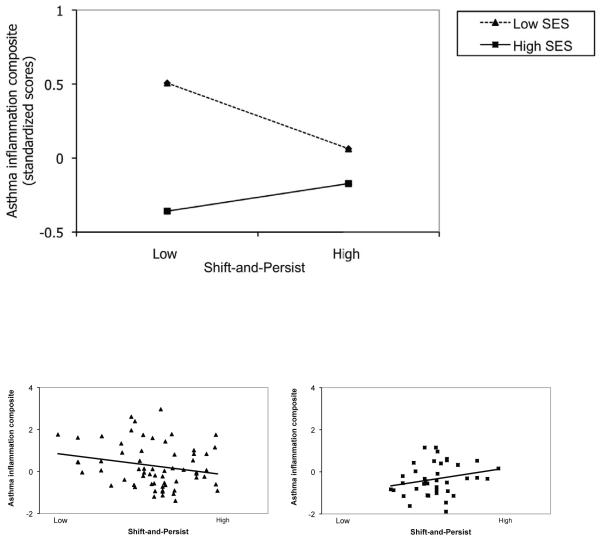
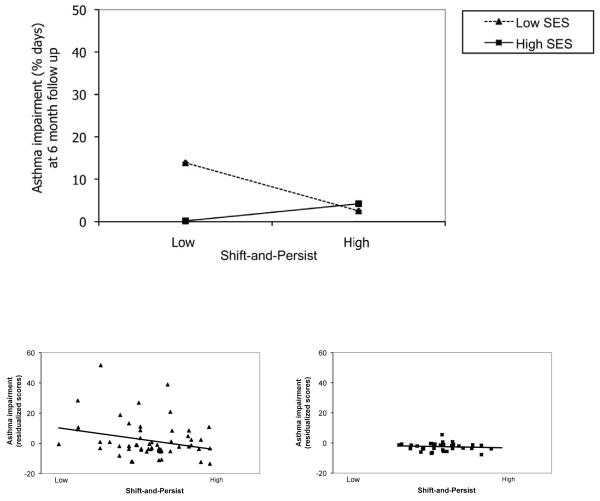
Results: Children who came from low-SES backgrounds but who engaged in shift-and-persist strategies displayed less asthma inflammation at baseline (β = 0.19, P < .05), as well as less asthma impairment (reduced rescue inhaler use and fewer school absences; β = 0.32, P < .01) prospectively at the 6-month follow-up period. In contrast, shift-and-persist strategies were not beneficial among high-SES children with asthma.
Conclusion: An approach that focuses on the psychological qualities that low-SES children develop to adapt to stressors might represent a practical and effective starting point for reducing health disparities. Moreover, the approaches that are effective in low-SES communities might be different from those that are optimal in a high-SES context.
Copyright © 2011 American Academy of Allergy, Asthma & Immunology. Published by Mosby, Inc. All rights reserved.
Figures
References
-
- Adler NE, Boyce WT, Chesney MA, Folkman S, Syme SL. Socioeconomic inequalities in health: No easy solution. Journal of the American Medical Association. 1993;269:3140–3145. - PubMed
-
- Chen E, Matthews KA, Boyce WT. Socioeconomic differences in children’s health: How and why do these relationships change with age? Psychological Bulletin. 2002;128:295–329. - PubMed
-
- Simon PA, Zeng ZW, Wold CM, Haddock W, Fielding JE. Prevalence of childhood asthma and associated morbidity in Los Angeles County: Impacts of race/ethnicity and income. J Asthma. 2003;40:535–543. - PubMed
