


Intestinal parasite screening in internationally adopted children: importance of multiple stool specimens
- PMID: 21824880
- PMCID: PMC9923786
- DOI: 10.1542/peds.2010-3032
Intestinal parasite screening in internationally adopted children: importance of multiple stool specimens
Abstract
Objective: Our goal was to determine the prevalence of intestinal parasites in internationally adopted children, to examine factors associated with infection, and to determine if evaluating multiple stool specimens increases the yield of parasite identification.
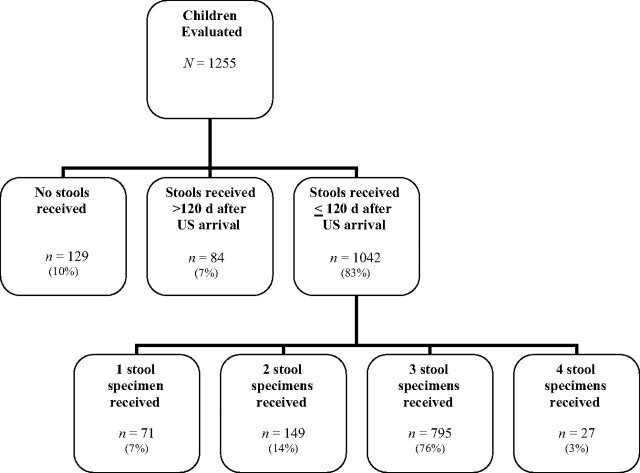
Methods: We evaluated internationally adopted children with at least 1 stool specimen submitted for ova and parasite testing within 120 days after arrival to the United States. In children submitting 3 stool specimens, in which at least 1 specimen was positive for the pathogen studied, we examined whether multiple stool specimens increased the likelihood of pathogen identification.
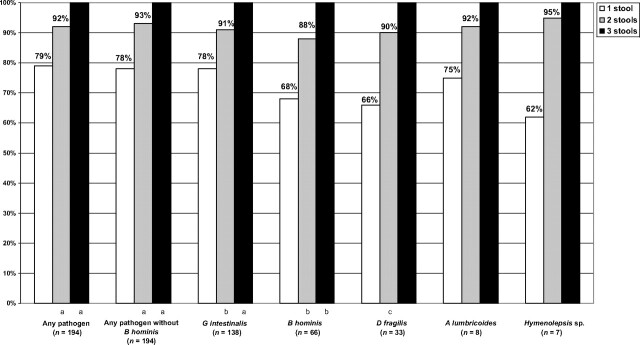
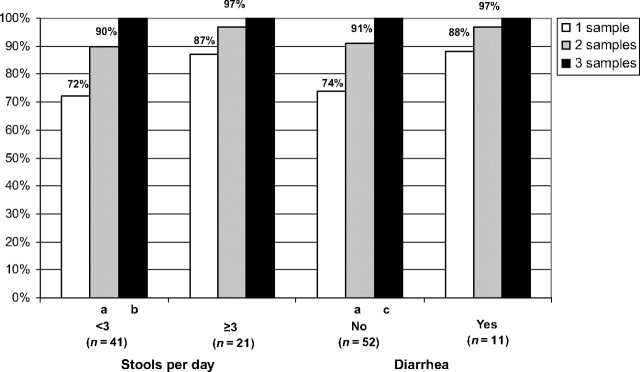
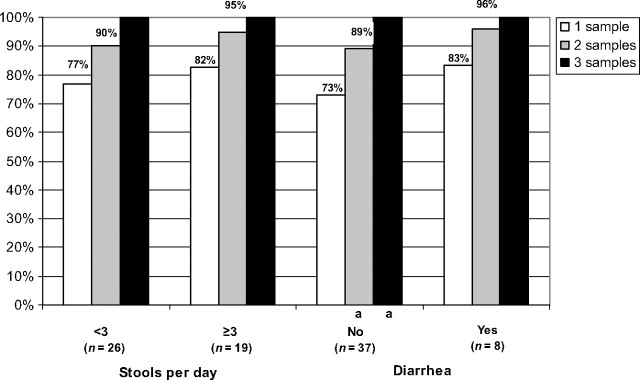
Results: Of the 1042 children studied, 27% had at least 1 pathogen identified; with pathogen-specific prevalence of Giardia intestinalis (19%), Blastocystis hominis (10%), Dientamoeba fragilis (5%), Entamoeba histolytica (1%), Ascaris lumbricoides (1%), and Hymenolepsis species (1%). The lowest prevalence occurred in South Korean (0%), Guatemalan (9%), and Chinese (13%) children, and the highest prevalence occurred in Ethiopian (55%) and Ukrainian (74%) children. Increasing age was significantly associated with parasite identification, whereas malnutrition and gastrointestinal symptoms were not. Overall, the yield of 1 stool specimen was 79% with pathogen recovery significantly increasing for 2 (92%) and 3 (100%) specimens, respectively (P < .0001). Pathogen identification also significantly increased with evaluation of additional stool specimens for children with and without gastrointestinal symptoms.
Conclusions: We provide data for evidence-based guidelines for intestinal parasite screening in internationally adopted children. Gastrointestinal symptoms were not predictive of pathogen recovery, and multiple stool specimens increased pathogen identification in this high-risk group of children.
Conflict of interest statement
Figures
References
-
- US Department of State. Immigrant visas issued to orphans coming to US. Available at: http://adoption.state.gov/about_us/statistics.php . Accessed July 22, 2011
-
- American Academy of Pediatrics. Medical evaluation of internationally adopted children for infectious diseases. In: Pickering LK , Baker CJ , Long SS , McMillan JA eds. Red Book: 2009 Report of the Committee on Infectious Diseases. 28th ed. Elk Grove Village, IL: American Academy of Pediatrics; 2009:177–184
-
- Hostetter MK , Iverson S , Thomas W , McKenzie D , Dole K , Johnson DE . Medical evaluation of internationally adopted children. N Engl J Med. 1991;325(7):479–485 - PubMed
-
- Johnson DE , Miller LC , Iverson S , et al. The health of children adopted from Romania. JAMA. 1992;268(24):3446–3451 - PubMed
-
- Albers LH , Johnson DE , Hostetter MK , Iverson S , Miller LC . Health of children from the former Soviet Union and Eastern Europe. JAMA. 1997;278(11):922–924 - PubMed
MeSH terms
Grants and funding
LinkOut - more resources
Full Text Sources
Medical
