. 2011 Oct;55(10):4643-51.
doi: 10.1128/AAC.00384-11. Epub 2011 Aug 8.

Impaired parasite attachment as fitness cost of metronidazole resistance in Giardia lamblia

Affiliations

Impaired parasite attachment as fitness cost of metronidazole resistance in Giardia lamblia

Noa Tejman-Yarden et al. Antimicrob Agents Chemother. 2011 Oct.

Abstract

Infections with the diarrheagenic protozoan pathogen Giardia lamblia are most commonly treated with metronidazole (Mz). Treatment failures with Mz occur in 10 to 20% of cases and Mz resistance develops in the laboratory, yet clinically, Mz-resistant (Mz(r)) G. lamblia has rarely been isolated from patients. To understand why clinical Mz(r) isolates are rare, we questioned whether Mz resistance entails fitness costs to the parasite. Our studies employed several newly generated and established isogenic Mz(r) cell lines with stable, high-level resistance to Mz and significant cross-resistance to tinidazole, nitazoxanide, and furazolidone. Oral infection of suckling mice revealed that three of five Mz(r) cell lines could not establish infection, while two Mz(r) cell lines infected pups, albeit with reduced efficiencies. Failure to colonize resulted from a diminished capacity of the parasite to attach to the intestinal mucosa in vivo and to epithelial cells and plastic surfaces in vitro. The attachment defect was related to impaired glucose metabolism, since the noninfectious Mz(r) lines consumed less glucose, and glucose promoted ATP-independent parasite attachment in the parental lines. Thus, resistance of Giardia to Mz is accompanied by a glucose metabolism-related attachment defect that can interfere with colonization of the host. Because glucose-metabolizing pathways are important for activation of the prodrug Mz, it follows that a fitness trade-off exists between diminished Mz activation and reduced infectivity, which may explain the observed paucity of clinical Mz(r) isolates of Giardia. However, the data also caution that some forms of Mz resistance do not markedly interfere with in vivo infectivity.


Figures
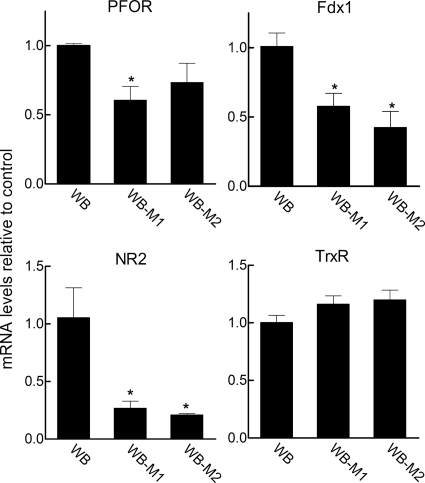
Fig. 1.
Fig. 1.
Differential expression in new Mzr lines of genes associated with reduction of 5-NI drugs. The indicated cells were examined by real-time PCR for mRNA levels of PFOR, ferredoxin 1 (Fdx1), nitroreductase 2 (NR2), and thioredoxin reductase (TrxR). Expression levels are shown relative to those in the parental WB cells (means + SEM; n = 3 to 4 per group). *, P < 0.05 (t test) relative to WB.
Fig. 2.
Fig. 2.
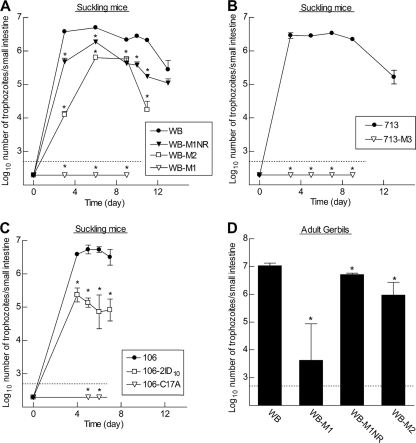
Infectivity of Mzr G. lamblia cell lines in different animal models. Suckling mice (A to C) and adult gerbils (D) were infected orally with 107 trophozoites of the indicated G. lamblia isolates and lines. Trophozoite numbers were determined in the small intestine at different times (A to C) or after 10 days (D) and are expressed as means ± SEM of the log10 values of 3 to 6 mice or 4 to 6 gerbils for each data point. The dotted horizontal line depicts the detection limit of the assay. *, P < 0.05 (t test [A to C] or Mann-Whitney test [D]) relative to the respective parental cell line at the same time point.
Fig. 3.
Fig. 3.
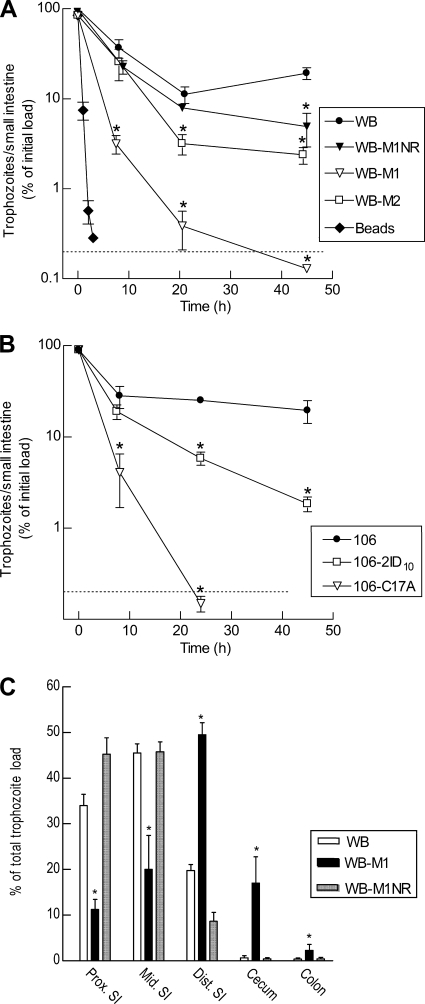
Retention and distribution of Mzr and Mzs G. lamblia in the small intestine. (A and B) Suckling mice were inoculated with 107 trophozoites of the indicated G. lamblia isolates and lines, or with polystyrene beads, and trophozoites and beads were enumerated in the small intestine at the designated times. Data are means ± SEM of the percentages of the initial inoculum (3 to 6 animals per data point). *, P < 0.05 relative to the respective parental line. (C) Distribution of Giardia along the orad-caudad axis was determined for three small intestine (SI) segments (proximal, mid, and distal), the cecum, and colon of suckling mice 8 h after inoculation with 107 trophozoites. Counts are expressed as means ± SEM of the percentage relative to the total counts in the entire gastrointestinal tract in each animal (n = 3 to 4 per group). *, P < 0.05 (t test) relative to the parental cell line for each segment.
Fig. 4.
Fig. 4.
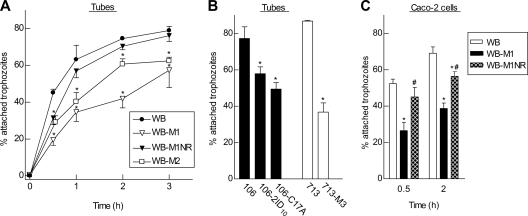
In vitro attachment of different G. lamblia lines. Different G. lamblia isolates and lines were added to fresh culture tubes and incubated for the indicated times (A) or for 2 h (B) or were coincubated for 0.5 and 2 h with confluent monolayers of Caco-2 cells (C). Numbers of attached and nonattached trophozoites were determined separately and were used to calculate total numbers in the cultures. Data are means ± SEM of the percentage of attached relative to total trophozoites in each group from 3 to 5 separate experiments. *, P < 0.05 (t test) relative to each parental line; #, P < 0.05 (t test) relative to WB-M1 in panel C.
Fig. 5.
Fig. 5.
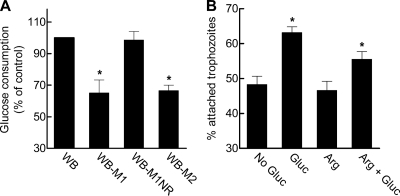
Role of glucose in attachment of G. lamblia. (A) Trophozoites in medium containing 5 mM glucose were plated into 24-well tissue culture plates and incubated under anaerobic conditions, and levels of glucose remaining in the medium were measured after a 5-h incubation period. Glucose consumption is expressed as the mean + SEM percent relative to consumption of the parental cell line WB (n = 3 to 4 experiments). The average glucose consumption of WB cells was 21 nmol/106 cells/h. *, P < 0.05 (paired t test) relative to the parental cell line. (B) Attachment of G. lamblia WB to plastic tubes was assessed 1.5 h after incubation in RPMI medium containing cysteine, bile, fetal calf serum, and 5 mM glucose (Gluc) and/or 5 mM arginine (Arg). Data are means + SEM percentages of attached cells relative to total cells in the culture (n = 3 experiments). *, P < 0.05 (t test) relative to the percentage of attached cells in medium without glucose or added arginine (No Gluc).

References

    1. Ankarklev J., Jerlstrom-Hultqvist J., Ringqvist E., Troell K., Svard S. G. 2010. Behind the smile: cell biology and disease mechanisms of Giardia species. Nat. Rev. Microbiol. 8:413–422 - PubMed
    1. Arguello-Garcia R., Cruz-Soto M., Romero-Montoya L., Ortega-Pierres G. 2009. In vitro resistance to 5-nitroimidazoles and benzimidazoles in Giardia duodenalis: variability and variation in gene expression. Infect. Genet. Evol. 9:1057–1064 - PubMed
    1. Bloch T., Davis T. E., Jr., Schwenk G. R., Jr 1987. Giardia lamblia in peritoneal fluid. Acta Cytol. 31:783–784 - PubMed
    1. Boreham P. F., Phillips R. E., Shepherd R. W. 1986. The activity of drugs against Giardia intestinalis in neonatal mice. J. Antimicrob. Chemother. 18:393–398 - PubMed
    1. Boreham P. F., Phillips R. E., Shepherd R. W. 1988. Altered uptake of metronidazole in vitro by stocks of Giardia intestinalis with different drug sensitivities. Trans. R. Soc. Trop. Med. Hyg. 82:104–106 - PubMed

Publication types