


Exposure to moderate air pollution during late pregnancy and cord blood cytokine secretion in healthy neonates
- PMID: 21826232
- PMCID: PMC3149643
- DOI: 10.1371/journal.pone.0023130
Exposure to moderate air pollution during late pregnancy and cord blood cytokine secretion in healthy neonates
Abstract
Background/objectives: Ambient air pollution can alter cytokine concentrations as shown in vitro and following short-term exposure to high air pollution levels in vivo. Exposure to pollution during late pregnancy has been shown to affect fetal lymphocytic immunophenotypes. However, effects of prenatal exposure to moderate levels of air pollutants on cytokine regulation in cord blood of healthy infants are unknown.
Methods: In a birth cohort of 265 healthy term-born neonates, we assessed maternal exposure to particles with an aerodynamic diameter of 10 µm or less (PM₁₀), as well as to indoor air pollution during the last trimester, specifically the last 21, 14, 7, 3 and 1 days of pregnancy. As a proxy for traffic-related air pollution, we determined the distance of mothers' homes to major roads. We measured cytokine and chemokine levels (MCP-1, IL-6, IL-10, IL-1ß, TNF-α and GM-CSF) in cord blood serum using LUMINEX technology. Their association with pollution levels was assessed using regression analysis, adjusted for possible confounders.
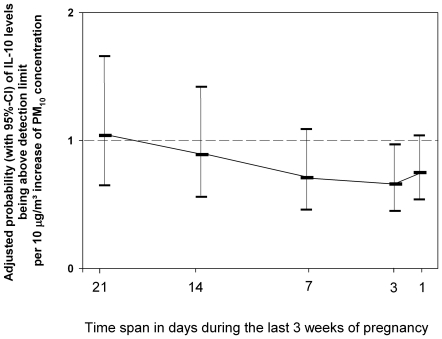
Results: Mean (95%-CI) PM₁₀ exposure for the last 7 days of pregnancy was 18.3 (10.3-38.4 µg/m³). PM₁₀ exposure during the last 3 days of pregnancy was significantly associated with reduced IL-10 and during the last 3 months of pregnancy with increased IL-1ß levels in cord blood after adjustment for relevant confounders. Maternal smoking was associated with reduced IL-6 levels. For the other cytokines no association was found.
Conclusions: Our results suggest that even naturally occurring prenatal exposure to moderate amounts of indoor and outdoor air pollution may lead to changes in cord blood cytokine levels in a population based cohort.
Conflict of interest statement
Figures
References
-
- Alessandrini F, Beck-Speier I, Krappmann D, Weichenmeier I, Takenaka S, et al. Role of oxidative stress in ultrafine particle-induced exacerbation of allergic lung inflammation. Am J Respir Crit Care Med. 2009;179:984–991. - PubMed
-
- Brauer M, Hoek G, Smit HA, de Jongste JC, Gerritsen J, et al. Air pollution and development of asthma, allergy and infections in a birth cohort. Eur Respir J. 2007;29:879–888. - PubMed
-
- Samet JM, Dominici F, Curriero FC, Coursac I, Zeger SL. Fine particulate air pollution and mortality in 20 U.S. cities, 1987–1994. N Engl J Med. 2000;343:1742–1749. - PubMed
-
- McCreanor J, Cullinan P, Nieuwenhuijsen MJ, Stewart-Evans J, Malliarou E, et al. Respiratory effects of exposure to diesel traffic in persons with asthma. N Engl J Med. 2007;357:2348–2358. - PubMed
-
- Moreno Ramiez E, Hernandez Urzua MA, Gonzalez Villegas AC, Casas Solis J, Zaitseva G. [Study of immunoglobulins, proinflammatory cytokines, lymphoproliferation and phagocytosis in peripheral blood of healthy young people exposed to different levels of atmospheric pollution]. Rev Alerg Mex. 2006;53:3–8. - PubMed
Publication types
MeSH terms
Substances
LinkOut - more resources
Full Text Sources
Medical
Research Materials
Miscellaneous
