. 2011 Sep 23;286(38):33613-21.
doi: 10.1074/jbc.M111.245126. Epub 2011 Aug 2.

Ubiquitin ligase activity of Cul3-KLHL7 protein is attenuated by autosomal dominant retinitis pigmentosa causative mutation

Affiliations

Ubiquitin ligase activity of Cul3-KLHL7 protein is attenuated by autosomal dominant retinitis pigmentosa causative mutation

Yu Kigoshi et al. J Biol Chem. .

Abstract

Substrate-specific protein degradation mediated by the ubiquitin proteasome system (UPS) is crucial for the proper function of the cell. Proteins are specifically recognized and ubiquitinated by the ubiquitin ligases (E3s) and are then degraded by the proteasome. BTB proteins act as the substrate recognition subunit that recruits their cognate substrates to the Cullin 3-based multisubunit E3s. Recently, it was reported that missense mutations in KLHL7, a BTB-Kelch protein, are related to autosomal dominant retinitis pigmentosa (adRP). However, the involvement of KLHL7 in the UPS and the outcome of the adRP causative mutations were unknown. In this study, we show that KLHL7 forms a dimer, assembles with Cul3 through its BTB and BACK domains, and exerts E3 activity. Lys-48-linked but not Lys-63-linked polyubiquitin chain co-localized with KLHL7, which increased upon proteasome inhibition suggesting that KLHL7 mediates protein degradation via UPS. An adRP-causative missense mutation in the BACK domain of KLHL7 attenuated only the Cul3 interaction but not dimerization. Nevertheless, the incorporation of the mutant as a heterodimer in the Cul3-KLHL7 complex diminished the E3 ligase activity. Together, our results suggest that KLHL7 constitutes a Cul3-based E3 and that the disease-causing mutation inhibits ligase activity in a dominant negative manner, which may lead to the inappropriate accumulation of the substrates targeted for proteasomal degradation.


Figures
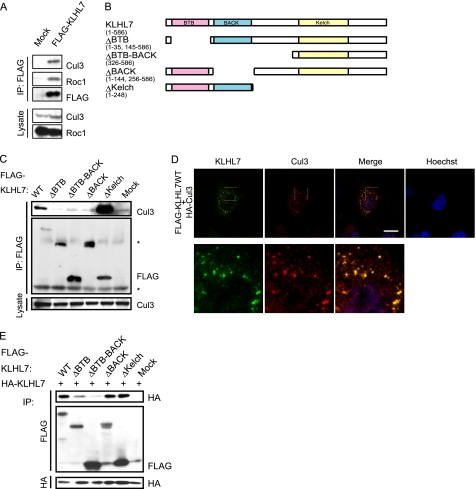
FIGURE 1.
FIGURE 1.
KLHL7 forms a Cul3-based complex. A, HCT116 cells transfected with FLAG-KLHL7 or mock vectors were immunoprecipitated (IP) with anti-FLAG antibody and immunoblotted with antibodies to Cul3, Roc1, and FLAG as indicated. B, schematic representations of KLHL7 (wild-type (WT) and deletion mutants). C, deletion mutants of FLAG-tagged KLHL7 were expressed in HCT116 cells, immunoprecipitated with anti-FLAG antibody, and immunoblotted with anti-Cul3 and anti-FLAG antibodies. Nonspecific bands are indicated with an asterisk. D, HeLa cells cultured on coverslips were transfected with HA-Cul3 and FLAG-KLHL7. The cells were fixed and stained with anti-HA and anti-FLAG antibodies and Hoechst 33342. Scale bar, 20 μm. E, deletion mutants of FLAG-tagged KLHL7 were co-expressed with HA-tagged full-length KLHL7 in HCT116 cells and immunoprecipitated with anti-FLAG and anti-HA antibodies. The immunoprecipitates were blotted with anti-HA and anti-FLAG antibodies.
FIGURE 2.
FIGURE 2.
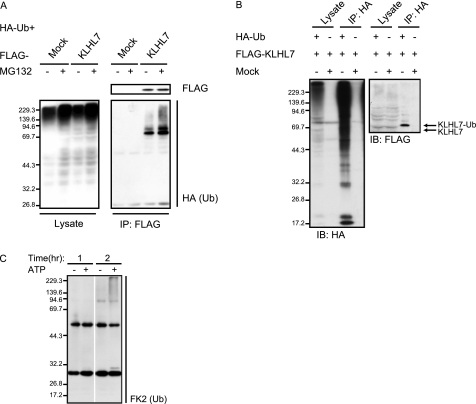
Cul3-KLHL7 is an E3 ligase. A, FLAG-KLHL7 or mock vectors were co-expressed with HA-Ub in HCT116 cells and treated with 20 μm MG132 (+) or DMSO (−) prior to harvesting. Cell lysates were immunoprecipitated (IP) with anti-FLAG antibody and blotted with anti-FLAG and anti-HA antibodies. B, FLAG-KLHL7 was co-expressed with HA-Ub in HCT116 cells. After 20 μm MG132 treatment, the cell lysates were immunoprecipitated with anti-HA antibody and subjected to immunoblotting (IB) with anti-HA and anti-FLAG antibodies. C, in vitro ubiquitination assay using Cul3-KLHL7 complex immunopurified from HCT116 cells. Cul3-KLHL7 was incubated with recombinant E1 (UBE1), E2 (UBC4), and Ub, with or without ATP at 30 °C. The reaction was stopped at the indicated times and then immunoblotted with anti-FK2 Ub antibody.
FIGURE 3.
FIGURE 3.
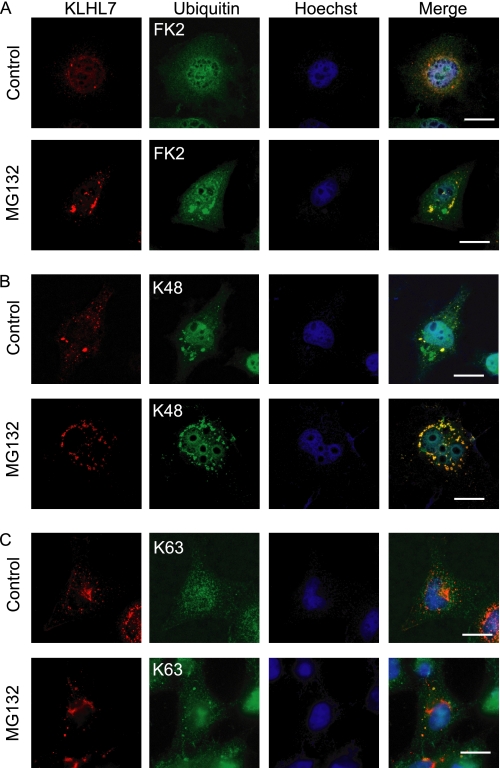
Ub-positive KLHL7 puncta increase with proteasome inhibition. A–C, HeLa cells cultured on coverslips were transfected with FLAG-KLHL7 and treated with either 20 μm of MG132 or DMSO and stained with antibodies to FLAG (red) and Ub (green) with anti-FK2 (A), anti-K48 (B), and anti-K63 (C). The nucleus was stained with Hoechst 33342. Scale bars, 20 μm.
FIGURE 4.
FIGURE 4.
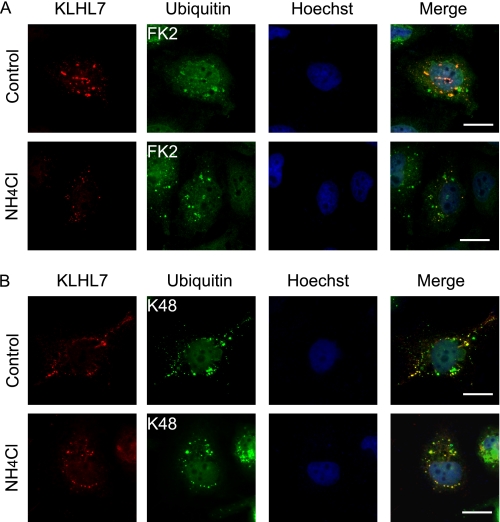
Ub-positive KLHL7 does not increase by lysosome inhibition. A and B, HeLa cells cultured on coverslips were transfected with FLAG-KLHL7 and treated with or without NH4Cl for lysosome inhibition and stained with antibodies to FLAG and Ub with anti-FK2 (A) and anti-K48 (B). The nucleus was detected with Hoechst 33342. Scale bars, 20 μm.
FIGURE 5.
FIGURE 5.
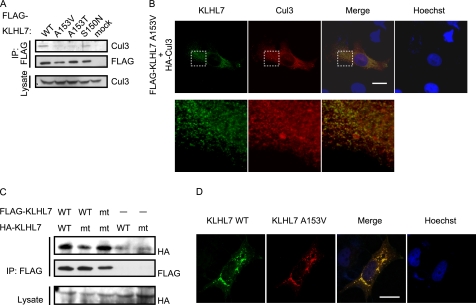
Ala-153 mutations of KLHL7 inhibit Cul3 interaction but not dimerization. A, HCT116 cells were transfected with either FLAG-KLHL7 wild-type or missense mutants. The cell lysates were immunoprecipitated (IP) with anti-FLAG antibody and immunoblotted with anti-Cul3 and anti-FLAG antibodies. B, HeLa cells cultured on coverslips were transfected with HA-Cul3 and FLAG-KLHL7 A153V. The cells were fixed and stained with anti-HA and anti-FLAG antibodies and Hoechst 33342. C, FLAG-KLHL7 (wild-type (WT) and A153V (mt)) and HA-KLHL7 (wild-type (WT) and A153V (mt)) were expressed in HCT116 cells as indicated. FLAG-KLHL7 was immunoprecipitated with anti-FLAG antibody and immunoblotted with anti-HA and anti-FLAG antibodies. D, HeLa cells on coverslips were transfected with FLAG-KLHL7 and HA-KLHL7 A153V. After fixation, cells were stained with anti-FLAG and anti-HA antibodies and Hoechst 33342. Scale bars, 20 μm.
FIGURE 6.
FIGURE 6.
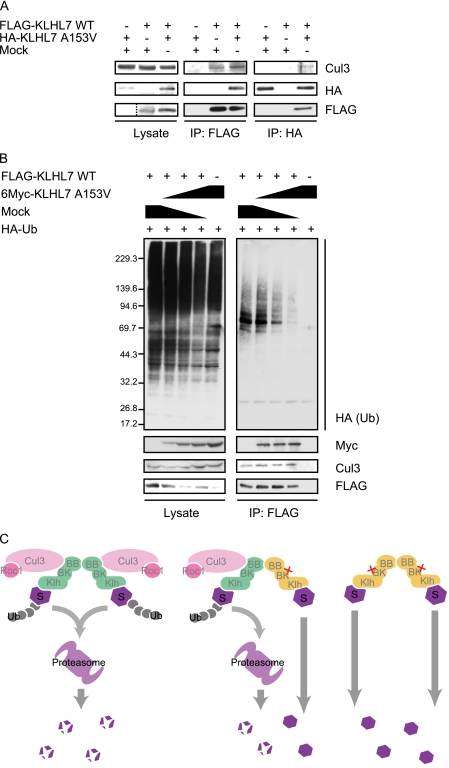
KLHL7 A153V attenuates Cul3-KLHL7 ligase activity. A, HCT116 cells were transfected with FLAG-KLHL7 and HA-KLHL7 A153V as indicated. The cell lysates were immunoprecipitated (IP) with anti-FLAG or anti-HA antibodies and immunoblotted with anti-Cul3, anti-HA, and anti-FLAG antibodies. B, HCT116 cells were transfected with FLAG-KLHL7, HA-Ub, and increasing amounts of 6Myc-KLHL7 A153V. The cells were treated with 20 μm MG132 for 1 h prior to harvesting and immunoprecipitated with anti-FLAG antibodies. Immunoblot analyses were done using anti-HA, anti-Myc, anti-Cul3, and anti-FLAG antibodies. C, molecular models of KLHL7-mediated ubiquitination. KLHL7 is indicated in green, the Ala-153 mutant in yellow, and the substrate as S. The domains of KLHL7 are as indicated: BB, BTB; BK, BACK; Klh, Kelch. The wild-type KLHL7 homodimer binds to two sets of Cul3/Roc and targets the substrates for ubiquitination (left panel). The heterodimer of wild-type and Ala-153 mutant can only bind to one set of Cul3/Roc1 and may ubiquitinate one of the two substrates, or not at all (middle panel). The Ala-153 mutant homodimer cannot bind to Cul3/Roc1 and fails to target the substrates for ubiquitination (right panel).

References

    1. Hershko A., Ciechanover A. (1998) Annu. Rev. Biochem. 67, 425–479 - PubMed
    1. Pickart C. M. (2001) Annu. Rev. Biochem. 70, 503–533 - PubMed
    1. Pickart C. M., Fushman D. (2004) Curr. Opin. Chem. Biol. 8, 610–616 - PubMed
    1. Olzmann J. A., Chin L. S. (2008) Autophagy 4, 85–87 - PMC - PubMed
    1. Xu P., Duong D. M., Seyfried N. T., Cheng D., Xie Y., Robert J., Rush J., Hochstrasser M., Finley D., Peng J. (2009) Cell 137, 133–145 - PMC - PubMed

Publication types

MeSH terms