


Parenting behavior, child functioning, and health behaviors in preadolescents with type 1 diabetes
- PMID: 21828111
- PMCID: PMC3173745
- DOI: 10.1093/jpepsy/jsr039
Parenting behavior, child functioning, and health behaviors in preadolescents with type 1 diabetes
Abstract
Objective: To examine the association of critical parenting behaviors with preadolescent reported depressive symptoms, self-efficacy, and self-care behaviors in youth with type 1 diabetes (T1D).
Method: A total of 84 youth with T1D, ages 9-11 years, completed the Diabetes Family Behavior Checklist, Child Depression Inventory, Self-Efficacy for Diabetes scale, and Self-Care Inventory during a baseline assessment for a randomized controlled trial of an intervention to promote adherence.
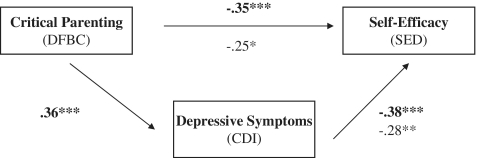
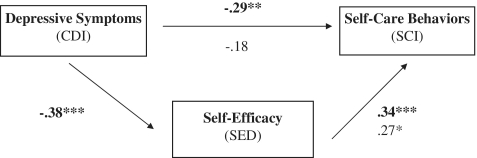
Results: Preadolescents who reported more critical parenting behaviors reported more depressive symptoms and lower self-efficacy. The relationship between critical parenting and self-efficacy was partially mediated by depressive symptoms. In a second model, depressive symptoms were associated with lower self-efficacy and fewer self-care behaviors. The relationship between depressive symptoms and self-care was fully mediated by self-efficacy.
Conclusions: Critical parenting behaviors are associated with preadolescents' psychological well-being, which has implications for self-care. Clinical implications include decreasing critical parenting behaviors and monitoring preadolescents with T1D for depressive symptoms.
Figures
References
-
- American Diabetes Association (ADA) Diabetes care in the school and day care setting. Diabetes Care. 2007;30:S66–73. - PubMed
-
- Anderson B, Auslander W F, Jung K C, Miller J P, Santiago J V. Assessing family sharing of diabetes responsibilities. Journal of Pediatric Psychology. 1990;15:477–492. - PubMed
-
- Anderson B, Ho J, Brackett J, Finkelstein D, Laffel L. Parental involvement in diabetes management tasks: Relationships to blood glucose monitoring adherence and metabolic control in young adolescents with insulin-dependent diabetes mellitus. Journal of Pediatrics. 1997;130:257–265. - PubMed
-
- Baron R M, Kenny D A. The moderator-mediator variable distinction in social psychological research: Conceptual, strategic, and statistical considerations. Journal of Personality and Social Psychology. 1986;51:1173–1182. - PubMed
-
- Berg C A, Skinner M, Ko K, Butler J M, Palmer D L, Butner J, Wiebe D J. The fit between stress appraisal and dyadic coping in understanding perceived coping effectiveness for adolescents with type 1 diabetes. Journal of Family Psychology. 2009;23:521–530. - PubMed
