


Prediction of microvascular invasion of hepatocellular carcinoma by pre-operative CT imaging
- PMID: 21828149
- PMCID: PMC3474124
- DOI: 10.1259/bjr/65897774
Prediction of microvascular invasion of hepatocellular carcinoma by pre-operative CT imaging
Abstract
Objective: The aim of this study was to diagnose microvascular invasion in patients with solitary hepatocellular carcinoma (HCC) from pre-operative CT imaging.
Methods: 102 patients with solitary HCC who underwent curative hepatectomy were retrospectively included in our study. The pre-operative 3-phase CT imaging and laboratory data for the 102 patients were reviewed. Tumour size, tumour margin, peritumoral enhancement and α-fetoprotein level were assessed. Surgical pathology was reviewed; tumour differentiation, liver fibrosis score and microvascular invasion were recorded.
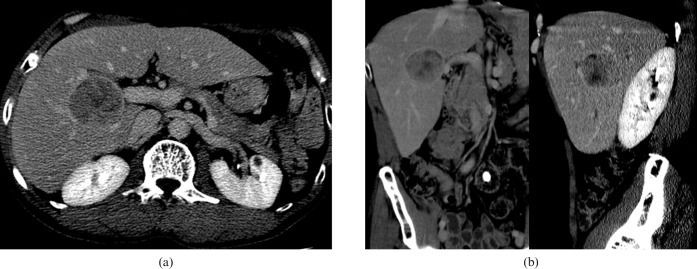
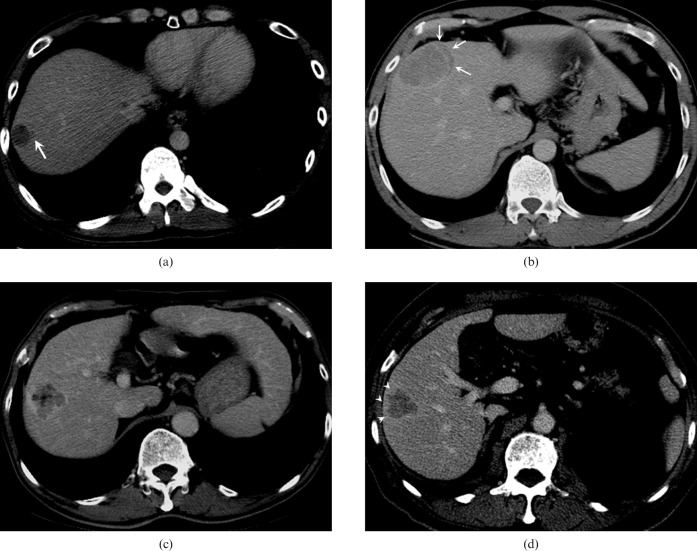
Results: The histopathological results revealed that 50 HCCs were positive and the other 52 were negative for microvascular invasion. Univariate analysis revealed that tumour size (p = 0.036), higher Edmondson-Steiner grade (p = 0.047) and non-smooth tumour margin (p < 0.001) showed statistically significant associations with microvascular invasion. Multivariate logistic regression analysis showed that non-smooth tumour margin had a statistically significant association with microvascular invasion only (p < 0.001). The sensitivity, specificity, positive predictive value and negative predictive value of the non-smooth tumour margin in the prediction of microvascular invasion were 66%, 86.5%, 82.5% and 72.6%, respectively.
Conclusion: Non-smooth tumour margin in pre-operative CT had a statistically significant association with microvascular invasion. More aggressive treatment should be considered in HCC patients with suspected positive microvascular invasion.
Figures
References
-
- Lau WY, Lai EC. Hepatocellular carcinoma: current management and recent advances. Hepatobiliary Pancreat Dis Int 2008;7:237–57 - PubMed
-
- Clark HP, Carson WF, Kavanagh PV, Ho CP, Shen P, Zagoria RJ. Staging and current treatment of hepatocellular carcinoma. Radiographics 2005;25:S3–23 - PubMed
-
- Ng KK, Vauthey JN, Pawlik TM, Lauwers GY, Regimbeau JM, Belghiti J, et al. Is hepatic resection for large or multinodular hepatocellular carcinoma justified? Results from a multi-institutional database. Ann Surg Oncol 2005;12:364–73 - PubMed
-
- Mor E, Kaspa RT, Sheiner P, Schwartz M. Treatment of hepatocellular carcinoma associated with cirrhosis in the era of liver transplantation. Ann Intern Med 1998;129:643–53 - PubMed
-
- Shah SA, Cleary SP, Wei AC, Yang I, Taylor BR, Hemming AW, et al. Recurrence after liver resection for hepatocellular carcinoma: risk factors, treatment, and outcomes. Surgery 2007;141:330–9 - PubMed
