. 2011 Aug;23(8):2991-3006.
doi: 10.1105/tpc.111.085829. Epub 2011 Aug 9.

Plastid uridine salvage activity is required for photoassimilate allocation and partitioning in Arabidopsis

Affiliations

Plastid uridine salvage activity is required for photoassimilate allocation and partitioning in Arabidopsis

Mingjie Chen et al. Plant Cell. 2011 Aug.

Abstract

Nucleotides are synthesized from de novo and salvage pathways. To characterize the uridine salvage pathway, two genes, UKL1 and UKL2, that tentatively encode uridine kinase (UK) and uracil phosphoribosyltransferase (UPRT) bifunctional enzymes were studied in Arabidopsis thaliana. T-DNA insertions in UKL1 and UKL2 reduced transcript expression and increased plant tolerance to toxic analogs 5-fluorouridine and 5-fluorouracil. Enzyme activity assays using purified recombinant proteins indicated that UKL1 and UKL2 have UK but not UPRT activity. Subcellular localization using a C-terminal enhanced yellow fluorescent protein fusion indicated that UKL1 and UKL2 localize to plastids. The ukl2 mutant shows reduced transient leaf starch during the day. External application of orotate rescued this phenotype in ukl2, indicating pyrimidine pools are limiting for starch synthesis in ukl2. Intermediates for lignin synthesis were upregulated, and there was increased lignin and reduced cellulose content in the ukl2 mutant. Levels of ATP, ADP, ADP-glucose, UTP, UDP, and UDP-glucose were altered in a light-dependent manner. Seed composition of the ukl1 and ukl2 mutants included lower oil and higher protein compared with the wild type. Unlike single gene mutants, the ukl1 ukl2 double mutant has severe developmental defects and reduced biomass accumulation, indicating these enzymes catalyze redundant reactions. These findings point to crucial roles played by uridine salvage for photoassimilate allocation and partitioning.


Figures
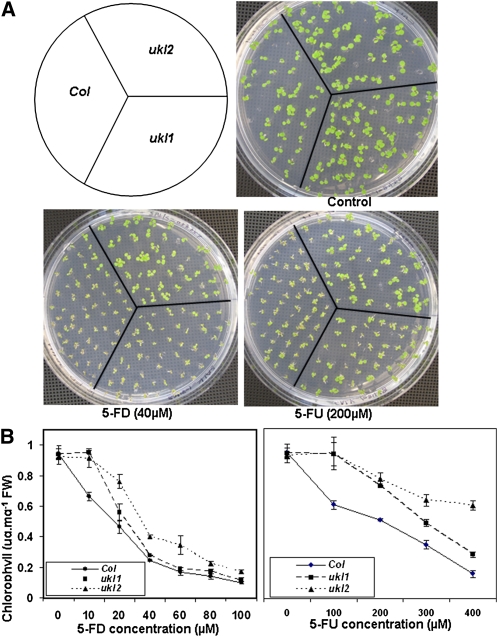
Figure 1.
Figure 1.
ukl1 and ukl2 Show Reduced Sensitivity to 5-FU and 5-FD Inhibition of Seedling Growth. (A) ukl1 and ukl2 are more tolerant to 5-FU and 5-FD inhibition of seedling growth. The wild type and mutants were germinated on half-strength MS medium supplemented with 5-FU or 5-FD at specified concentrations for 5 d. Col, Columbia ecotype. (B) Quantification of the chlorophyll content of the wild type and mutants grown on MS medium containing different concentrations of 5-FU or 5-FD for 5 d. Data are expressed as mean ± se for three measurements. FW, fresh weight. [See online article for color version of this figure.]
Figure 2.
Figure 2.
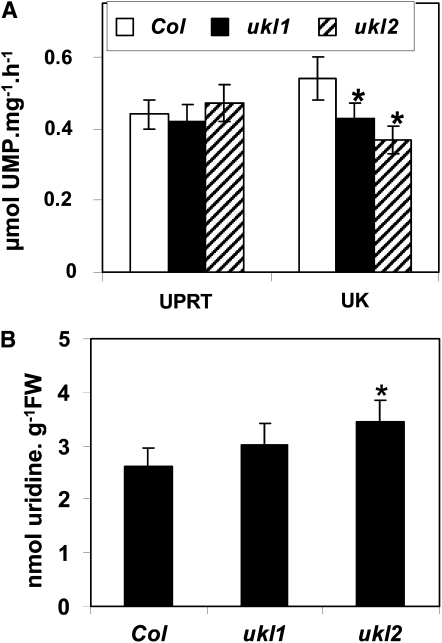
UK Activity Is Lower and Uridine Content Higher in ukl1 and ukl2 Mutants Compared with the Wild Type. (A) UK and UPRT activity assays from 4-week-old aerial leaves of wild-type and ukl1 and ukl2 mutant plants (n = 4). Col, Columbia ecotype. (B) Uridine and uracil content were quantified from wild-type and ukl1 and ukl2 mutant plants (n = 3). Plants were germinated on MS plates, and tissues were harvested after 1 week of growth for uridine and uracil isolation. Data are expressed as mean ± se. Asterisk represents significant difference (P < 0.05). FW, fresh weight.
Figure 3.
Figure 3.
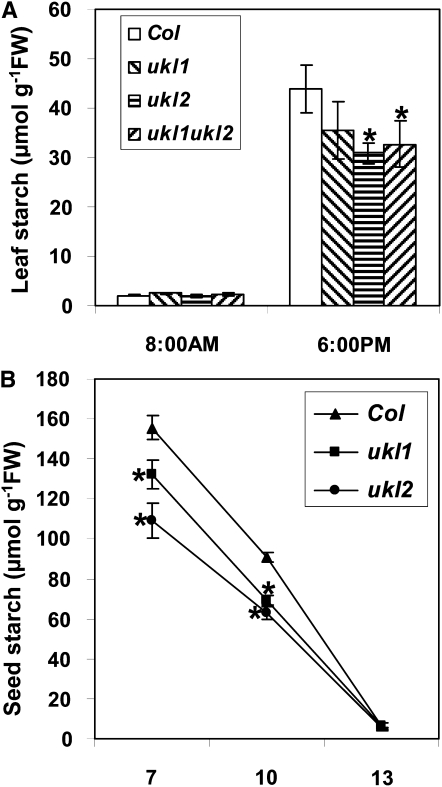
Leaf and Seed Starch Content in ukl1 and ukl2 Mutants Is Reduced. (A) Quantification of the leaf starch content of the wild type and mutants. Five individual plants were used. Data are expressed as means ± se. P values are 0.59, 0.004, and 0.036 for the ukl1 ukl2 single mutants and the ukl1 ukl2 double mutant, respectively. Col, Columbia ecotype; FW, fresh weight. (B) Quantification of the seed starch content during different developmental stages (n = 4). Siliques were harvested at 7, 10, and 13 DAF; seeds were dissected from siliques for starch quantization. Student’s t tests were performed on the ukl1 and ukl2 mutants: at 7 DAF, the P values were 0.032 and 0.012, respectively; and at 10 DAF, the P values were 0.045 and 0.039, respectively. Asterisk represents significant difference (P < 0.05).
Figure 4.
Figure 4.
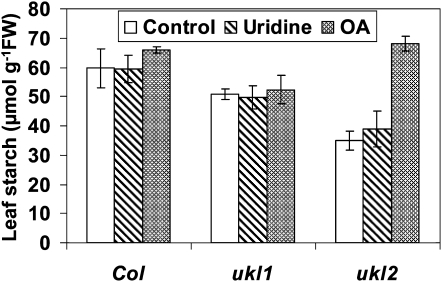
OA Application Affects Leaf Starch Content in ukl2 mutant plants. Plants were grown under long-day conditions for 30 d and then sprayed with 1 mM uridine or OA daily after germination. Leaves were harvested at 6:00 pm for starch quantification. Data are expressed as mean ± se (n = 5). Col, Columbia ecotype; FW, fresh weight.
Figure 5.
Figure 5.
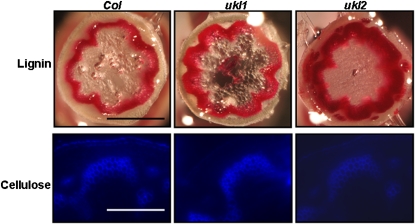
Lignin and Cellulose Accumulation in the ukl2 Mutant Is Altered. Cellulose content is reduced and lignin content enhanced in the ukl2 mutant plants. For visualization of secondary walls, tissues were stained with phloroglucinol-HCl for lignin and with fluorescent brightener 28 for cellulose. Scale bars for lignin and cellulose staining are 1 and 2 mm, respectively. Col, Columbia ecotype.
Figure 6.
Figure 6.
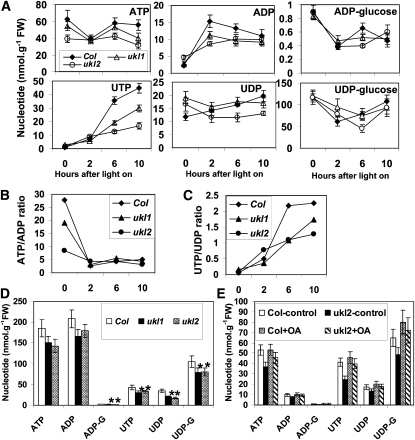
Uridinylate and Adenylate Levels in Wild-Type, ukl1, and ukl2 Leaves. (A) Adenylate and uridinylate dynamic changes during light period in Arabidopsis leaves. Plants were grown in growth chambers for 30 d. Aerial leaves were harvested at 0, 2, 6, and 10 h after illumination for nucleotide isolation. Data are expressed as mean ± se of determinations on six individual plants per line. Col, Columbia ecotype; FW, fresh weight. (B) and (C) The ATP/ADP (B) and UTP/UDP (C) ratios have been calculated to characterize levels of the major adenine and uridine nucleotides. (D) Silique nucleotide levels in the wild type and ukl1 and ukl2 mutants. Siliques were harvested 5 DAF after 8 h illumination. Asterisk represents significant difference (P < 0.05, n = 3). (E) OA application affected nucleotide levels in the ukl2 mutant. Plants were grown in growth chambers and sprayed daily with 1 mM orotate for 3 weeks, beginning 1 week after germination. Data are expressed as mean ± se of determinations on six individual plants per line.
Figure 7.
Figure 7.
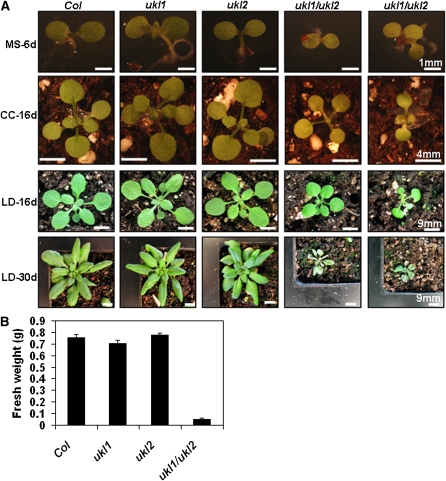
UKL1 and UKL2 Are Genetically Redundant and Required for Vegetative Growth in Arabidopsis. (A) The wild type, ukl1 and ukl2 single mutants, and ukl1 ukl2 double mutants (two independent lines) were germinated on MS medium. Seedlings were transferred into soil and grown under continuous white light (CC) or long-day (LD) conditions. Plants were photographed at either 6, 16, or 30 d as noted. Col, Columbia ecotype. (B) Fresh weight of aerial leaves grown under LD condition for 30 d. Data are expressed as mean ± se (n = 24). [See online article for color version of this figure.]
Figure 8.
Figure 8.
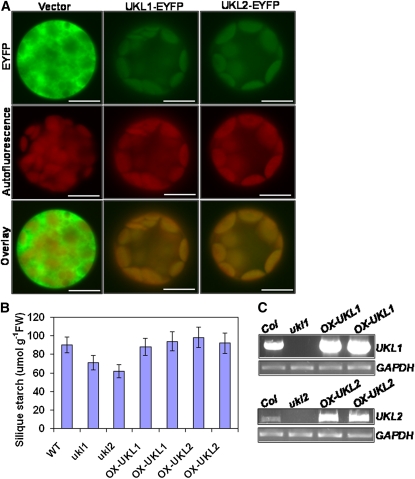
Subcellular Localization and Complementation of UKL1 and UKL2. (A) Fluorescence imaging of protoplasts isolated from stably transformed Arabidopsis leaf cells expressing EYFP, UKL1-EYFP, or UKL2-EYFP chimeric proteins. Top panels show EYFP signal in green; middle panels show chlorophyll autofluorescence in red; bottom panels show overlay of the EYFP and autofluorescence signals. Bars = 10 μm. (B) Silique starch content of the wild type (WT), ukl1 and ukl2 mutants, and individual transgenic lines overexpressing UKL1 or UKL2 in their respective homozygous mutant background. Siliques at 7 DAF were harvested after 9 h illumination for starch quantification. Data are expressed as mean ± se (n = 4). FW, fresh weight. (C) Overexpression of UKL1 or UKL2 in the transgenic lines confirmed with RT-PCR. T2 seeds from above complemented transgenic lines were germinated on MS plates for 5 d and used for RNA isolation. Seedlings were harvested for total RNA isolation. GAPDH was used as loading control. Col, Columbia ecotype.
Figure 9.
Figure 9.
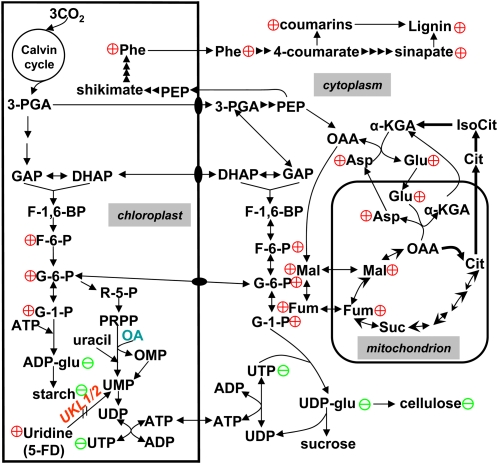
Model for Interaction of Uridine Salvage in Light-Adapted Leaves. Plastid pyrimidine salvage activity influences photoassimilate partitioning into starch, cellulose, and lignin. The knockout of UKL2 reduces UDP-glucose synthesis and restricts carbon flow into cellulose biosynthesis. The concomitant buildup of simple carbohydrates appears to channel carbon into lignin biosynthesis as well as other metabolic intermediates. 3-PGA, 3-phosphoglycerate; GAP, d-glyceraldehyde-3-phosphate; DHAP, dihydroxyacetone phosphate; F1,6-P, fructose-1,6-bisphosphate; F-6-P, d-fructose-6-phosphate; G-6-P, β-d-glucose-6-phosphate; G-1-P, β-d-glucose-1-phosphate; ADP-glu, ADP-d-glucose; UDP-glu, UDP-d-glucose; PEP, phosphoenolpyruvate; OAA, oxaloacetate; Cit, citrate; IsoCit, isocitrate; α -KGA, α-ketoglutarate; Suc-CoA, succinyl-CoA; Suc, succinate; Fum, fumarate; Mal, malate; OMP, orotidine 5′-monophosphate. Plus (+), higher in ukl2 than wild type; minus (−), lower in ukl2 mutant than the wild type. [See online article for color version of this figure.]

References

    1. Anterola A.M., Jeon J.H., Davin L.B., Lewis N.G. (2002). Transcriptional control of monolignol biosynthesis in Pinus taeda: Factors affecting monolignol ratios and carbon allocation in phenylpropanoid metabolism. J. Biol. Chem. 277: 18272–18280 - PubMed
    1. Ashihara H. (1977). Changes in the activities of the de novo and salvage pathways of pyrimidine nucleotide biosynthesis during germination of black gram (Phaseolus mungo) seeds. Z. Pflanzenphysiol. 81: 199–211
    1. Boerjan W., Ralph J., Baucher M. (2003). Lignin biosynthesis. Annu. Rev. Plant Biol. 54: 519–546 - PubMed
    1. Bolwell G.P., Butt V.S., Davies D.R., Zimmerlin A. (1995). The origin of the oxidative burst in plants. Free Radic. Res. 23: 517–532 - PubMed
    1. Broeckling C.D., Reddy I.R., Duran A.L., Zhao X.C., Sumner L.W. (2006). MET-IDEA: Data extraction tool for mass spectrometry-based metabolomics. Anal. Chem. 78: 4334–4341 - PubMed

Publication types

MeSH terms