


Mode of birth delivery affects oral microbiota in infants
- PMID: 21828355
- PMCID: PMC3173012
- DOI: 10.1177/0022034511418973
Mode of birth delivery affects oral microbiota in infants
Abstract
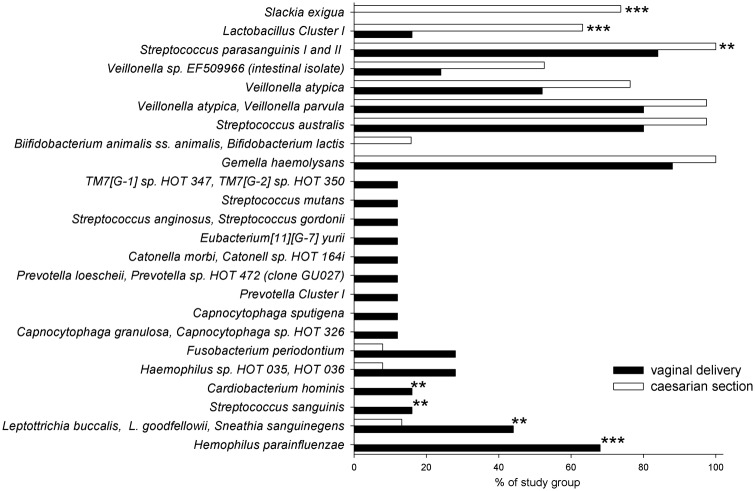
Establishment of the microbiota of the gut has been shown to differ between infants delivered by Caesarian section (C-section) and those delivered vaginally. The aim of the present study was to compare the oral microbiota in infants delivered by these different routes. The oral biofilm was assayed by the Human Oral Microbe Identification Microarray (HOMIM) in healthy three-month-old infants, 38 infants born by C-section, and 25 infants delivered vaginally. Among over 300 bacterial taxa targeted by the HOMIM microarray, Slackia exigua was detected only in infants delivered by C-section. Further, significantly more bacterial taxa were detected in the infants delivered vaginally (79 species/species clusters) compared with infants delivered by C-section (54 species/species clusters). Multivariate modeling revealed a strong model that separated the microbiota of C-section and vaginally delivered infants into two distinct colonization patterns. In conclusion, our study indicated differences in the oral microbiota in infants due to mode of delivery, with vaginally delivered infants having a higher number of taxa detected by the HOMIM microarray.
Conflict of interest statement
The authors declare no potential conflicts of interest with respect to the authorship and/or publication of this article.
Figures
References
-
- Abiko Y, Sato T, Mayanagi G, Takahashi N. (2010). Profiling of subgingival plaque biofilm microflora from periodontally healthy subjects and from subjects with periodontitis using quantitative real-time PCR. J Periodontal Res 45:389-395 - PubMed
-
- Ahrné S, Lönnermark E, Wold AE, Aberg N, Hesselmar B, Saalman R, et al. (2005). Lactobacilli in the intestinal microbiota of Swedish infants. Microbes Infect 7:1256-1262 - PubMed
-
- Bylesjö M, Rantalainen M, Cloarec O, Nicholson JK, Holmes E, Trygg J. (2006). OPLS discriminant analysis: combining the strengths of PLS-DA and SIMCA classification. J Chemometrics 20:341-351
Publication types
MeSH terms
Substances
Grants and funding
LinkOut - more resources
Full Text Sources
Medical
