


Peutz-Jeghers syndrome and family planning: the attitude towards prenatal diagnosis and pre-implantation genetic diagnosis
- PMID: 21829227
- PMCID: PMC3260925
- DOI: 10.1038/ejhg.2011.152
Peutz-Jeghers syndrome and family planning: the attitude towards prenatal diagnosis and pre-implantation genetic diagnosis
Abstract
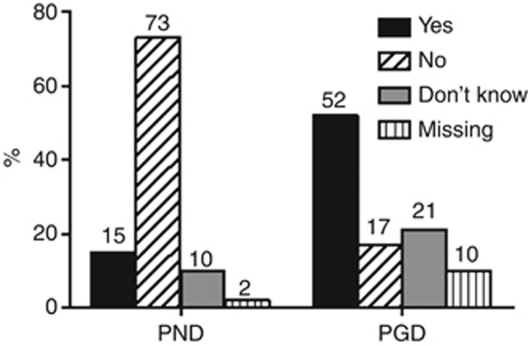
Peutz-Jeghers syndrome (PJS) is a hereditary disorder caused by LKB1 gene mutations, and is associated with considerable morbidity and decreased life expectancy. This study was conducted to assess the attitude of PJS patients towards family planning, prenatal diagnosis (PND) and pregnancy termination, and pre-implantation genetic diagnosis (PGD). In a cross-sectional study, 61 adult PJS patients were asked to complete a questionnaire concerning genetic testing, family planning, PND and PGD. The questionnaire was completed by 52 patients (85% response rate, 44% males) with a median age of 44 (range 18-74) years. A total of 37 (71%) respondents had undergone genetic testing. In all, 24 respondents (46%, 75% males) had children. A total of 15 (29%) respondents reported that their diagnosis of PJS had influenced their decisions regarding family planning, including 10 patients (19%, 9/10 females) who did not want to have children because of their disease. Termination of pregnancy after PND in case of a foetus with PJS was considered 'acceptable' for 15% of the respondents, whereas 52% considered PGD acceptable. In conclusion, the diagnosis of PJS influences the decisions regarding family planning in one third of PJS patients, especially in women. Most patients have a negative attitude towards pregnancy termination after PND, while PGD in case of PJS is judged more acceptable. These results emphasise the importance of discussing aspects regarding family planning with PJS patients, including PND and PGD.
Figures
References
-
- Hemminki A, Markie D, Tomlinson I, et al. A serine/threonine kinase gene defective in Peutz-Jeghers syndrome. Nature. 1998;391:184–187. - PubMed
-
- Jenne DE, Reimann H, Nezu J, et al. Peutz-Jeghers syndrome is caused by mutations in a novel serine threonine kinase. Nat Genet. 1998;18:38–43. - PubMed
-
- Peutz JLA. Over een zeer merkwaardige, gecombineerde familiaire polyposis van de slijmliezen van den tractus intestinalis met die van de neuskeelholte en gepaard met eigenaardige pigmentaties van huid en slijmvliezen. Ned Maandschr v Geneesk. 1921;10:134–146.
-
- Utsunomiya J, Gocho H, Miyanaga T, Hamaguchi E, Kashimure A. Peutz-Jeghers syndrome: its natural course and management. Johns Hopkins Med J. 1975;136:71–82. - PubMed
MeSH terms
LinkOut - more resources
Full Text Sources
Other Literature Sources
Medical
Miscellaneous
