


Modulation of immune responses in stress by Yoga
- PMID: 21829284
- PMCID: PMC3144610
- DOI: 10.4103/0973-6131.43541
Modulation of immune responses in stress by Yoga
Abstract
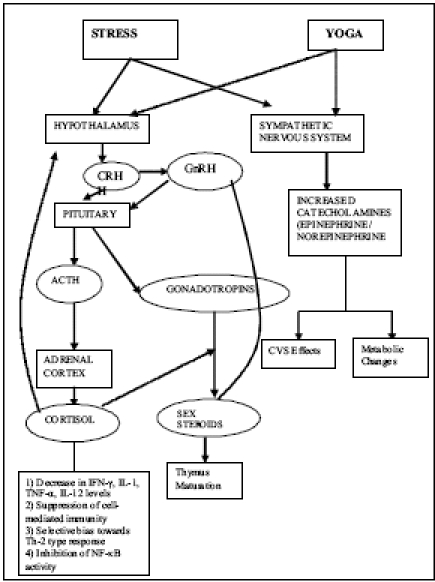
Stress is a constant factor in today's fastpaced life that can jeopardize our health if left unchecked. It is only in the last half century that the role of stress in every ailment from the common cold to AIDS has been emphasized, and the mechanisms involved in this process have been studied. Stress influences the immune response presumably through the activation of the hypothalamic-pituitary adrenal axis, hypothalamic pituitary-gonadal axis, and the sympathetic-adrenal-medullary system. Various neurotransmitters, neuropeptides, hormones, and cytokines mediate these complex bidirectional interactions between the central nervous system (CNS) and the immune system. The effects of stress on the immune responses result in alterations in the number of immune cells and cytokine dysregulation. Various stress management strategies such as meditation, yoga, hypnosis, and muscle relaxation have been shown to reduce the psychological and physiological effects of stress in cancers and HIV infection. This review aims to discuss the effect of stress on the immune system and examine how relaxation techniques such as Yoga and meditation could regulate the cytokine levels and hence, the immune responses during stress.
Keywords: Hypothalamo-pituitary adrenal axis; Yoga; immune reponse; neuroendocrine factors; stress.
Figures
References
-
- McEwen BS, Stellar E. Stress and the individual: Mechanisms leading to disease. Arch Intern Med. 1993;153:2093–101. - PubMed
-
- Elliot GR, Eisdorfer C. Stress and human health: An analysis and implications of research, A study by the Institute of Medicine, National Academy of Sciences. New York: Springer Publishing; 1982. pp. 11–24.
-
- Baum A, Cohen L, Hall M. Control and intrusive memories as possible determinants of chronic stress. Psychosom Med. 1993;55:274–86. - PubMed
-
- Solomon GF, Moos RH. Emotions, immunity and disease: A speculative theoretical integration. Arch Gen Psychiatry. 1964;11:57–67. - PubMed
-
- Kiecolt – Glaser JK, Marucha PT, Malarkey WB, Mercado AM, Glaser R. Slowing of wound healing by psychological stress. Lancet. 1995;346:1194–6. - PubMed
LinkOut - more resources
Full Text Sources