Are HIV epidemics among men who have sex with men emerging in the Middle East and North Africa?: a systematic review and data synthesis
- PMID: 21829329
- PMCID: PMC3149074
- DOI: 10.1371/journal.pmed.1000444
Are HIV epidemics among men who have sex with men emerging in the Middle East and North Africa?: a systematic review and data synthesis
Abstract
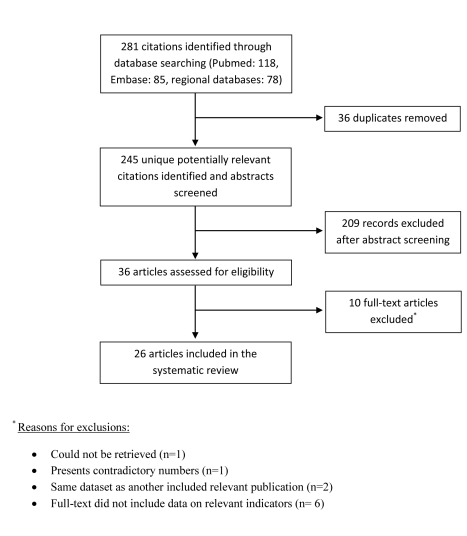
Background: Men who have sex with men (MSM) bear a disproportionately higher burden of HIV infection than the general population. MSM in the Middle East and North Africa (MENA) are a largely hidden population because of a prevailing stigma towards this type of sexual behavior, thereby limiting the ability to assess infection transmission patterns among them. It is widely perceived that data are virtually nonexistent on MSM and HIV in this region. The objective of this review was to delineate, for the first time, the evidence on the epidemiology of HIV among MSM in MENA.
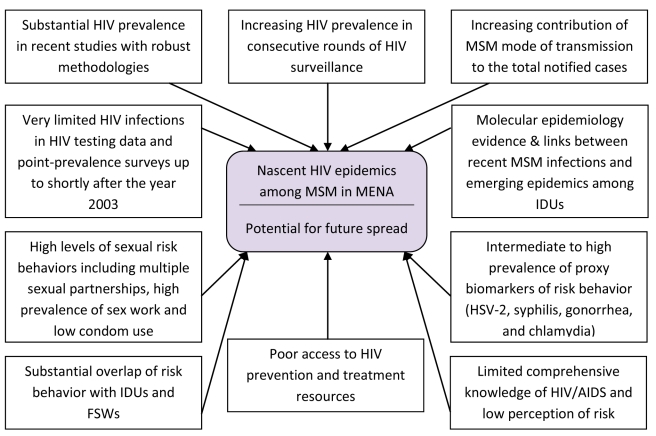
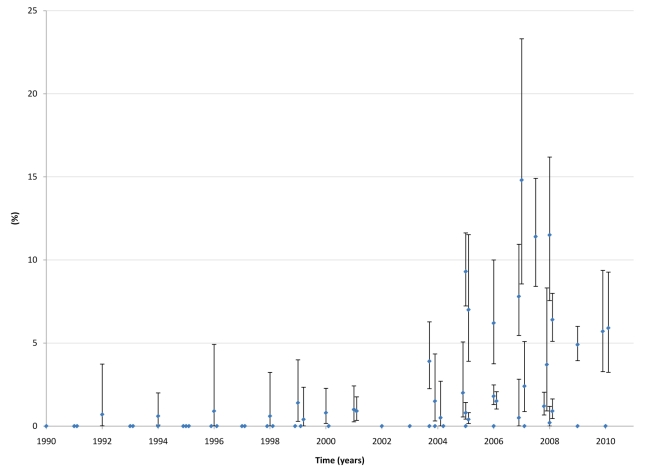
Methods and findings: This was a systematic review of all biological, behavioral, and other related data on HIV and MSM in MENA. Sources of data included PubMed (Medline), international organizations' reports and databases, country-level reports and databases including governmental and nongovernmental organization publications, and various other institutional documents. This review showed that onsiderable data are available on MSM and HIV in MENA. While HIV prevalence continues at low levels among different MSM groups, HIV epidemics appear to be emerging in at least few countries, with a prevalence reaching up to 28% among certain MSM groups. By 2008, the contribution of MSM transmission to the total HIV notified cases increased and exceeded 25% in several countries. The high levels of risk behavior (4-14 partners on average in the last six months among different MSM populations) and of biomarkers of risks (such as herpes simplex virus type 2 at 3%-54%), the overall low rate of consistent condom use (generally below 25%), the relative frequency of male sex work (20%-76%), and the substantial overlap with heterosexual risk behavior and injecting drug use suggest potential for further spread.
Conclusions: This systematic review and data synthesis indicate that HIV epidemics appear to be emerging among MSM in at least a few MENA countries and could already be in a concentrated state among several MSM groups. There is an urgent need to expand HIV surveillance and access to HIV testing, prevention, and treatment services in a rapidly narrowing window of opportunity to prevent the worst of HIV transmission among MSM in the Middle East and North Africa. Please see later in the article for the Editors' Summary.
Conflict of interest statement
The authors have declared that no competing interests exist.
Figures
References
-
- Kilmarx PH. Global epidemiology of HIV. Curr Opin HIV AIDS. 2009;4:240–246. - PubMed
-
- van Griensven F, de Lind van Wijngaarden JW, Baral S, Grulich A. The global epidemic of HIV infection among men who have sex with men. Curr Opin HIV AIDS. 2009;4:300–307. - PubMed
-
- Beyrer C, A LWirtz, Johns B, Sifakis F, et al. DamianWalker. Directions in development. Human devlopment. Washington, DC: The World Bank Press; 2011. The Global HIV epidemics among men who have sex with men.
-
- Trends in HIV/AIDS diagnoses among men who have sex with men-33 states, 2001-2006. MMWR Morb Mortal Wkly Rep. 2008;57:681–686. - PubMed
-
- Sanders EJ, Graham SM, Okuku HS, van der Elst EM, Muhaari A, et al. HIV-1 infection in high risk men who have sex with men in Mombasa, Kenya. AIDS. 2007;21:2513–2520. - PubMed
Publication types
MeSH terms
LinkOut - more resources
Full Text Sources
Medical
Research Materials