. 2011 Jul;7(7):e1002142.
doi: 10.1371/journal.ppat.1002142. Epub 2011 Jul 28.

Novel chikungunya vaccine candidate with an IRES-based attenuation and host range alteration mechanism

Affiliations

Novel chikungunya vaccine candidate with an IRES-based attenuation and host range alteration mechanism

Kenneth Plante et al. PLoS Pathog. 2011 Jul.

Abstract

Chikungunya virus (CHIKV) is a reemerging mosquito-borne pathogen that has recently caused devastating urban epidemics of severe and sometimes chronic arthralgia. As with most other mosquito-borne viral diseases, control relies on reducing mosquito populations and their contact with people, which has been ineffective in most locations. Therefore, vaccines remain the best strategy to prevent most vector-borne diseases. Ideally, vaccines for diseases of resource-limited countries should combine low cost and single dose efficacy, yet induce rapid and long-lived immunity with negligible risk of serious adverse reactions. To develop such a vaccine to protect against chikungunya fever, we employed a rational attenuation mechanism that also prevents the infection of mosquito vectors. The internal ribosome entry site (IRES) from encephalomyocarditis virus replaced the subgenomic promoter in a cDNA CHIKV clone, thus altering the levels and host-specific mechanism of structural protein gene expression. Testing in both normal outbred and interferon response-defective mice indicated that the new vaccine candidate is highly attenuated, immunogenic and efficacious after a single dose. Furthermore, it is incapable of replicating in mosquito cells or infecting mosquitoes in vivo. This IRES-based attenuation platform technology may be useful for the predictable attenuation of any alphavirus.


Conflict of interest statement

CDP, JW and DTS are employees of Inviragen, Inc. DTS is a stockholder and board member of Inviragen, Inc. JEO is a consultant and stockholder of Inviragen, Inc. IF and SCW are inventors on a UTMB patent application describing IRES-attenuated alphavirus vaccines. Inviragen has obtained license to the patent for commercial development.

Figures
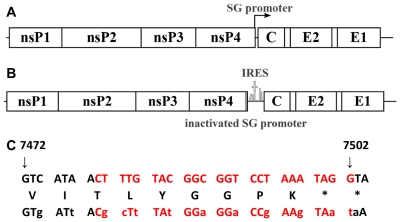
Figure 1
Figure 1. Genetic organization of wild-type CHIKV and the sequence of the subgenomic promoter.
A. Cartoon showing the locations of the 2 open reading frames encoding the nonstructural proteins and the subgenomic message encoding the capsid (C) as well as the envelope glycoproteins E2 and E1. B. Inactivation of the subgenomic promoter and insertion of the encephalomyocarditis internal ribosome entry site (IRES) to drive expression of the structural proteins from the genomic message. C. Wild-type subgenomic promoter (above) and inactivated promoter sequence (below) with synonymous mutations in lower-case. Deduced amino acid sequence is between nucleotide sequences. Red letters represent the subgenomic promoter region.
Figure 2
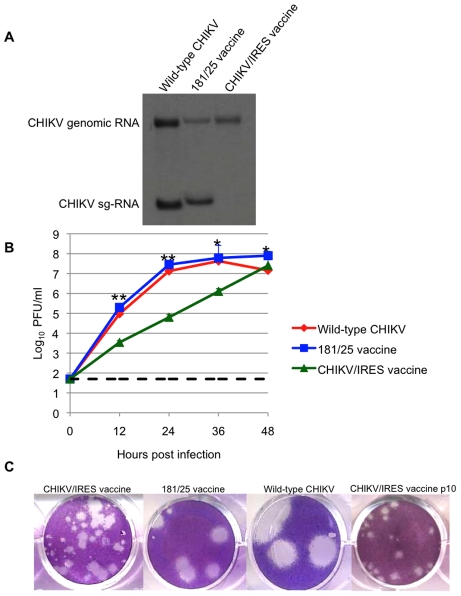
Figure 2. Replication of CHIKV/IRES in vitro.
A. Viral RNA present in Vero cells 22 hours after infection with CHIKV/IRES and CHIKV strains LR and 181/25. Slight differences in genomic and subgenomic RNA sizes of wt-LR strain and 181/25 reflect differences in untranslated sequence lengths. B. Replication kinetics of vaccine strains CHIKV/IRES and 181/25, as well as wt CHIKV in Vero cells after infection at a multiplicity of 0.1 PFU/cell. C. Plaque morphology of vaccine strains CHIKV/IRES, CHIKV/IRES Vero p10, and 181/25, as well as wt-CHIKV 3 days after infection of Vero cells. *  = p<0.05; **  = p<0.001.
Figure 3
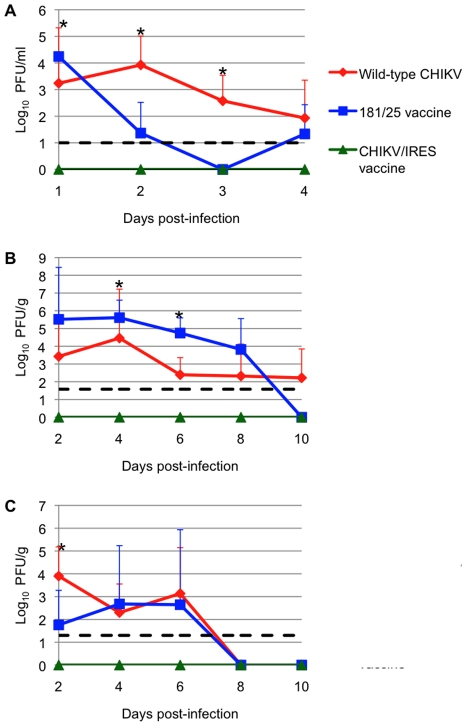
Figure 3. Vaccination of 6-day-old CD-1 mice after with 106 PFU of wt-CHIKV or vaccine candidates 181/25 or CHIKV/IRES.
A: viremia; B: knee tissue; C: brain. Dashed line shows limit of detection for the plaque assay. Bars indicate standard deviations. *  = p<0.05.
Figure 4
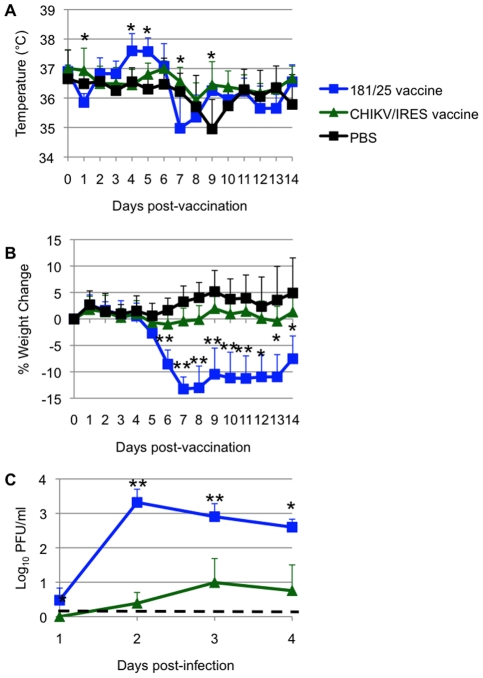
Figure 4. Vaccination of 10-week-old A129 mice.
Mice were inoculated intradermally with 104 PFU of CHIKV/IRES or 181/25, or after sham infected with PBS. A. Temperature. B. Weights. C. Viremia determined using qRT-PCR. Bars indicate standard deviations. N = 7 for CHIKV/IRES and N = 4 for strain 181/25. *  =  p<0.05. and **  =  p<0.001.
Figure 5
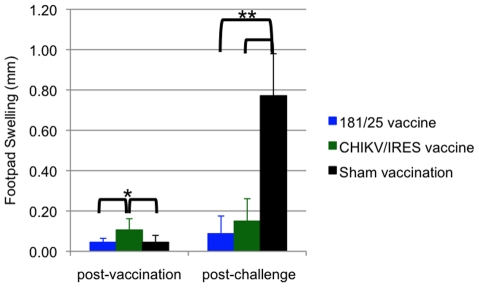
Figure 5. Foot swelling for 10-week-old A129 mice after intradermal vaccination with 104 PFU of CHIKV/IRES or 181/25.
The mice were challenged 30 days later with wt-CHIKV and a post-challenge measurement was taken 48 hours after. Foot thickness was measured with a caliper as the vertical height of the hind feet at the balls. Bars indicate standard deviations. N = 7 for CHIKV/IRES and N = 4 for strain 181/25. *  = p<0.05. and **  = p<0.001.
Figure 6
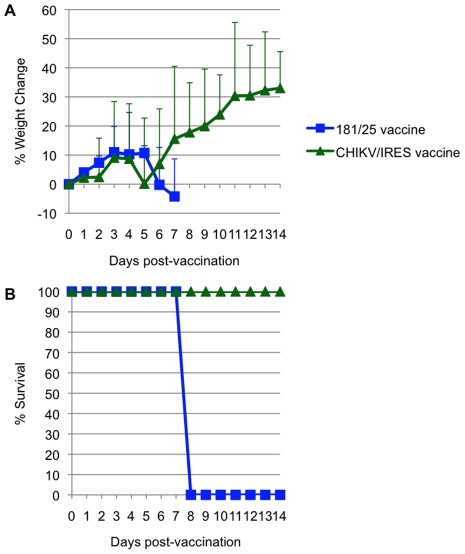
Figure 6. Virulence for 3-week-old A129 mice for strains 181/25 and CHIKV/IRES.
A. Weight post-vaccination. B. Survival post-vaccination.
Figure 7
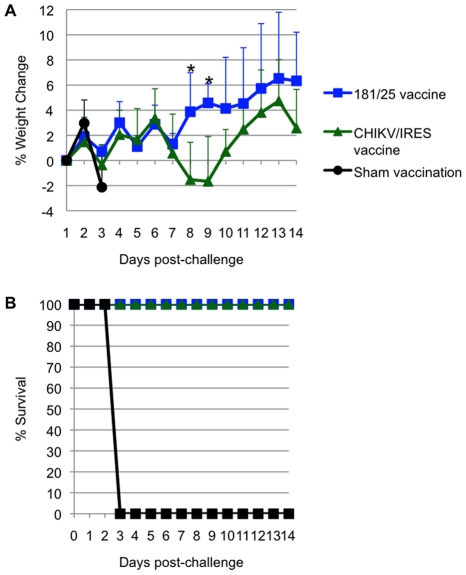
Figure 7. Weight and survival in 10-week-old A129 vaccinated with CHIKV/IRES, 181/25, or PBS, then challenged with wt- CHIKV (100 PFU).
A. Weight post-challenge. B. Survival post-challenge. *  = p value<0.05.
Figure 8
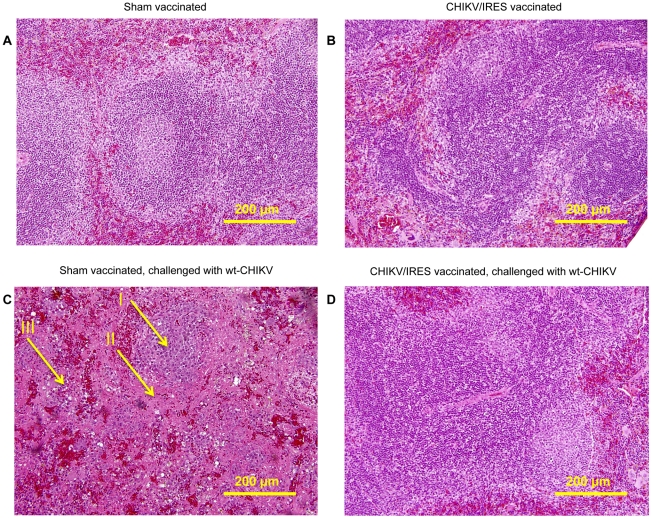
Figure 8. Representative splenic histopathology of A129 mice post-vaccination and –challenge, 20X magnification.
A. PBS-vaccinated animal 4 days post-vaccination. B. CHIKV/IRES-vaccinated animal, 4 days post-vaccination. C. PBS-vaccinated animals, 4 days post-challenge; I: center of remnant lymphoid follicle. II: proteinacious debris. III: monocytoid cells. D. CHIKV/IRES vaccinated animals, 4 days post-challenge.
Figure 9
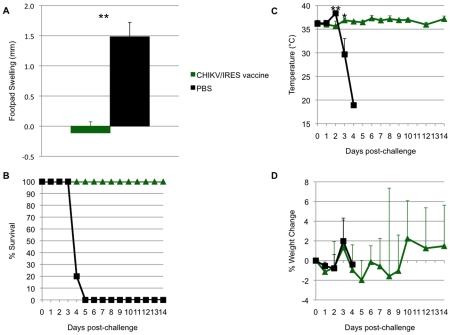
Figure 9. Duration of immunity in A129 mice.
Mice were vaccinated at 10 weeks of age and challenged 94 days later. A. Sham-vaccinated mice experienced significant foot swelling compared to CHIKV/IRES-vaccinated mice. B. All vaccinated mice survived challenge while sham-vaccinated mice succumbed to infection by day 5. C. Sham-vaccinated animals experienced significant hyperthermia on day 2 and hypothermia on day 3, while vaccinated animals maintained relatively stable temperatures. D. There was no significant difference in weight change between the cohorts. *  = p<0.05; **  = p<0.001.
Figure 10
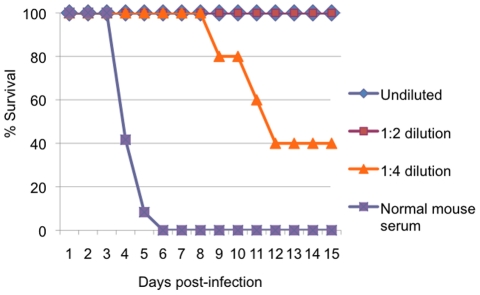
Figure 10. Protection of mice with passive transfer of immune serum.
Survival of 10-week-old A129 mice after intraperitoneal inoculation of diluted or undiluted immune CD-1 mouse serum from animals vaccinated with CHIKV/IRES, and challenge with 100 PFU of wt-CHIKV. N = 5.

References

    1. Karabatsos N. San Antonio: American Society of Tropical Medicine and Hygiene; 1985. International Catalog of Arboviruses Including Certain Other Viruses of Vertebrates.1147
    1. Carey DE. Chikungunya and dengue: a case of mistaken identity? J Hist Med Allied Sci. 1971;26:243–262. - PubMed
    1. Rao TR. Recent epidemics caused by chikungunya virus in India, 1963–1965. Scientific Culture. 1966;32:215.
    1. Halstead SB, Nimmannitya S, Margiotta MR. Dengue d chikungunya virus infection in man in Thailand, 1962–1964. II. Observations on disease in outpatients. Am J Trop Med Hyg. 1969;18:972–983. - PubMed
    1. Enserink M. Infectious diseases. Massive outbreak draws fresh attention to little-known virus. Science. 2006;311:1085. - PubMed

Publication types

MeSH terms