. 2011;6(7):e22426.
doi: 10.1371/journal.pone.0022426. Epub 2011 Jul 28.

A systems biology-based classifier for hepatocellular carcinoma diagnosis

Affiliations

A systems biology-based classifier for hepatocellular carcinoma diagnosis

Yanqiong Zhang et al. PLoS One. 2011.

Abstract

Aim: The diagnosis of hepatocellular carcinoma (HCC) in the early stage is crucial to the application of curative treatments which are the only hope for increasing the life expectancy of patients. Recently, several large-scale studies have shed light on this problem through analysis of gene expression profiles to identify markers correlated with HCC progression. However, those marker sets shared few genes in common and were poorly validated using independent data. Therefore, we developed a systems biology based classifier by combining the differential gene expression with topological features of human protein interaction networks to enhance the ability of HCC diagnosis.

Methods and results: In the Oncomine platform, genes differentially expressed in HCC tissues relative to their corresponding normal tissues were filtered by a corrected Q value cut-off and Concept filters. The identified genes that are common to different microarray datasets were chosen as the candidate markers. Then, their networks were analyzed by GeneGO Meta-Core software and the hub genes were chosen. After that, an HCC diagnostic classifier was constructed by Partial Least Squares modeling based on the microarray gene expression data of the hub genes. Validations of diagnostic performance showed that this classifier had high predictive accuracy (85.88∼92.71%) and area under ROC curve (approximating 1.0), and that the network topological features integrated into this classifier contribute greatly to improving the predictive performance. Furthermore, it has been demonstrated that this modeling strategy is not only applicable to HCC, but also to other cancers.

Conclusion: Our analysis suggests that the systems biology-based classifier that combines the differential gene expression and topological features of human protein interaction network may enhance the diagnostic performance of HCC classifier.


Conflict of interest statement

Competing Interests: The authors have declared that no competing interests exist.

Figures

Figure 1
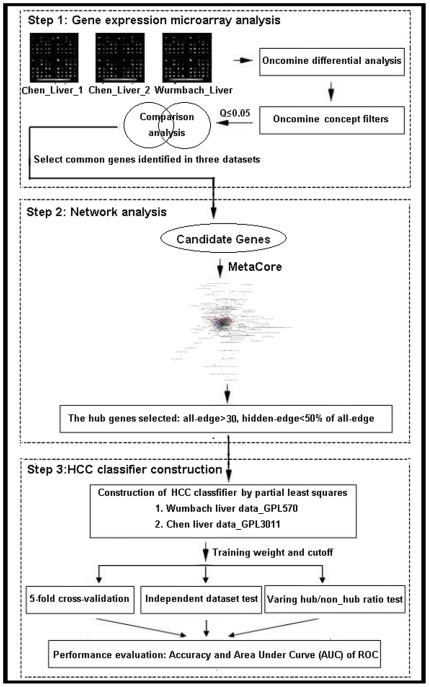
Figure 1. A schematic diagram of this novel systems biology-based gene expression classifier for HCC diagnosis.
First, the genes differentially expressed in HCC tissues relative to their corresponding non-tumor tissues were filtered by a corrected Q value cut-off and Concept filters in the Oncomine platform. The identified genes that are common among different microarray datasets were chosen as the candidate genes. Then, their networks were analyzed by GeneGO Meta-Core software and the hub genes were chosen. After that, HCC diagnostic classifier was constructed by PLS modeling based on the microarray gene expression data of the hub genes. Finally, the diagnostic performance of this classifier was evaluated by predictive accuracy and area under ROC curve.
Figure 2
Figure 2
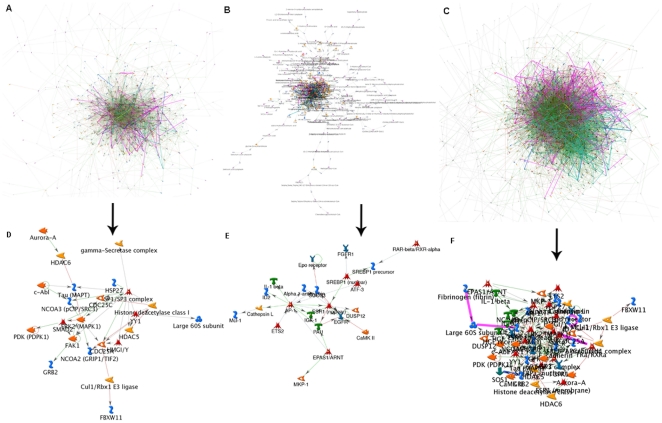
Network for upregulated genes (A), downregulated genes (B) and all differentially expressed genes (C). Hub-based network view of 10 upregulated hub genes (D), 7 downregulated hub genes (E) and 27 differentially expressed hub genes (F). GeneGO MetaCore was used to generate a network of direct connections among genes selected for analysis. Red, green, and gray arrows indicate negative, positive, and unspecified effects, respectively. Hubs were identified as having more than thirty connections and less than 50% of edges hidden within the network.
Figure 3
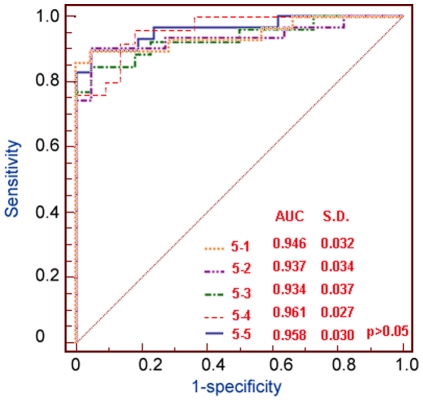
Figure 3. ROC curves for 5-fold cross-validations against the golden standard datasets.
Each point on the ROC curve denotes the sensitivity and specificity against a set of weights and score threshold. Different colors are used to distinguish the curves of classifier in cross-validations for five times. AUC values are also presented in the figure. Sensitivity and specificity are computed during the 5-fold cross-validations (see text for details).
Figure 4
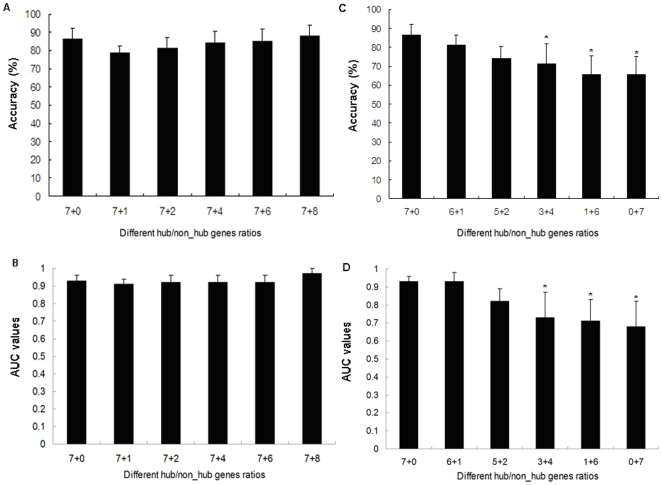
Figure 4. Performance of HCC classifier (Classifier 2) with adding new non-hub genes (A for predictive accuracy and B for AUC values) and with different ratios of hub and non-hub genes (C for predictive accuracy and D for AUC values).
A and B showed that the predictive performance of the classifier does not change significantly with the non-hub genes being added (p>0.05); C and D indicated that the classifier worked much less properly with the hub genes being gradually reduced and non-hub genes gradually increased. Especially, the predictive performance of the classifier was decreased with statistic significance when the proportion of hub genes was reduced to 3/7 of the original one (*p<0.05).
Figure 5
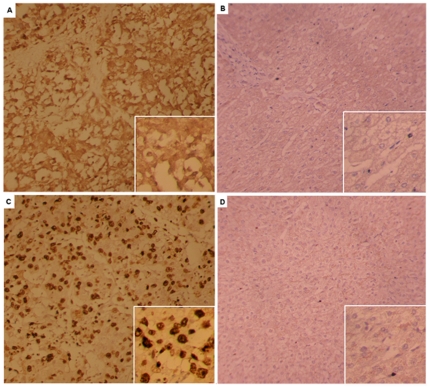
Figure 5. Immunohistochemical staining for MAPK1 and NCOA2 (Original magnification×200).
A, MAPK1 expression was found in cell cytoplasm and/or nucleus at various levels in HCC tissues; B, MAPK1 staining was negative in paracarcinomatous liver tissues; C, NCOA2 expression was found in nucleus of tumor cells at various levels in HCC tissues; D, NCOA2 staining was negative in paracarcinomatous liver tissues.

References

    1. Hoshida Y, Villanueva A, Kobayashi M, Peix J, Chiang DY, et al. Gene expression in fixed tissues and outcome in hepatocellular carcinoma. N Engl J Med. 2008;359:1995–2004. - PMC - PubMed
    1. Sherman M. Recurrence of hepatocellular carcinoma. N Engl J Med. 2008;359:2045–2047. - PubMed
    1. Sakamoto M, Mori T, Masugi Y, Effendi K, Rie I, et al. Candidate molecular markers for histological diagnosis of early hepatocellular carcinoma. Intervirology. 2008;(Suppl 1):42–45. - PubMed
    1. Ikoma J, Kaito M, Ishihara T, Nakagawa N, Kamei A, et al. Early diagnosis of hepatocellular carcinoma using a sensitive assay for serum des-gamma-carboxy prothrombin: a prospective study. Hepatogastroenterology. 2002;49:235–238. - PubMed
    1. Song PM, Zhang Y, He YF, Bao HM, Luo JH, et al. Bioinformatics analysis of metastasis-related proteins in hepatocellular carcinoma. World J Gastroenterol. 2008;14:5816–5822. - PMC - PubMed

Publication types

MeSH terms

Substances