


Prediction of dengue incidence using search query surveillance
- PMID: 21829744
- PMCID: PMC3149016
- DOI: 10.1371/journal.pntd.0001258
Prediction of dengue incidence using search query surveillance
Abstract
Background: The use of internet search data has been demonstrated to be effective at predicting influenza incidence. This approach may be more successful for dengue which has large variation in annual incidence and a more distinctive clinical presentation and mode of transmission.
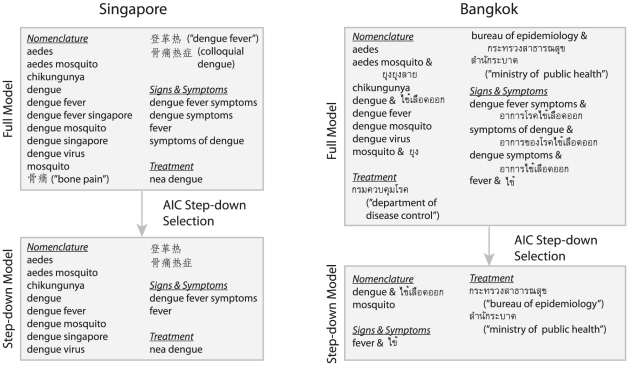
Methods: We gathered freely-available dengue incidence data from Singapore (weekly incidence, 2004-2011) and Bangkok (monthly incidence, 2004-2011). Internet search data for the same period were downloaded from Google Insights for Search. Search terms were chosen to reflect three categories of dengue-related search: nomenclature, signs/symptoms, and treatment. We compared three models to predict incidence: a step-down linear regression, generalized boosted regression, and negative binomial regression. Logistic regression and Support Vector Machine (SVM) models were used to predict a binary outcome defined by whether dengue incidence exceeded a chosen threshold. Incidence prediction models were assessed using r² and Pearson correlation between predicted and observed dengue incidence. Logistic and SVM model performance were assessed by the area under the receiver operating characteristic curve. Models were validated using multiple cross-validation techniques.
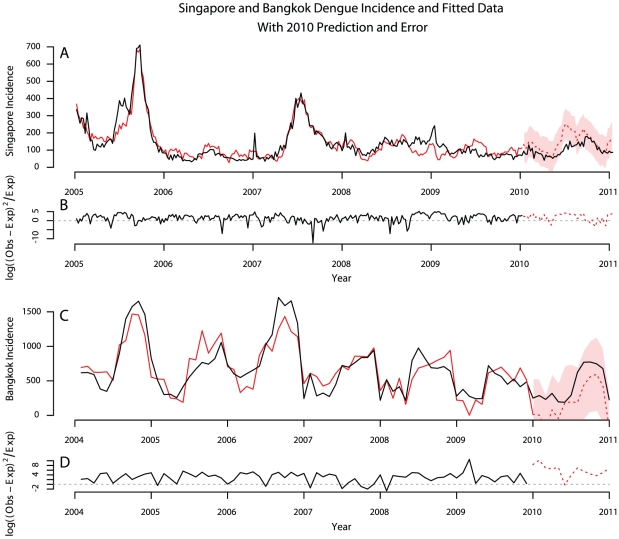
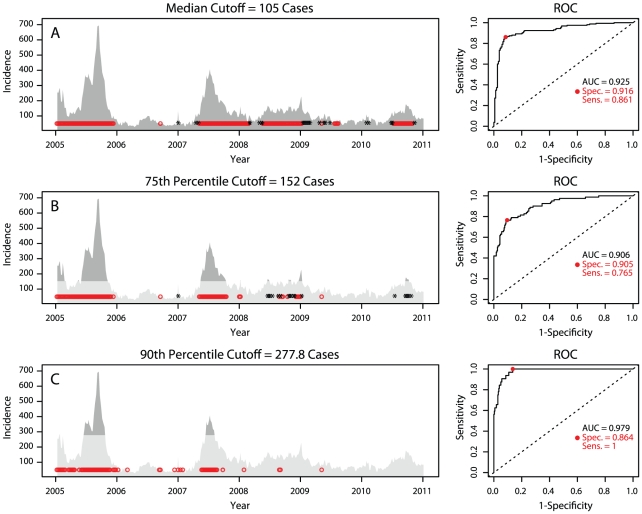
Results: The linear model selected by AIC step-down was found to be superior to other models considered. In Bangkok, the model has an r² = 0.943, and a correlation of 0.869 between fitted and observed. In Singapore, the model has an r² = 0.948, and a correlation of 0.931. In both Singapore and Bangkok, SVM models outperformed logistic regression in predicting periods of high incidence. The AUC for the SVM models using the 75th percentile cutoff is 0.906 in Singapore and 0.960 in Bangkok.
Conclusions: Internet search terms predict incidence and periods of large incidence of dengue with high accuracy and may prove useful in areas with underdeveloped surveillance systems. The methods presented here use freely available data and analysis tools and can be readily adapted to other settings.
Conflict of interest statement
The authors have declared that no competing interests exist.
Figures
References
-
- Ginsberg J, Mohebbi MH, Patel RS, Brammer L, Smolinski MS, et al. Detecting inuenza epidemics using search engine query data. Nature. 2009;457:1012–4. - PubMed
-
- Johnson HA, Wagner MM, Hogan WR, Chapman W, Olszewski RT, et al. Analysis of web access logs for surveillance of inuenza. Stud Health Technol Inform. 2004;107:1202–6. - PubMed
-
- Polgreen PM, Chen Y, Pennock DM, Nelson FD. Using internet searches for inuenza surveillance. Clinical Infectious Diseases. 2008;47:1443–1448. - PubMed
Publication types
MeSH terms
Grants and funding
LinkOut - more resources
Full Text Sources
Other Literature Sources
Medical
