. 2011 Dec 1;440(2):195-202.
doi: 10.1042/BJ20110876.

The yeast ABC transporter Pdr18 (ORF YNR070w) controls plasma membrane sterol composition, playing a role in multidrug resistance

Affiliations

The yeast ABC transporter Pdr18 (ORF YNR070w) controls plasma membrane sterol composition, playing a role in multidrug resistance

Tânia R Cabrito et al. Biochem J. .

Abstract

The action of multidrug efflux pumps in MDR (multidrug resistance) acquisition has been proposed to partially depend on the transport of physiological substrates which may indirectly affect drug partition and transport across cell membranes. In the present study, the PDR18 gene [ORF (open reading frame) YNR070w], encoding a putative PDR (pleiotropic drug resistance) transporter of the ATP-binding cassette superfamily, was found to mediate plasma membrane sterol incorporation in yeast. The physiological role of Pdr18 is demonstrated to affect plasma membrane potential and is proposed to underlie its action as a MDR determinant, conferring resistance to the herbicide 2,4-D (2,4-dichlorophenoxyacetic acid). The action of Pdr18 in yeast tolerance to 2,4-D, which was found to contribute to reduce [(14)C]2,4-D intracellular accumulation, may be indirect, given the observation that 2,4-D exposure deeply affects the sterol plasma membrane composition, this effect being much stronger in a Δpdr18 background. PDR18 activation under 2,4-D stress is regulated by the transcription factors Nrg1, controlling carbon source availability and the stress response, and, less significantly, Yap1, involved in oxidative stress and MDR, and Pdr3, a key regulator of the yeast PDR network, consistent with a broad role in stress defence. Taken together, the results of the present study suggest that Pdr18 plays a role in plasma membrane sterol incorporation, this physiological trait contributing to an MDR phenotype.


Figures
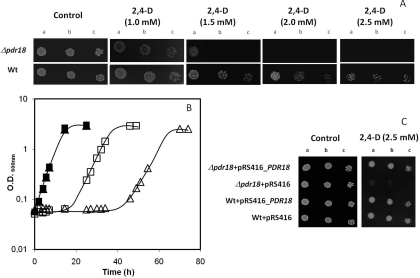
Figure 1
Figure 1. Comparison of the susceptibility to 2,4-D of S. cerevisiae BY4741 and the derived deletion mutant Δpdr18, through cultivation in liquid medium (B) or spot assays (A and C)
(A) Spot assays were carried out as described in the Experimental section. The cell suspensions used to prepare the spots in lanes b and c were 1:5 and 1:25 serial dilutions respectively of the suspensions with a D600=0.05±0.005 spotted in lane a. Pictures were taken after 2 days of incubation. (B) Growth curves of wild-type (wt) (■,□), and Δpdr18 (▲,Δ) cells in MM4 liquid medium, pH 3.5 (■,▲) or in this medium supplemented with 0.45 mM 2,4-D (□,Δ). Cells of the inocula were grown in the absence of the herbicide and the growth curves are representative of at least three independent experiments. (C) Spot assays were carried as described in the Experimental section. The cell suspensions used to prepare the spots in lanes b and c were 1:5 and 1:25 serial dilutions respectively of the suspensions with an D600=0.05±0.005 spotted in lane a. Pictures were taken after 4 days of incubation.
Figure 2
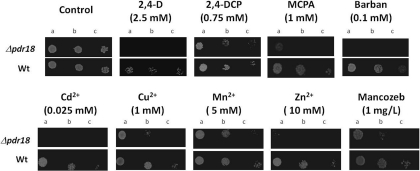
Figure 2. Susceptibility to the herbicides 2,4-D, MCPA and barban, to 2,4-DCP, to the agricultural fungicide mancozeb, and to the metal ions Zn2+, Mn2+, Cu2+ and Cd2+ induced stress of the deletion mutant Δpdr18 compared with the wild-type, assessed by spot assays
Cells used for the spot assays were prepared as described in the Experimental section. The cell suspensions used to prepare the spots in lanes b and c were 1:5 and 1:25 serial dilutions respectively, of the suspensions with an D600=0.05±0.005 spotted in lane a. Pictures were taken after 2 or 3 days of incubation. wt, wild-type.
Figure 3
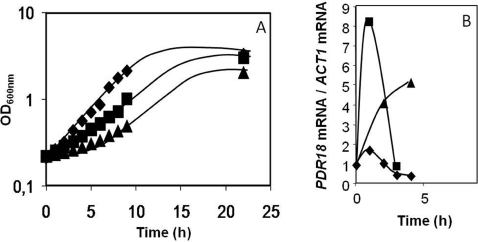
Figure 3. PDR18 transcript levels in yeast cells exposed to 2,4-D-imposed stress
(A) Comparison of the susceptibility to 2,4-D-induced stress of S. cerevisiae parental strain BY4741 exposed to 0 (◆), 0.3 (■) or 0.45 (▲) mM 2,4-D through cultivation in MM4 liquid medium (pH 3.5). Cells used to prepare the inocula were previously grown in the absence of 2,4-D until mid-exponential phase. Growth curves are representative of at least three independent growth experiments. (B) Comparison of the relative transcript values of PDR18 mRNA/ACT1 mRNA, in cells of parental strain BY4741 during the period of adaptation to 2,4-D by RT–PCR. The PDR18 mRNA value for the control conditions (0 h, unsupplemented medium) was set as 1 and the remaining values were relative values. Values are the means±S.D. for at least three independent experiments.
Figure 4
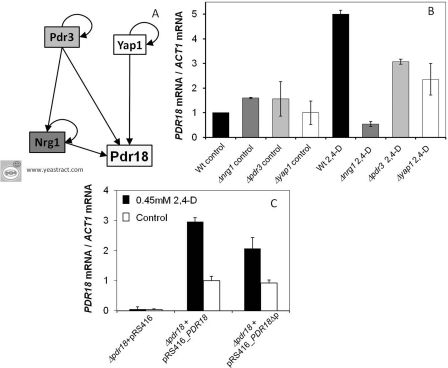
Figure 4. PDR18 expression regulation under 2,4-D-imposed stress
(A) Representation of the putative regulatory network controlling PDR18 transcription, according to the information in the YEASTRACT database (http://www.yeastract.com). (B) Relative values of PDR18 mRNA in wild-type strain (wt) and Δnrg1, Δpdr3 and Δyap1 mutant cells before and 4 h following a yeast cell population exposure to 0.45 mM 2,4-D. The relative value of mRNA for the wild-type strain immediately before exposure to the herbicide (control) was set as 1. Values are means±S.D. for at least three independent experiments. (C) Relative values of PDR18 mRNA in Δpdr18 cells transformed with pRS416_PDR18, pRS416_PDR18Δp or the corresponding empty vector before and 4 h following a yeast cell population exposure to 0.45 mM 2,4-D. The relative value of mRNA for the Δpdr18 strain, harbouring the pRS416_PDR18 plasmid, immediately before exposure to the herbicide was set as 1. Values are means±S.D. for at least three independent experiments.
Figure 5
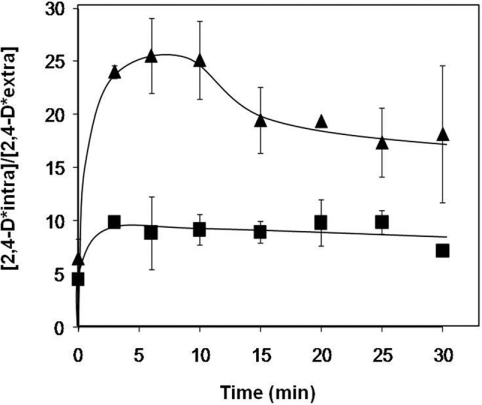
Figure 5. Accumulation of [14C]2,4-D
Comparison of [14C]2,4-D accumulation in non-adapted cells of S. cerevisiae BY4741 (■) and the derived deletion mutant Δpdr18 (▲), during cultivation for 30 min in MM4 liquid medium (pH 3.5) supplemented with 0.3 mM non-radioactive 2,4-D (Sigma) and 0.5 μM [14C]2,4-D. The accumulation [2,4-D* intra/2,4-D* extra] values are the means±S.D. for at least three independent experiments.
Figure 6
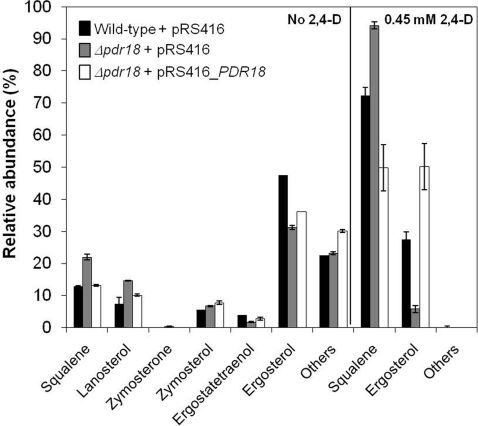
Figure 6. PDR18 expression affects plasma membrane sterol composition
Comparison of the relative abundance of sterol content in yeast plasma membrane of the S. cerevisiae BY4741 strain and the derived deletion mutant Δpdr18 harbouring the PDR18 expression plasmid or the corresponding empty vector, both grown under control conditions or after 1 h of exposure to 0.45 mM 2,4-D, measured by GC-MS. Values are means±S.D. for at least three independent experiments.
Figure 7
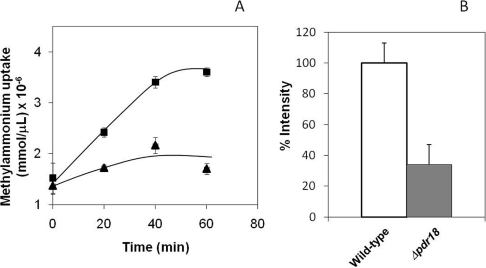
Figure 7. PDR18 gene expression is important to maintain plasma membrane potential in yeast cells
(A) Time-course accumulation of [14C]methylammonium was followed during incubation of S. cerevisiae BY4741 (■) and the derived deletion mutant Δpdr18 (▲), at 30°C, in growth MM4 liquid medium (pH 3.5), supplemented with the radiolabelled ammonium analogue. Relative levels of [14C]methylammonium, assessed as described in the Experimental section, are means±S.D. for at least three independent experiments. (B) Comparison of the average membrane potential using the fluorescent probe DiCO6(3). Values of membrane potential are set as the percentage of the value obtained for wild-type cells and are means±S.D. for at least three independent experiments.

References

    1. Roepe P. D., Wei L. Y., Hoffman M. M., Fritz F. Altered drug translocation mediated by the MDR protein: direct, indirect, or both? J. Bioenerg. Biomembr. 1996;28:541–555. - PubMed
    1. Sá-Correia I., Santos S., Teixeira M., Cabrito T., Mira N. Drug:H+ antiporters in chemical stress response in yeast. Trends Microbiol. 2009;17:22–31. - PubMed
    1. Jungwirth H., Kuchler K. Yeast ABC transporters: a tale of sex, stress, drugs and aging. FEBS Lett. 2006;580:1131–1138. - PubMed
    1. Tomitori H., Kashiwagi K., Asakawa T., Kakinuma Y., Michael A. J., Igarashi K. Multiple polyamine transport systems on the vacuolar membrane in yeast. Biochem. J. 2001;353:681–688. - PMC - PubMed
    1. Teixeira M. C., Cabrito T. R., Hanif Z. M., Vargas R. C., Tenreiro S., Sá-Correia I. Yeast response and tolerance to polyamine toxicity involving the drug:H+ antiporter Qdr3 and the transcription factors Yap1 and Gcn4. Microbiology. 2011;157:945–956. - PubMed

Publication types

MeSH terms