. 2011 Aug 23;108(34):14342-7.
doi: 10.1073/pnas.1111695108. Epub 2011 Aug 10.

ATP-activated P2X2 current in mouse spermatozoa

Affiliations

ATP-activated P2X2 current in mouse spermatozoa

Betsy Navarro et al. Proc Natl Acad Sci U S A. .

Abstract

Sperm cells acquire hyperactivated motility as they ascend the female reproductive tract, which enables them to overcome barriers and penetrate the cumulus and zona pellucida surrounding the egg. This enhanced motility requires Ca(2+) entry via cation channel of sperm (CatSper) Ca(2+)-selective ion channels in the sperm tail. Ca(2+) entry via CatSper is enhanced by the membrane hyperpolarization mediated by Slo3, a K(+) channel also present in the sperm tail. To date, no transmitter-mediated currents have been reported in sperm and no currents have been detected in the head or midpiece of mature spermatozoa. We screened a number of neurotransmitters and biomolecules to examine their ability to induce ion channel currents in the whole spermatozoa. Surprisingly, we find that none of the previously reported neurotransmitter receptors detected by antibodies alone are functional in mouse spermatozoa. Instead, we find that mouse spermatozoa have a cation-nonselective current in the midpiece of spermatozoa that is activated by external ATP, consistent with an ATP-mediated increase in intracellular Ca(2+) as previously reported. The ATP-dependent current is not detected in mice lacking the P2X2 receptor gene (P2rx2(-/-)). Furthermore, the slowly desensitizing and strongly outwardly rectifying ATP-gated current has the biophysical and pharmacological properties that mimic heterologously expressed mouse P2X2. We conclude that the ATP-induced current on mouse spermatozoa is mediated by the P2X2 purinergic receptor/channel. Despite the loss of ATP-gated current, P2rx2(-/-) spermatozoa have normal progressive motility, hyperactivated motility, and acrosome reactions. However, fertility of P2rx2(-/-) males declines with frequent mating over days, suggesting that P2X2 receptor adds a selection advantage under these conditions.


Conflict of interest statement

The authors declare no conflict of interest.

Figures
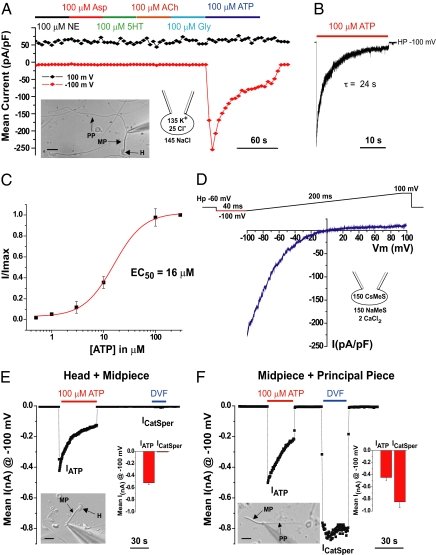
Fig. 1.
Fig. 1.
ATP gates a mouse spermatozoan channel. (A) Responses to saturating concentrations of neurotransmitters: glycine, serotonin, norepinephrine, aspartate, acetylcholine, and ATP. Currents were evoked by 1-s voltage ramps from −100 to 100 mV applied every 4 s from a holding potential of −60 mV. Black diamonds are average currents at +100 mV; red diamonds are average currents at −100 mV (n = 6). ACh, acetylcholine; Asp, aspartate; Gly, glycine; HP, holding potential; 5-HT, serotonin; NE, norepinephrine. (Inset) Differential interference contrast (DIC) image of the whole spermatozoa under patch clamp showing the head, midpiece, and principal piece. H, head; MP, midpiece; PP, principal piece. (Scale bar: 10 μM.) (B) Fast-activating and slowly desensitizing (τ = 24 ± 4 s; n = 6) current evoked by ATP in a sperm cell held at −100 mV. (C) ATP concentration–response curve. Data points were fitted with the Hill equation. EC50 = 16 μM ATP (n = 8). I/Imax = ratio of measured current to maximum current. (D) Representative IATP in response to voltage ramp. Vm, membrane voltage. (E) IATP recordings from the head plus midpiece fragment. nA, nanoAmperes. (Inset) DIC image, summary histogram (n = 5). ICatSper, specific to the tail fragment, is not present in the head plus the midpiece. (F) ICatSper and IATP were recorded from the midpiece plus the principal piece. (Inset) DIC image, summary histogram (n = 4).
Fig. 2.
Fig. 2.
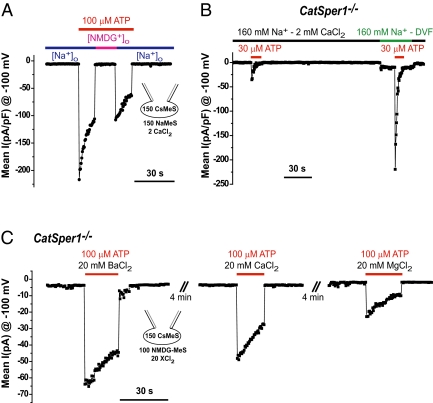
Cationic nonselective divalent-permeant IATP. (A) No significant IATP was seen when extracellular cations (Na+ and Ca2+) were replaced by NMDG-Cl. (B) Reduction of extracellular divalent cations (Ca2+) in the DVF solution increased the monovalent (Na+) current activated by ATP. (C) Divalent cationic currents elicited by ATP. IATP conducted Ba2+ > Ca2+ > Mg2+, consistent with P2X ion channels.
Fig. 3.
Fig. 3.
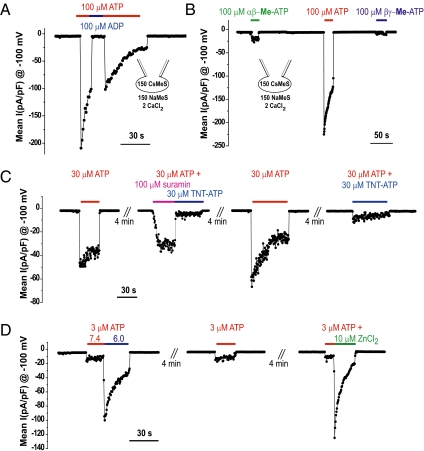
Pharmacological characterization of IATP. (A) Fast exchange perfusion system application of ATP analogs. ATP activated IATP, which was not activated when ADP replaced ATP. Short ramp protocol (200 ms from −100 to 100 mV, holding potential = −60 mV) was applied every 0.5 s. pA; pF. (B) α,β-Methylene–ATP and β,γ-methylene–ATP evoked currents were 7% and 4% of those evoked by ATP. αβ-Me, α,β-methylene; βγ-Me, β,γ-methylene. (C) Block of IATP by 100 μM suramin was 44 ± SEM% compared with ∼90% block by 30 μM trinitrophenyl-ATP (TNT-ATP). (D) Acid pH (6.0) and 10 μM Zn2+ potentiated IATP approximately fivefold in mouse sperm cells (n = 5).
Fig. 4.
Fig. 4.
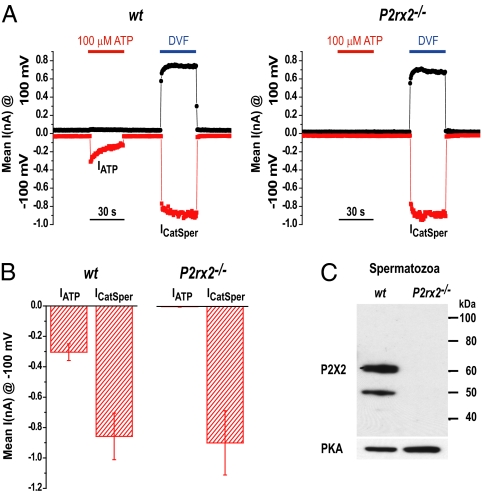
Absence of IATP in P2rx2−/− spermatozoa. (A) Spermatozoa (wt and P2rx2−/− ) were recorded blinded to genotype. ICatSper and IATP are from a 400-ms voltage ramp from −100 to 100 mV every 0.5 s (holding potential = 0 mV). Each symbol represents the current amplitude at −100 mV (red squares) and +100 mV (black circles). (B) Average IATP and ICatSper measured from wt (−319 ± 54 pA and −858 ± 153 pA, respectively; n = 7) and P2rx2−/− (−1.2 ± 4 pA and −898 ± 200 pA, respectively; n = 5) sperm cells. pA. (C) Sperm cell lysates from wt and P2rx2−/− mice were analyzed by Western blotting using anti-P2X2 antibody. Protein kinase A regulatory subunit type II was the loading control. PKA, protein kinase A.

References

    1. Carlson AE, et al. CatSper1 required for evoked Ca2+ entry and control of flagellar function in sperm. Proc Natl Acad Sci USA. 2003;100:14864–14868. - PMC - PubMed
    1. Kirichok Y, Navarro B, Clapham DE. Whole-cell patch-clamp measurements of spermatozoa reveal an alkaline-activated Ca2+ channel. Nature. 2006;439:737–740. - PubMed
    1. Qi H, et al. All four CatSper ion channel proteins are required for male fertility and sperm cell hyperactivated motility. Proc Natl Acad Sci USA. 2007;104:1219–1223. - PMC - PubMed
    1. Ren D, et al. A sperm ion channel required for sperm motility and male fertility. Nature. 2001;413:603–609. - PMC - PubMed
    1. Lishko PV, Botchkina IL, Kirichok Y. Progesterone activates the principal Ca2+ channel of human sperm. Nature. 2011;471:387–391. - PubMed

Publication types

LinkOut - more resources