


ATP-activated P2X2 current in mouse spermatozoa
- PMID: 21831833
- PMCID: PMC3161588
- DOI: 10.1073/pnas.1111695108
ATP-activated P2X2 current in mouse spermatozoa
Abstract
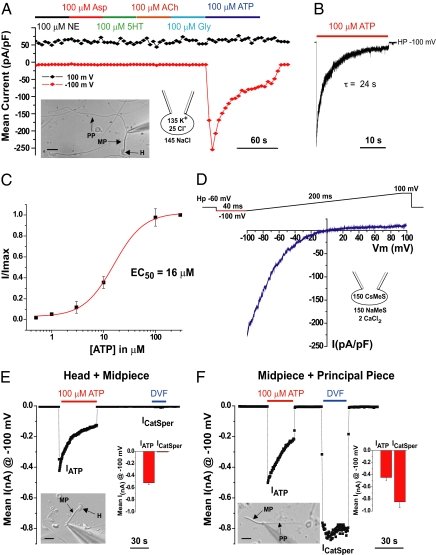
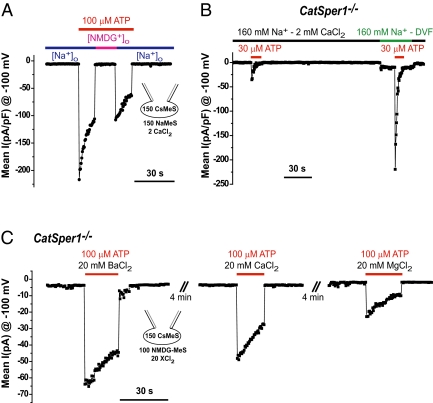
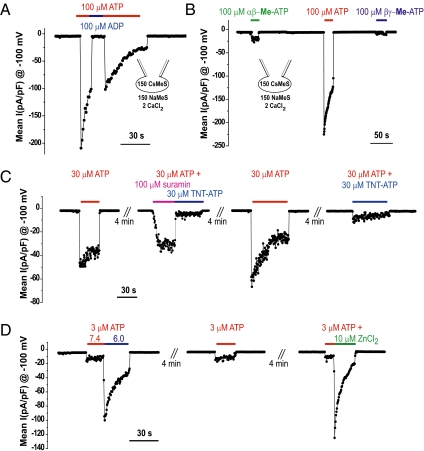
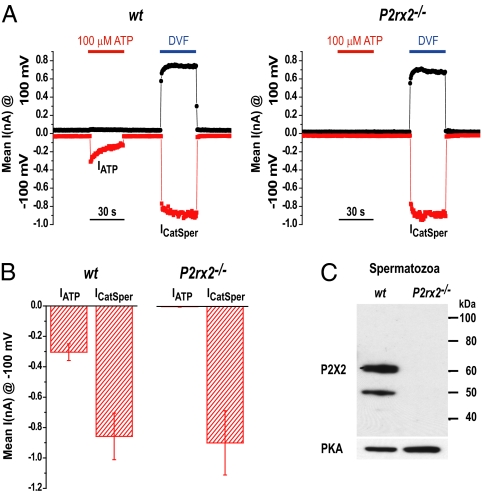
Sperm cells acquire hyperactivated motility as they ascend the female reproductive tract, which enables them to overcome barriers and penetrate the cumulus and zona pellucida surrounding the egg. This enhanced motility requires Ca(2+) entry via cation channel of sperm (CatSper) Ca(2+)-selective ion channels in the sperm tail. Ca(2+) entry via CatSper is enhanced by the membrane hyperpolarization mediated by Slo3, a K(+) channel also present in the sperm tail. To date, no transmitter-mediated currents have been reported in sperm and no currents have been detected in the head or midpiece of mature spermatozoa. We screened a number of neurotransmitters and biomolecules to examine their ability to induce ion channel currents in the whole spermatozoa. Surprisingly, we find that none of the previously reported neurotransmitter receptors detected by antibodies alone are functional in mouse spermatozoa. Instead, we find that mouse spermatozoa have a cation-nonselective current in the midpiece of spermatozoa that is activated by external ATP, consistent with an ATP-mediated increase in intracellular Ca(2+) as previously reported. The ATP-dependent current is not detected in mice lacking the P2X2 receptor gene (P2rx2(-/-)). Furthermore, the slowly desensitizing and strongly outwardly rectifying ATP-gated current has the biophysical and pharmacological properties that mimic heterologously expressed mouse P2X2. We conclude that the ATP-induced current on mouse spermatozoa is mediated by the P2X2 purinergic receptor/channel. Despite the loss of ATP-gated current, P2rx2(-/-) spermatozoa have normal progressive motility, hyperactivated motility, and acrosome reactions. However, fertility of P2rx2(-/-) males declines with frequent mating over days, suggesting that P2X2 receptor adds a selection advantage under these conditions.
Conflict of interest statement
The authors declare no conflict of interest.
Figures
References
-
- Kirichok Y, Navarro B, Clapham DE. Whole-cell patch-clamp measurements of spermatozoa reveal an alkaline-activated Ca2+ channel. Nature. 2006;439:737–740. - PubMed
-
- Lishko PV, Botchkina IL, Kirichok Y. Progesterone activates the principal Ca2+ channel of human sperm. Nature. 2011;471:387–391. - PubMed
Publication types
MeSH terms
Substances
Grants and funding
LinkOut - more resources
Full Text Sources
Molecular Biology Databases
Miscellaneous
