


Bladder dysfunction in diabetes mellitus
- PMID: 21833175
- PMCID: PMC3153010
- DOI: 10.3389/fphar.2010.00136
Bladder dysfunction in diabetes mellitus
Abstract
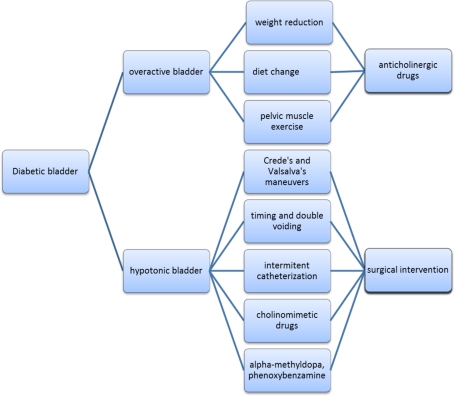
Diabetic cystopathy is a well-recognized complication of diabetes mellitus, which usually develops in middle-aged or elderly patients with long-standing and poorly controlled disease. It may have broad spectrum clinical presentations. Patients may be asymptomatic, or have a wide variety of voiding complaints from overactive bladder and urge incontinence to decreased bladder sensation and overflow incontinence. This review focuses on pathophysiological mechanisms responsible for urologic complications of diabetes and emphasizing on recent developments in our understanding of this condition. We also tried to shed some light on therapeutic modalities like behavioral, pharmacological, and surgical approaches.
Keywords: cystopathy; diabetes; incontinence; neurogenic bladder.
Figures
References
-
- Abrams P., Andersson K. E., Buccafusco J. J., Chapple C., de Groat W. C., Fryer A. D., Kay G., Laties A., Nathanson N. M., Pasricha P. J., Wein A. J. (2006). Muscarinic receptors: their distribution and function in body systems, and the implications for treating overactive bladder. Br. J. Pharmacol. 148, 565–578 - PMC - PubMed
-
- Apodaca G., Kiss S., Ruiz W., Meyers S., Zeidel M., Birder L. (2003). Disruption of bladder epithelium barrier function after spinal cord injury. Am. J. Physiol. Renal Physiol. 284, F966–F976 - PubMed
-
- Biastre K., Burnakis T. (2009). Trospium chloride treatment of overactive bladder. Ann. Pharmacother. 43, 283–295 - PubMed
LinkOut - more resources
Full Text Sources
