


Constructing agency: the role of language
- PMID: 21833227
- PMCID: PMC3153776
- DOI: 10.3389/fpsyg.2010.00162
Constructing agency: the role of language
Abstract
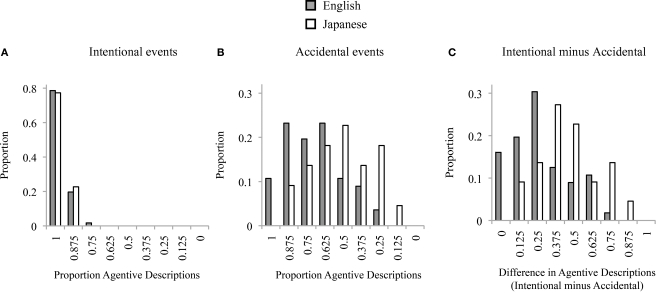
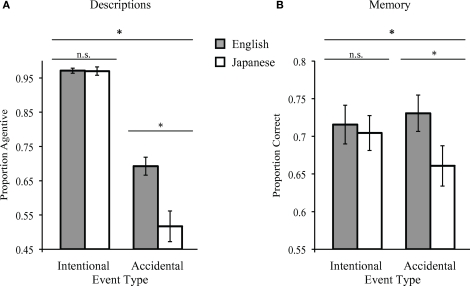
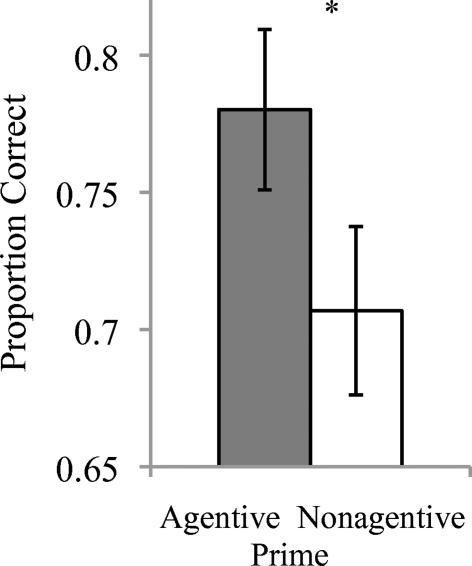
Is agency a straightforward and universal feature of human experience? Or is the construction of agency (including attention to and memory for people involved in events) guided by patterns in culture? In this paper we focus on one aspect of cultural experience: patterns in language. We examined English and Japanese speakers' descriptions of intentional and accidental events. English and Japanese speakers described intentional events similarly, using mostly agentive language (e.g., "She broke the vase"). However, when it came to accidental events English speakers used more agentive language than did Japanese speakers. We then tested whether these different patterns found in language may also manifest in cross-cultural differences in attention and memory. Results from a non-linguistic memory task showed that English and Japanese speakers remembered the agents of intentional events equally well. However, English speakers remembered the agents of accidents better than did Japanese speakers, as predicted from patterns in language. Further, directly manipulating agency in language during another laboratory task changed people's eye-witness memory, confirming a possible causal role for language. Patterns in one's linguistic environment may promote and support how people instantiate agency in context.
Keywords: accident; agents; causality; culture; events; eye-witness memory; language.
Figures
References
-
- Billman D., Krych M. (1998). “Path and manner verbs in action: effects of “skipping” or “exiting” on event memory,” in Proceedings of the 20th annual meeting of the Cognitive Science Society. Mahwah, NJ: Lawrence Erlbaum Associates
-
- Bohnemeyer J., Enfield N., Essegbey J., Kita S. (2010). “The macro-event property: the segmentation of causal chains,” in Event Representation in Language and Cognition, eds Bohnemeyer J., Pederson E. (Cambridge: Cambridge University Press; ), 43–67
-
- Boroditsky L., Schmidt L., Phillips W. (2003). “Sex, syntax, and semantics,” in Language in Mind: Advances in the Study of Language and Thought, eds Gentner D., Goldin-Meadow S. (Cambridge, MA: MIT Press; ), 61–79
LinkOut - more resources
Full Text Sources
