Review
. 2011 Nov;17(33):3729-40.
doi: 10.2174/138161211798220918.

Cytokine signaling modulates blood-brain barrier function

Affiliations
Review

Cytokine signaling modulates blood-brain barrier function

Weihong Pan et al. Curr Pharm Des. 2011 Nov.

Abstract

The blood-brain barrier (BBB) provides a vast interface for cytokines to affect CNS function. The BBB is a target for therapeutic intervention. It is essential, therefore, to understand how cytokines interact with each other at the level of the BBB and how secondary signals modulate CNS functions beyond the BBB. The interactions between cytokines and lipids, however, have not been fully addressed at the level of the BBB. Here, we summarize current understanding of the localization of cytokine receptors and transporters in specific membrane microdomains, particularly lipid rafts, on the luminal (apical) surface of the microvascular endothelial cells composing the BBB. We then illustrate the clinical context of cytokine effects on the BBB by neuroendocrine regulation and amplification of inflammatory signals. Two unusual aspects discussed are signaling crosstalk by different classes of cytokines and genetic regulation of drug efflux transporters. We also introduce a novel area of focus on how cytokines may act through nuclear hormone receptors to modulate efflux transporters and other targets. A specific example discussed is the ATP-binding cassette transporter-1 (ABCA-1) that regulates lipid metabolism. Overall, cytokine signaling at the level of the BBB is a crucial feature of the dynamic regulation that can rapidly change BBB function and affect brain health and disease.


Figures
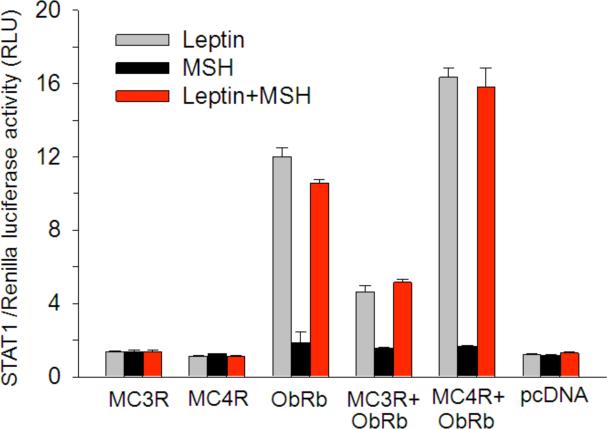
Fig. (1)
Fig. (1)
Effects of leptin and αMSH on STAT1 activation in HEK293 cells transfected with MC3R, MC4R, ObRb or control pcDNA plasmids. Leptin induced STAT1 activation only in cells overexpressing ObRb. MSH alone had no effect on STAT1 activation. Co-transfection of MC3R or MC4R along with ObRb plasmid had differential effects on leptin-induced STAT1 activity in that MC3R overexpression decreased, whereas MC4R overexpression increased, leptin-induced STAT1. The same change was seen in cells treated with both leptin and αMSH (n = 3 /group).
Fig. (2)
Fig. (2)
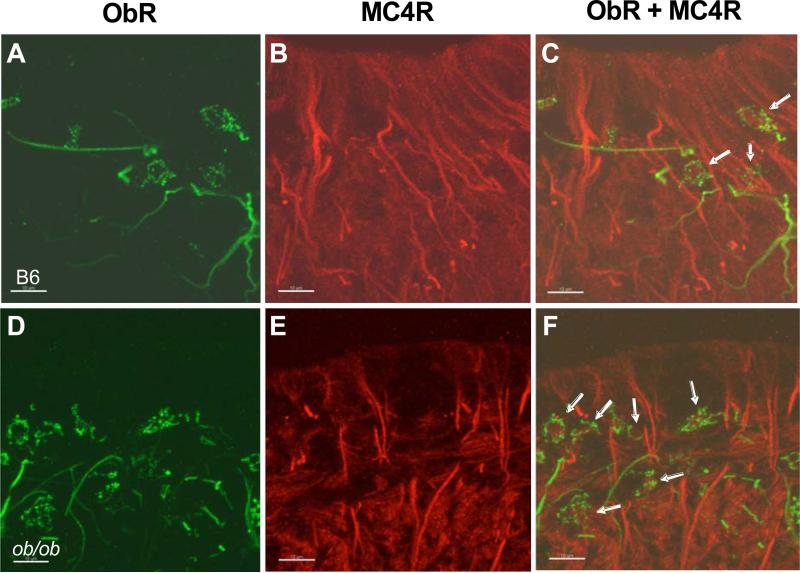
Confocal imaging showing the coexistence of MC4R and ObR in the median eminence of the mouse hypothalamus. MC4R (red) expression exhibited intense fiber-like staining and intermittent diffuse signaling in both wildtype (A) and ob/ob (D) mice. ObR (green) expression in wildtype mice (B) showed fiber and membrane-localized punctate staining, whereas ObR staining in ob/ob mice was more intense (E). The merged picture of MC4R and ObR staining shows the coexistence of both receptors in neuron-like cells (arrows) in the median eminence of both wildtype (C) and ob/ob mice (F). Scale bar: 10 μm.
Fig. (3)
Fig. (3)
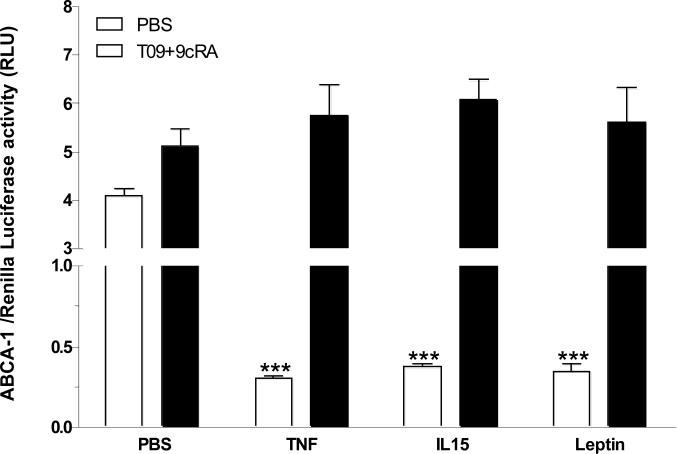
Effect of cytokines on ABCA-1 transporter promoter activity in RBE4 cells transfected with ABCA-1 luciferase promoter and control Renilla luciferase plasmids. Basal activity was significantly reduced when the cells were treated with TNF (5ng/ml), IL-15 (5ng/ml), or leptin 0.8μg/ml for 6 h (empty bars). Co-treatment of the cells with LXR ligand T0901317 (T09; 1 μM) and RXR ligand 9-cis retinoic acid (9cRA; 100 nM) induced a small but significant increase of ABCA-1 promoter activity in the phosphate-buffered saline (PBS) control group. Cytokine treatment did not affect this activation pattern (solid bars). ***: p < 0.005 in comparison with vehicle treatment (n = 3 /group).
Fig. (4)
Fig. (4)
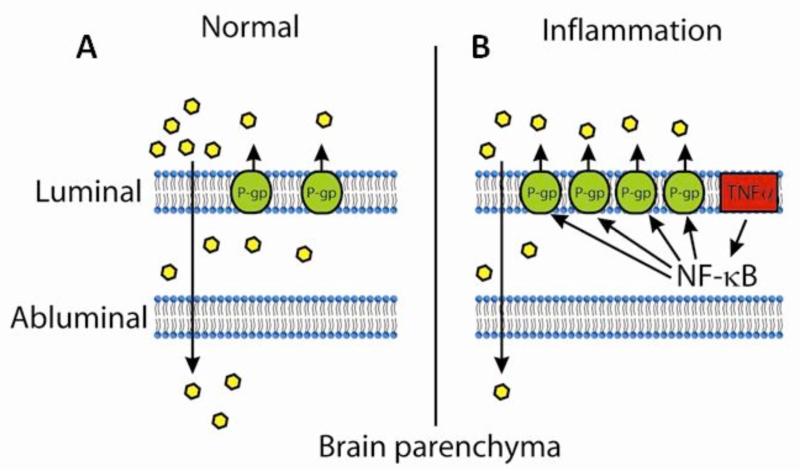
Schematic representation of regulation of P-gp during inflammation: Under normal physiological conditions, P-gp present on the luminal side of the BBB limits the brain uptake of drugs. In inflammatory diseases, TNF-α activates NFκB, which leads to transcriptional activation of P-gp. This leads to increased activity of P-gp and in turn causes further decrease in the brain penetration of drugs.

References

    1. Begley DJ. Peptides and the blood-brain barrier: the status of our understanding. Ann NY Acad Sci. 1994;739:89–100. - PubMed
    1. Abbott NJ. Dynamics of CNS barriers: evolution, differentiation, and modulation. Cell Mol Neurobiol. 2005;25(1):5–23. - PMC - PubMed
    1. Abbott NJ, Patabendige AA, Dolman DE, Yusof SR, Begley DJ. Structure and function of the blood-brain barrier. Neurobiol Dis. 2010;37(1):13–25. - PubMed
    1. Neuwelt EA. Mechanisms of disease: the blood-brain barrier. Neurosurgery. 2004;54(1):131–40. - PubMed
    1. Minn A, Ghersi-Egea JF, Perrin R, Leininger B, Siest G. Drug metabolizing enzymes in the brain and cerebral microvessels. Brain Res Brain Res Rev. 1991;16(1):65–82. - PubMed

Publication types

MeSH terms