. 2011 Aug 11:9:133.
doi: 10.1186/1479-5876-9-133.

Characterization and targeting of phosphatidylinositol-3 kinase (PI3K) and mammalian target of rapamycin (mTOR) in renal cell cancer

Affiliations

Characterization and targeting of phosphatidylinositol-3 kinase (PI3K) and mammalian target of rapamycin (mTOR) in renal cell cancer

Aymen A Elfiky et al. J Transl Med. .

Abstract

Background: PI3K and mTOR are key components of signal transduction pathways critical for cell survival. Numerous PI3K inhibitors have entered clinical trials, while mTOR is the target of approved drugs for metastatic renal cell carcinoma (RCC). We characterized expression of p85 and p110α PI3K subunits and mTOR in RCC specimens and assessed pharmacologic co-targeting of these molecules in vitro.

Methods: We employed tissue microarrays containing 330 nephrectomy cases using a novel immunofluorescence-based method of Automated Quantitative Analysis (AQUA) of in situ protein expression. In RCC cell lines we assessed synergism between PI3K and mTOR inhibitors and activity of NVP-BEZ235, which co-targets PI3K and mTOR.

Results: p85 expression was associated with high stage and grade (P < 0.0001 for both). High p85 and high mTOR expression were strongly associated with decreased survival, and high p85 was independently prognostic on multi-variable analysis. Strong co-expression of both PI3K subunits and mTOR was found in the human specimens. The PI3K inhibitor LY294002 and rapamycin were highly synergistic in all six RCC cell lines studied. Similar synergism was seen with all rapamycin concentrations used. NVP-BEZ235 inhibited RCC cell growth in vitro with IC(50)s in the low ηM range and resultant PARP cleavage.

Conclusions: High PI3K and mTOR expression in RCC defines populations with decreased survival, suggesting that they are good drug targets in RCC. These targets tend to be co-expressed, and co-targeting these molecules is synergistic. NVP-BEZ235 is active in RCC cells in vitro; suggesting that concurrent PI3K and mTOR targeting in RCC warrants further investigation.


Figures
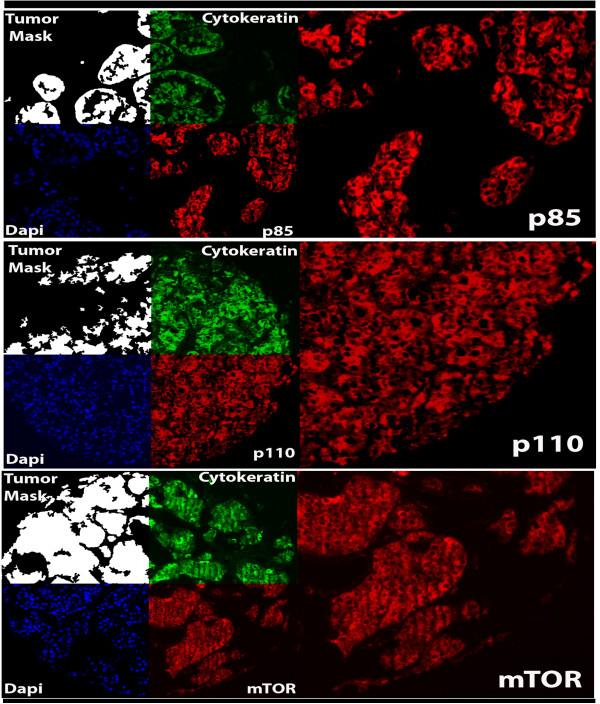
Figure 1
Figure 1
Automated, Quantitative Analysis (AQUA) of expression of p85, p110α and mTOR in renal cell carcinoma. AQUA uses cytokeratin to create a tumor mask (two upper left quadrants at × 10). Cytokeratin staining was cytoplasmic and the mask is made by filling in holes (lower left quadrants on left). 4', 6-diamidino-2-phenylindole (DAPI) defines the nuclear compartment within the tumor mask, which is then subtracted from the tumor mask to create a cytoplasmic compartment within the tumor mask. Target expression (A - p85, B - p110α and C - mTOR) expression is measured within the cytoplasmic compartments, within the tumor mask (lower right quadrants), and each clinical case is assigned a score based on pixel intensity per unit area within the tumor mask. Squares on right show × 40 magnification. in the tissue microarray. The correlation with p110α was particularly strong.
Figure 2
Figure 2
Associations between marker expression and clinical/pathological variables. (A) Associations between target expression (p85, p110α and mTOR) and histologic subtype. Expression of all three targets was higher in sarcomatoid tumors. (B) Associations between target expression and tumor stage and Fuhrman grade. p85 and mTOR were associated with high grade and p85 with high stage. p110α levels were not associated with stage or grade. (C) Kaplan-Meier survival curves of quartiles of AQUA scores for the three targets. High levels of both p85 and mTOR were associated with decreased survival.
Figure 3
Figure 3
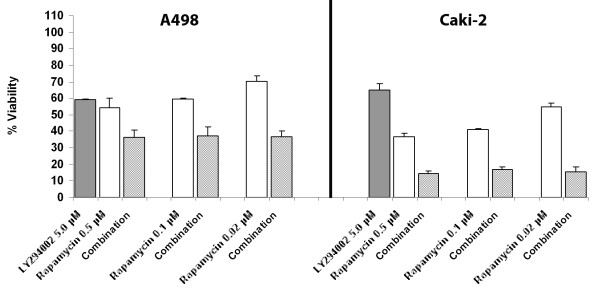
Synergism between PI3K and mTOR inhibition. Cell viability assays in A498 (A) and Caki-2 cells (B): Cells were treated with LY294002 alone, rapamycin alone (at three concentrations) or the combination of LY294002 and rapamycin. The combinations were highly synergistic, with similar viability seen for all three concentrations of rapamycin used. There was no significant difference between the different combination therapies (p > 0.5 for all).
Figure 4
Figure 4
Effects of NVP-BEZ235 on renal cell carcinoma cells in vitro. Targets of NVP-BEZ235, p-P70S6K, p-Akt and p-S6 were decreased in Caki-1, 769-P, A498 and 786-0 cells with exposure to the drug. Cells were exposed to 0.1 and 1.0 μM NVP-BEZ235, or DMSO (vehicle) for 4 and 24 hours. β-actin is shown as a loading control.

References

    1. Motzer RJ, Bander NH, Nanus DM. Renal-cell carcinoma. N Engl J Med. 1996;335:865–875. doi: 10.1056/NEJM199609193351207. - DOI - PubMed
    1. Vogelzang NJ, Stadler WM. Kidney cancer. Lancet. 1998;352:1691–1696. doi: 10.1016/S0140-6736(98)01041-1. - DOI - PubMed
    1. Pantuck AJ, Zisman A, Belldegrun AS. The changing natural history of renal cell carcinoma. J Urol. 2001;166:1611–1623. doi: 10.1016/S0022-5347(05)65640-6. - DOI - PubMed
    1. Ruckle T, Schwarz MK, Rommel C. PI3Kgamma inhibition: towards an 'aspirin of the 21st century'? Nat Rev Drug Discov. 2006;5:903–918. doi: 10.1038/nrd2145. - DOI - PubMed
    1. SEER Cancer Statistics Review, 1975-2008

Publication types

MeSH terms