


Malaria elimination in Isabel Province, Solomon Islands: establishing a surveillance-response system to prevent introduction and reintroduction of malaria
- PMID: 21834995
- PMCID: PMC3175476
- DOI: 10.1186/1475-2875-10-235
Malaria elimination in Isabel Province, Solomon Islands: establishing a surveillance-response system to prevent introduction and reintroduction of malaria
Abstract
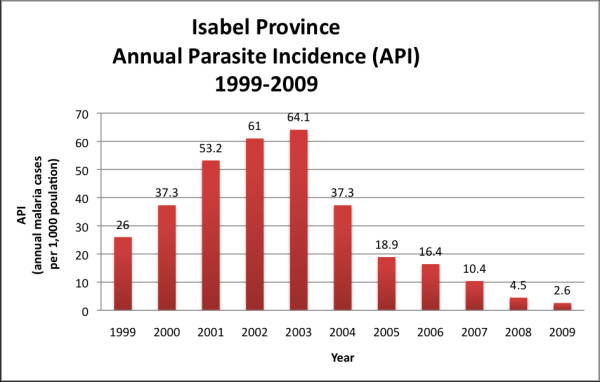
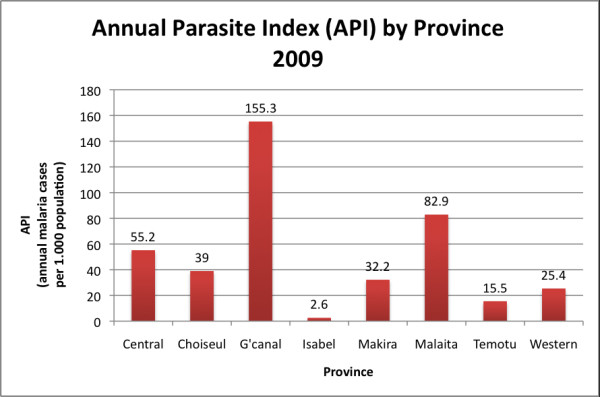
Background: The Solomon Islands National Malaria Programme is currently focused on intensified control and progressive elimination. Recent control efforts in Isabel Province have reduced their malaria incidence to 2.6/1,000 population in 2009 1 whereas most neighbouring provinces have much higher incidences. A malaria surveillance-response system that involves testing all travellers entering Isabel Province using rapid diagnostic tests (RDT) to prevent cases being imported had been proposed by local health authorities. This study provides information on the feasibility and acceptability of implementing a new approach of surveillance and response in the context of low levels of indigenous malaria transmission in Isabel Province.
Methods: A total of 13 focus group discussions (FGD) and 22 key informant interviews (KII) were conducted in Isabel Province, Solomon Islands. Key topics included: the travel patterns of people to, from and within Isabel Province; the acceptability, community perceptions, attitudes and suggestions towards the proposed surveillance programme; and management of suspected malaria cases. This information was triangulated with data obtained from port authorities, airlines and passenger ships travelling to and from Isabel Province in the preceding two years.
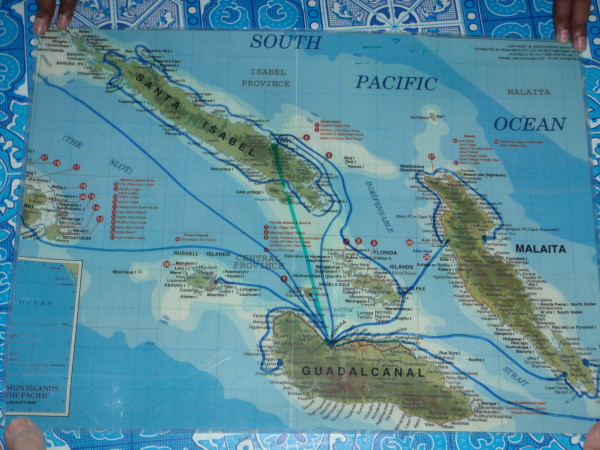
Results: Travel within Isabel Province and to and from other provinces is common with marked seasonality. The majority of inter-provincial travel is done on scheduled public transport; namely passenger ships and aircrafts. In Isabel Province there is a healthy community spirit as well as high concern regarding malaria and its importation and there is currently effective malaria passive case detection and management. Conducting malaria screening at ports and airports would be acceptable to the community.
Conclusion: A robust surveillance-response system is essential when moving towards malaria elimination. Many factors contribute positively towards the feasibility of an RDT based malaria surveillance system in Isabel Province. Due to financial and logistical restraints local health authorities have concluded that a system of community-based vigilance to identify new arrivals in villages and direct them to have malaria testing is more feasible than formal screening at ports and airports. A surveillance response system to prevent introduction of malaria into Isabel Province can be integrated into the National Malaria Control Programme provided the operational steps are carefully planned with regards to human and financial resources.
Figures
References
-
- NVBDCP. Solomon Islands National Vector Borne Diseases Control Programme Programmatic Report 2009. Honiara; 2009.
-
- WHO. World malaria report 2009. Geneva: World Health Organization; 2009. World Health Organization.
-
- World Health Organization Regional Office for the Western Pacific. Solomon Islands: Health Situation and Trend. http://www.wpro.who.int/countries/sol/2009/
-
- PacMISC. Pacific Malaria Initiative Support Centre; Annual Report July 2008 - June 2009. Prepared for the National Malaria Programs in Solomon Islands and Vanuatu. 2009.
-
- Pacific Malaria Initiative Support Centre. Discussion Paper: How best to measure progress towards elimination? Monitoring, Surveillance and Evaluation for Malaria Elimination in Solomon Islands and Vanuatu 2008-2014. 2009.
Publication types
MeSH terms
LinkOut - more resources
Full Text Sources
Medical
