


Review
doi: 10.1016/j.micinf.2011.07.007.
Epub 2011 Jul 28.
The role of microRNAs in Epstein-Barr virus latency and lytic reactivation
Affiliations
- PMID: 21835261
- PMCID: PMC4911174
- DOI: 10.1016/j.micinf.2011.07.007
Item in Clipboard
Review
The role of microRNAs in Epstein-Barr virus latency and lytic reactivation
Microbes Infect.
2011 Dec.
Abstract
Oncogenic viruses reprogram host gene expression driving proliferation, ensuring survival, and evading the immune response. The recent appreciation of microRNAs (miRNAs) as small non-coding RNAs that broadly regulate gene expression has provided new insight into this complex scheme of host control. This review highlights the role of viral and cellular miRNAs during the latent and lytic phases of the EBV life cycle.
Copyright © 2011 Institut Pasteur. Published by Elsevier Masson SAS. All rights reserved.
Figures
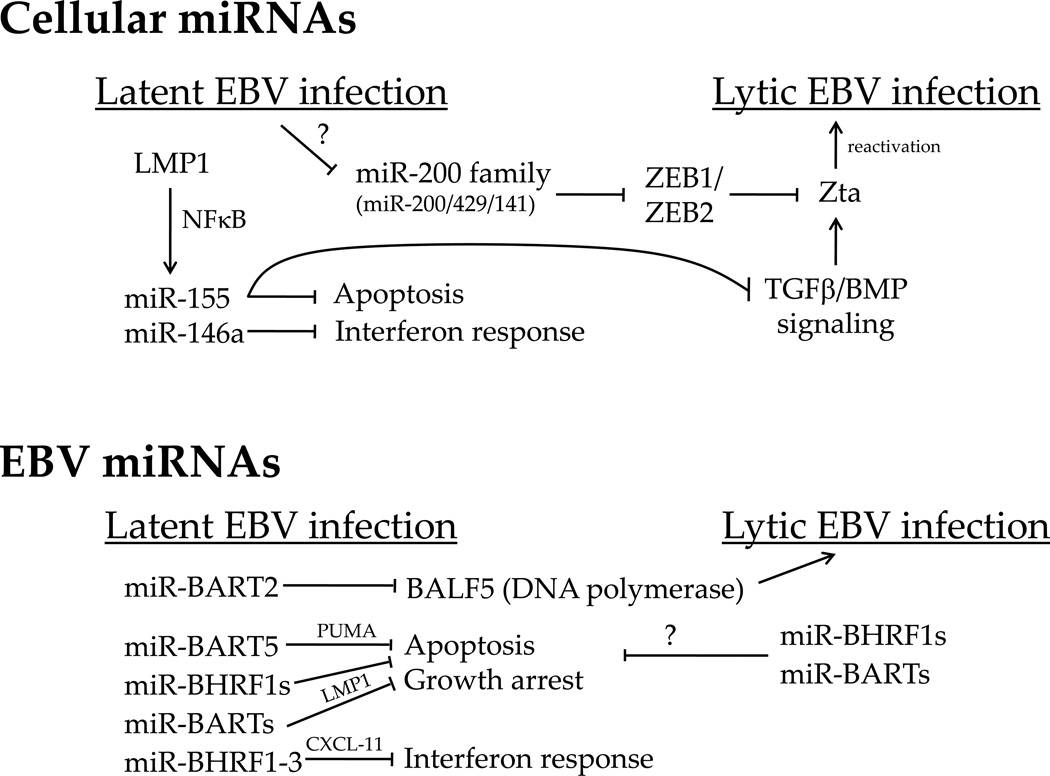
The names above inhibitory arrows are targets of the given miRNA (e.g. miR-BHRF1-3 and CXCL-11). Question marks indicate unknown mechanisms of action or speculative activities (such as the EBV miRNAs suppressing apoptosis during lytic reactivation). These interactions are largely derived from work in B cells, although they may be true in epithelial cells as well (e.g. miR-200 family and ZEB interaction, miR-BART5 and PUMA interaction, and miR-155 and BMP interaction).
References
-
- Garzon R, Calin GA, Croce CM. MicroRNAs in Cancer. Annu. Rev. Med. 2009;60:167–179. - PubMed
-
- Lewis BP, Burge CB, Bartel DP. Conserved seed pairing, often flanked by adenosines, indicates that thousands of human genes are microRNA targets. Cell. 2005;120:15–20. - PubMed
-
- Kieff E, Rickinson A. Epstein-Barr virus and its replication. In: Knipe DM, Howley PM, editors. Fields Virology. Philadelphia: Lippincott, Williams, and Wilkins; 2006. pp. 2603–2654.
Publication types
MeSH terms
Substances
Grants and funding
LinkOut - more resources
Full Text Sources
