


Novel adenoviruses in wild primates: a high level of genetic diversity and evidence of zoonotic transmissions
- PMID: 21835802
- PMCID: PMC3187507
- DOI: 10.1128/JVI.00810-11
Novel adenoviruses in wild primates: a high level of genetic diversity and evidence of zoonotic transmissions
Abstract
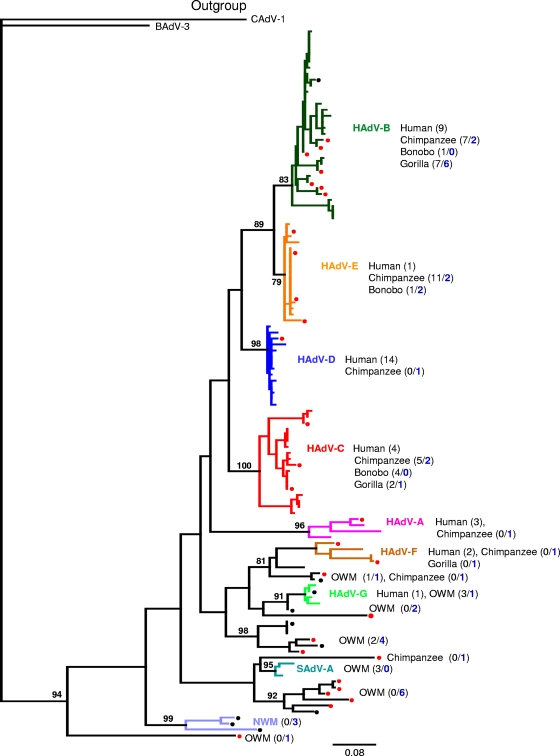
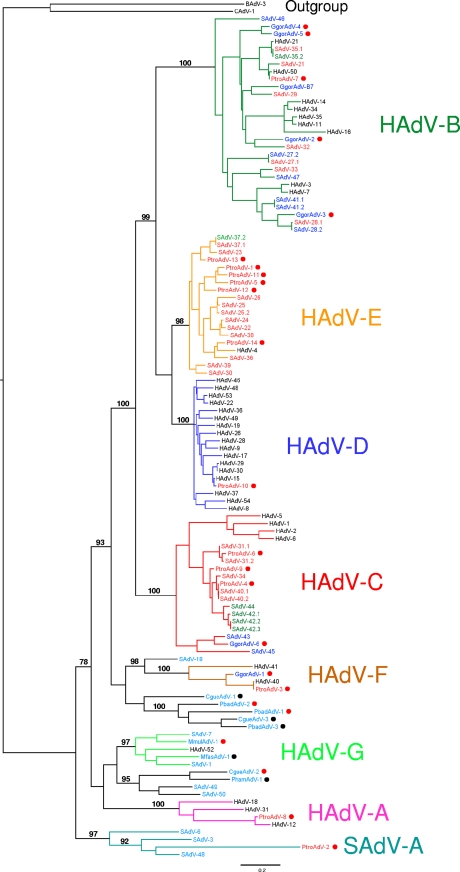
Adenoviruses (AdVs) broadly infect vertebrate hosts, including a variety of nonhuman primates (NHPs). In the present study, we identified AdVs in NHPs living in their natural habitats, and through the combination of phylogenetic analyses and information on the habitats and epidemiological settings, we detected possible horizontal transmission events between NHPs and humans. Wild NHPs were analyzed with a pan-primate AdV-specific PCR using a degenerate nested primer set that targets the highly conserved adenovirus DNA polymerase gene. A plethora of novel AdV sequences were identified, representing at least 45 distinct AdVs. From the AdV-positive individuals, 29 nearly complete hexon genes were amplified and, based on phylogenetic analysis, tentatively allocated to all known human AdV species (Human adenovirus A to Human adenovirus G [HAdV-A to -G]) as well as to the only simian AdV species (Simian adenovirus A [SAdV-A]). Interestingly, five of the AdVs detected in great apes grouped into the HAdV-A, HAdV-D, HAdV-F, or SAdV-A clade. Furthermore, we report the first detection of AdVs in New World monkeys, clustering at the base of the primate AdV evolutionary tree. Most notably, six chimpanzee AdVs of species HAdV-A to HAdV-F revealed a remarkably close relationship to human AdVs, possibly indicating recent interspecies transmission events.
Figures
References
-
- Andrewes C. A. 1989. Adenoviridae, p. 249–282. In Porterfield J. S. (ed.), Andrewes' viruses of vertebrates, 5th ed Bailliere Tindall, London, United Kingdom
-
- Arandjelovic M., et al. 2010. Effective non-invasive genetic monitoring of multiple wild western gorilla groups. Biol. Conserv. 143:1780–1791
-
- Bányai K., et al. 2010. Molecular detection of novel adenoviruses in fecal specimens of captive monkeys with diarrhea in China. Vet. Microbiol. 142:416–419 - PubMed
-
- Banyai K., et al. 2009. Searching for HAdV-52, the putative gastroenteritis-associated human adenovirus serotype in Southern Hungary. New Microbiol. 32:185–188 - PubMed
Publication types
MeSH terms
Substances
LinkOut - more resources
Full Text Sources
Other Literature Sources
Medical
