


Making electronic prescribing alerts more effective: scenario-based experimental study in junior doctors
- PMID: 21836158
- PMCID: PMC3197997
- DOI: 10.1136/amiajnl-2011-000199
Making electronic prescribing alerts more effective: scenario-based experimental study in junior doctors
Abstract
Objective: Expert authorities recommend clinical decision support systems to reduce prescribing error rates, yet large numbers of insignificant on-screen alerts presented in modal dialog boxes persistently interrupt clinicians, limiting the effectiveness of these systems. This study compared the impact of modal and non-modal electronic (e-) prescribing alerts on prescribing error rates, to help inform the design of clinical decision support systems.
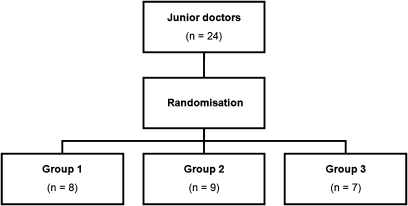
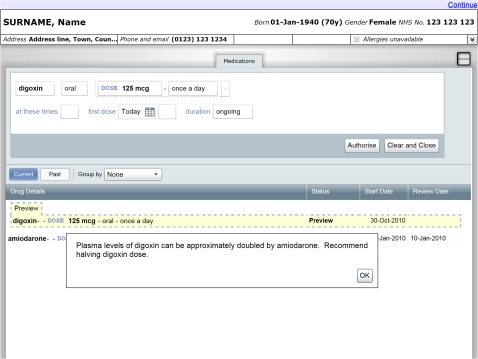
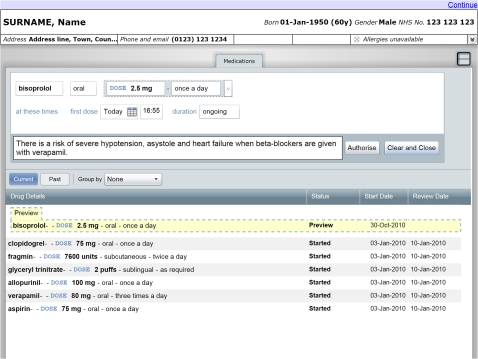
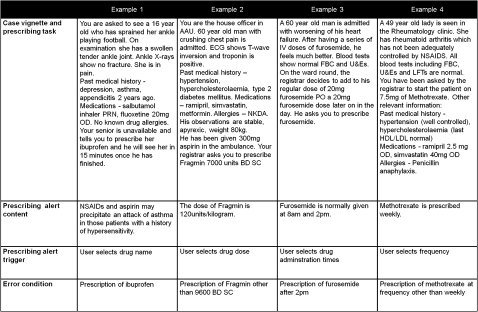
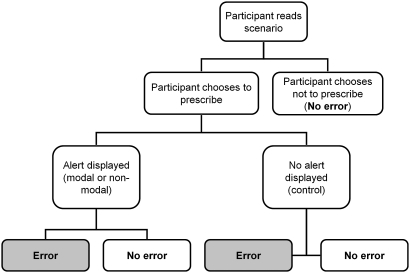
Design: A randomized study of 24 junior doctors each performing 30 simulated prescribing tasks in random order with a prototype e-prescribing system. Using a within-participant design, doctors were randomized to be shown one of three types of e-prescribing alert (modal, non-modal, no alert) during each prescribing task.
Measurements: The main outcome measure was prescribing error rate. Structured interviews were performed to elicit participants' preferences for the prescribing alerts and their views on clinical decision support systems.
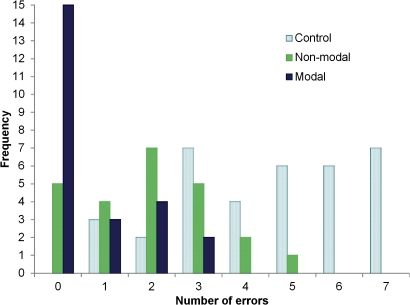
Results: Participants exposed to modal alerts were 11.6 times less likely to make a prescribing error than those not shown an alert (OR 11.56, 95% CI 6.00 to 22.26). Those shown a non-modal alert were 3.2 times less likely to make a prescribing error (OR 3.18, 95% CI 1.91 to 5.30) than those not shown an alert. The error rate with non-modal alerts was 3.6 times higher than with modal alerts (95% CI 1.88 to 7.04).
Conclusions: Both kinds of e-prescribing alerts significantly reduced prescribing error rates, but modal alerts were over three times more effective than non-modal alerts. This study provides new evidence about the relative effects of modal and non-modal alerts on prescribing outcomes.
Conflict of interest statement
Figures
References
-
- National Patient Safety Agency Patient Safety Incident Reports in the NHS National Reporting and Learning System Quarterly Data Summary—England. Issue 14. 2009. www.nrls.npsa.nhs.uk/resources/collections/quarterly-data-summaries/?ent... (accessed Oct 2010).
-
- Ashcroft D, Heathfield H, Lewis P. An in Depth Investigation into Causes of Prescribing Errors by Foundation Trainees in Relation to their Medical Education - EQUIP Study. www.gmc-uk.org/FINAL_Report_prevalence_and_causes_of_prescribing_errors.... (accessed Oct 2010).
-
- Sanders J, Esmail A. The frequency and nature of medical error in primary care: understanding the diversity across studies. Fam Pract 2003;20:231–6 - PubMed
-
- Smith J. Building a Safer National Health System for Patients: Improving Medication Safety. Department of Health, 2004. www.dh.gov.uk/en/Publicationsandstatistics/Publications/PublicationsPoli... (accessed Oct 2010).
Publication types
MeSH terms
LinkOut - more resources
Full Text Sources
Medical
