Sir2 histone deacetylase prevents programmed cell death caused by sustained activation of the Hog1 stress-activated protein kinase
- PMID: 21836634
- PMCID: PMC3185340
- DOI: 10.1038/embor.2011.154
Sir2 histone deacetylase prevents programmed cell death caused by sustained activation of the Hog1 stress-activated protein kinase
Abstract
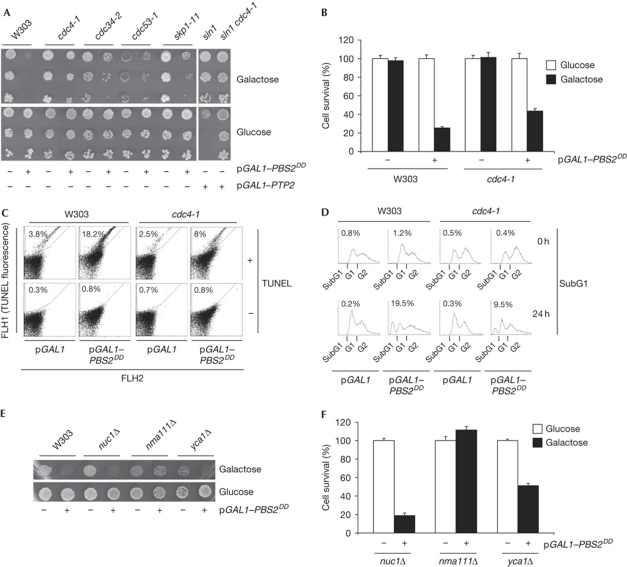
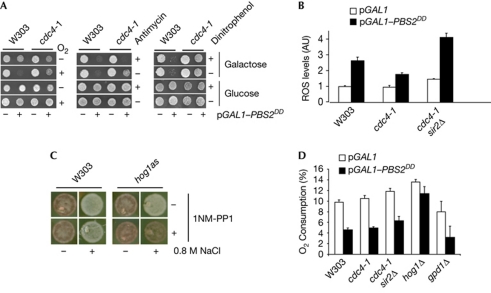
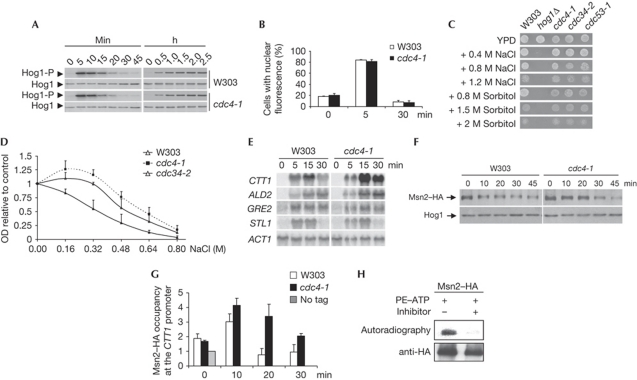
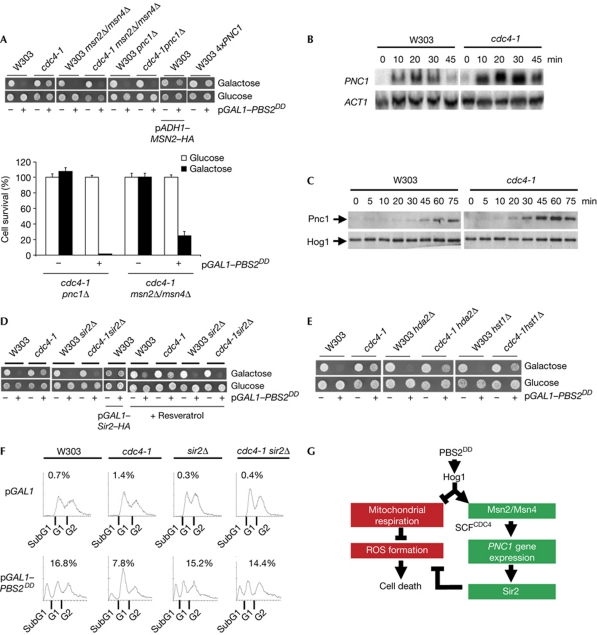
Exposure of yeast to high osmolarity induces a transient activation of the Hog1 stress-activated protein kinase (SAPK), which is required for cell survival under these conditions. However, sustained activation of the SAPK results in a severe growth defect. We found that prolonged SAPK activation leads to cell death, which is not observed in nma111 cells, by causing accumulation of reactive oxygen species (ROS). Mutations of the SCF(CDC4) ubiquitin ligase complex suppress cell death by preventing the degradation of Msn2 and Msn4 transcription factors. Accumulation of Msn2 and Msn4 leads to the induction of PNC1, which is an activator of the Sir2 histone acetylase. Sir2 is involved in protection against Hog1-induced cell death and can suppress Hog1-induced ROS accumulation. Therefore, cell death seems to be dictated by the balance of ROS induced by Hog1 and the protective effect of Sir2.
Conflict of interest statement
The authors declare that they have no conflict of interest.
Figures
References
-
- Aparicio OM, Billington BL, Gottschling DE (1991) Modifiers of position effect are shared between telomeric and silent mating-type loci in S. cerevisiae. Cell 66: 1279–1287 - PubMed
-
- Bitterman KJ, Anderson RM, Cohen HY, Latorre-Esteves M, Sinclair DA (2002) Inhibition of silencing and accelerated aging by nicotinamide, a putative negative regulator of yeast Sir2 and human SIRT1. J Biol Chem 277: 45099–45107 - PubMed
-
- Carmona-Gutierrez D, Eisenberg T, Büttner S, Meisinger C, Kroemer G, Madeo F (2010) Apoptosis in yeast: triggers, pathways, subroutines. Cell Death Diff 17: 763–773 - PubMed