


Weight-bearing asymmetry during sit-stand transitions related to impairment and functional mobility after total knee arthroplasty
- PMID: 21839986
- PMCID: PMC4526185
- DOI: 10.1016/j.apmr.2011.05.010
Weight-bearing asymmetry during sit-stand transitions related to impairment and functional mobility after total knee arthroplasty
Abstract
Objectives: To examine changes in weight-bearing (WB) asymmetry during sit-stand transitions for individuals during the first 6 months after unilateral total knee arthroplasty (TKA). Relationships between WB asymmetry, clinical measures of knee impairment, and functional mobility also were evaluated.
Design: Prospective repeated-measures design.
Setting: Clinical research laboratory.
Participants: People (N=36) with knee osteoarthritis (OA) scheduled to undergo unilateral TKA and a control (CTL) group (N=17 healthy people) were enrolled.
Intervention: The TKA group participated in acute, home, and outpatient phases of exercise-based rehabilitation.
Main outcome measures: WB asymmetry measured during a 5-Times Sit-to-Stand Test (FTSST) based on average vertical ground reaction force under each foot, self-reported knee pain using a numerical pain rating scale, knee active range of motion symmetry, knee extensor strength symmetry, FTSST time, 6-minute walk test distance, and Stair Climbing Test time.
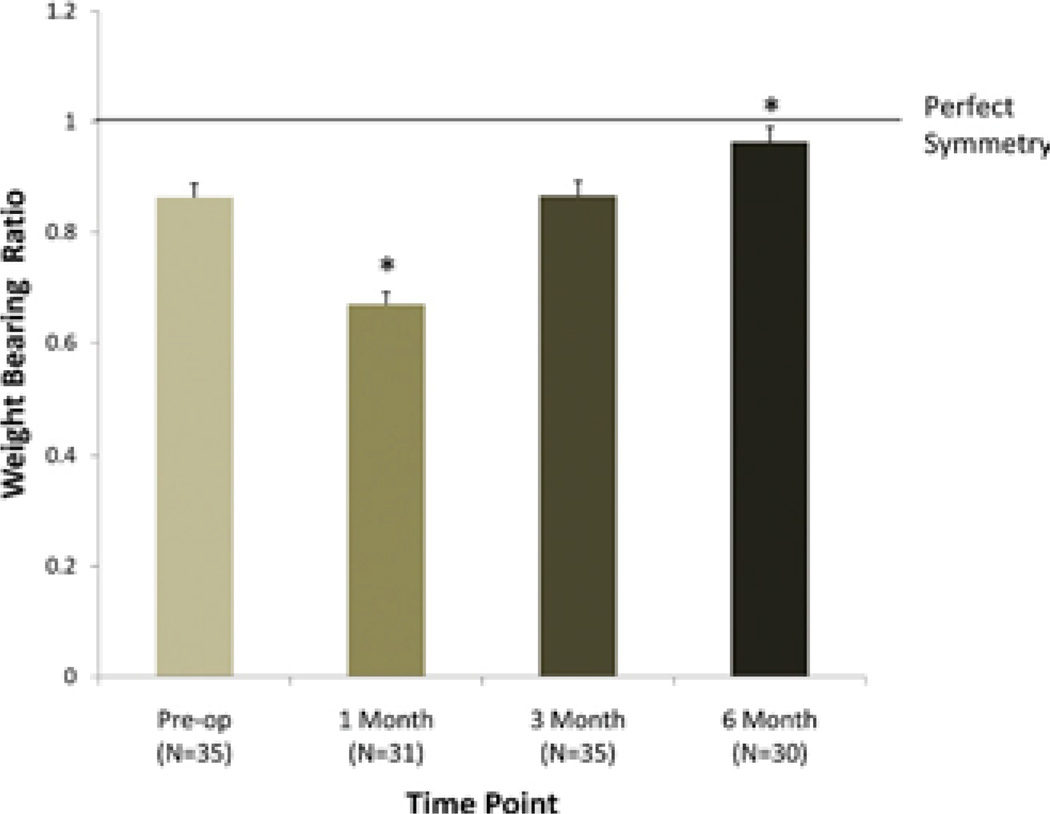
Results: Compared with preoperative values, the TKA group showed greater WB asymmetry at 1 month after surgery (P<.001). By 6 months, the TKA group had less WB asymmetry than preoperative values (P<.001), which was not different from the CTL group. Symmetry in WB correlated with functional outcomes and symmetry of quadriceps strength for the TKA group 6 months postoperatively.
Conclusions: Patients with unilateral knee OA showed WB asymmetry during sit-stand transitions early after unilateral TKA that improved by 6 months after surgery and was no different from that for healthy people of similar age. For people in the first 6 months after TKA, greater symmetry was related to better function and strength symmetry.
Copyright © 2011 American Congress of Rehabilitation Medicine. Published by Elsevier Inc. All rights reserved.
Figures
References
-
- March LM, Cross MJ, Lapsley H, et al. Outcomes after hip or knee replacement surgery for osteoarthritis. A prospective cohort study comparing patients’ quality of life before and after surgery with age-related population norms. Med J Aust. 1999;171:235–238. - PubMed
-
- Meier W, Mizner RL, Marcus RL, Dibble LE, Peters C, Lastayo PC. Total knee arthroplasty: muscle impairments, functional limitations, and recommended rehabilitation approaches. J Orthop Sports Phys Ther. 2008;38:246–256. - PubMed
-
- Walsh M, Woodhouse LJ, Thomas SG, Finch E. Physical impairments and functional limitations: a comparison of individuals 1 year after total knee arthroplasty with control subjects. Phys Ther. 1998;78:248–258. - PubMed
-
- Farquhar SJ, Reisman DS, Snyder-Mackler L. Persistence of altered movement patterns during a sit-to-stand task 1 year following unilateral total knee arthroplasty. Phys Ther. 2008;88:567–579. - PubMed
Publication types
MeSH terms
Grants and funding
LinkOut - more resources
Full Text Sources
Medical
