. 2011 Nov;4(6):707-13.
doi: 10.1161/CIRCHEARTFAILURE.111.961474. Epub 2011 Aug 12.

Impaired mitochondrial biogenesis precedes heart failure in right ventricular hypertrophy in congenital heart disease

Affiliations

Impaired mitochondrial biogenesis precedes heart failure in right ventricular hypertrophy in congenital heart disease

Georgios Karamanlidis et al. Circ Heart Fail. 2011 Nov.

Abstract

Background: The outcome of the surgical repair in congenital heart disease correlates with the degree of myocardial damage. In this study, we determined whether mitochondrial DNA depletion is a sensitive marker of right ventricular (RV) damage and whether impaired mitochondrial DNA (mtDNA) replication contributes to the transition from compensated hypertrophy to failure.

Methods and results: RV samples obtained from 31 patients undergoing cardiac surgery were compared with 5 RV samples from nonfailing hearts (control). Patients were divided into compensated hypertrophy and failure groups, based on preoperative echocardiography, catheterization, and/or MRI data. Mitochondrial enzyme activities (citrate synthase and succinate dehydrogenase) were maintained during hypertrophy and decreased by ≈40% (P<0.05 versus control) at the stage of failure. In contrast, mtDNA content was progressively decreased in the hypertrophied RV through failure (by 28±8% and 67±11%, respectively, P<0.05 for both), whereas mtDNA-encoded gene expression was sustained by increased transcriptional activity during compensated hypertrophy but not in failure. Mitochondrial DNA depletion was attributed to reduced mtDNA replication in both hypertrophied and failing RV, and it was independent of PGC-1 downregulation but was accompanied by reduced expression of proteins constituting the mtDNA replication fork. Decreased mtDNA content in compensated hypertrophy was also associated with pathological changes of mitochondria ultrastructure.

Conclusions: Impaired mtDNA replication causes early and progressive depletion of mtDNA in the RV of the patients with congenital heart disease during the transition from hypertrophy to failure. Decreased mtDNA content probably is a sensitive marker of mitochondrial injury in this patient population.


Figures
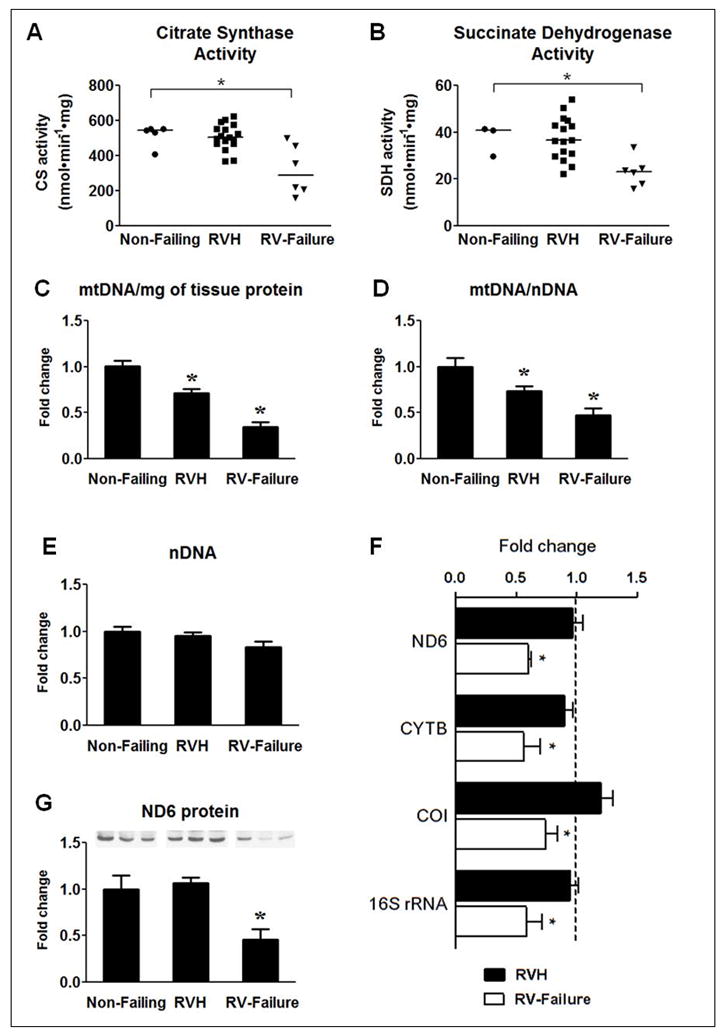
Figure 1
Figure 1
Assessment of mitochondrial enzyme activity and mtDNA content. (A) Citrate Synthase activity and (B) Succinate Dehydrogenase activity. Symbols in the scatter plots represent individual measurements and the continuous line indicates the group median. Mean of the fold changes ± SEM for (C) mtDNA content per mg of total protein, (D) mtDNA per nDNA and (E) nDNA per total DNA in RVH (n=17) and RV-Failure (n=6) group compared to Non-Failing RV controls (n=5). (F) Mean of the fold changes ± SEM of mRNA levels of ND6, CYTB, COI and 16S rRNA in the RVH (n=25) and RV-failure (n=6) relative to Non-Failing controls (indicated by the dashed line; n=5; * p≤0.05 vs. Non-Failing). (G) Mean of the fold changes ± SEM and a representative western blot for the ND6 (n=5 per group; * p≤0.05 vs. Non-Failing).
Figure 2
Figure 2
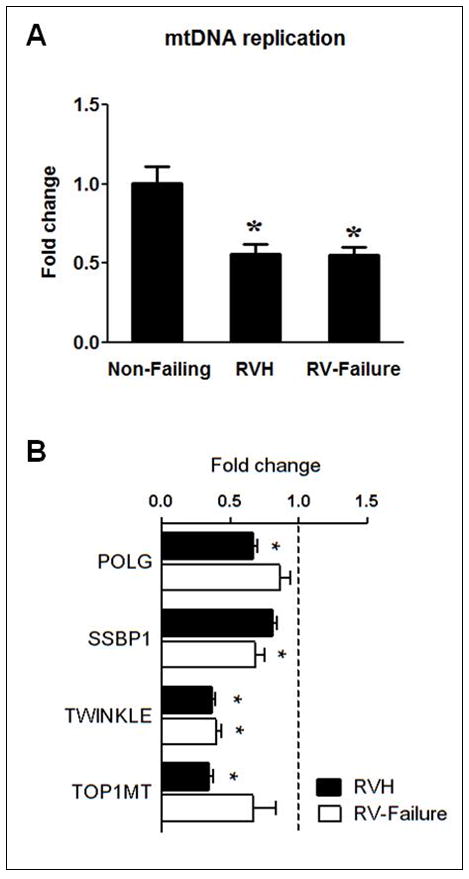
mtDNA replication. mtDNA replication was assessed by measuring the extension of 7S DNA beyond the D-Loop and normalized to the mtDNA content (A) and mRNA levels of POLG, SSBP1, TWINKLE and TOP1MT (B) in Non-Failing RV (indicated by the dashed line; n=5), RVH (n=25) and RV-failure (n=6). Data are shown as the mean of the fold changes ± SEM over the Non-Failing RV (* p≤0.05 vs. Non-Failing).
Figure 3
Figure 3
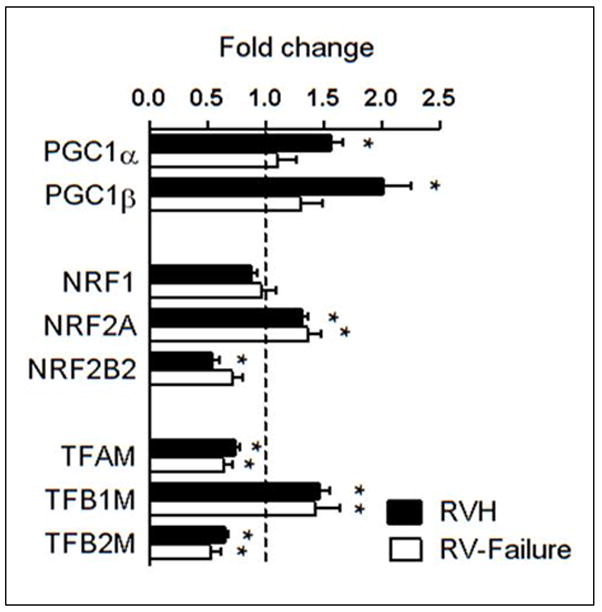
mRNA levels of the PGC-1 pathway in overloaded RV. Mean of the fold changes ± SEM in gene expressions for the PGC-1 pathway in the RVH (n=25) and RV-failure (n=6) relative to Non-Failing controls (indicated by the dashed line; n=5; * p≤0.05 vs. Non-Failing).
Figure 4
Figure 4
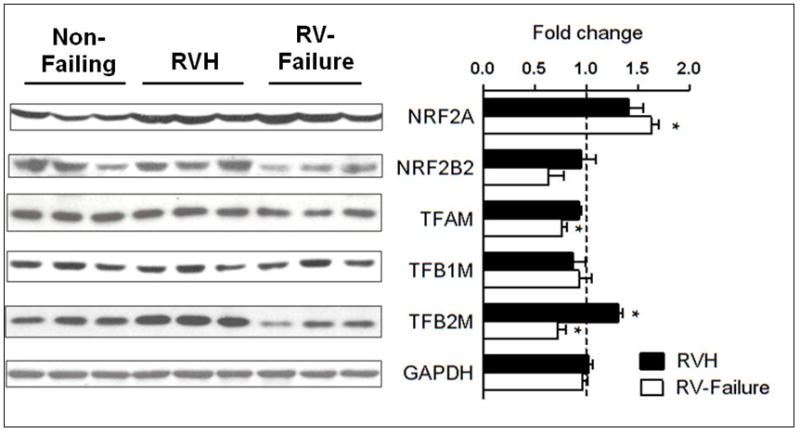
Protein levels of the PGC-1 downstream targets in overloaded RV. Representative western blots and mean of the fold changes ± SEM in gene expressions for the PGC-1 pathway in the RVH (n=5) and RV-failure (n=5) relative to Non-Failing controls (indicated by the dashed line; n=5; *p≤0.05 vs. Non-Failing).
Figure 5
Figure 5
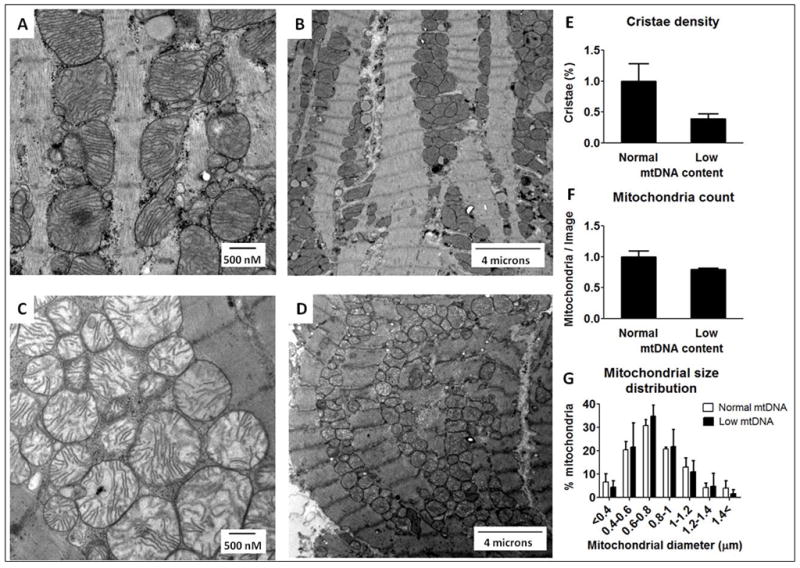
Mitochondrial ultrastructure in heart samples of compensated RV hypertrophy with normal and decreased mtDNA content. Representative electron micrographs of high and low magnifications a patient with normal mtDNA levels (A and B) and a patient with reduced mtDNA levels (C and D). Quantitative morphometric measurements of the cellular volume density for the mitochondrial cristae density (E), total mitochondria number (F) and mitochondrial size distribution (G) based on analysis of ten electron micrograph sections per patient from 2 patients per group. The bars represent mean of the fold changes ± SD.
Figure 6
Figure 6
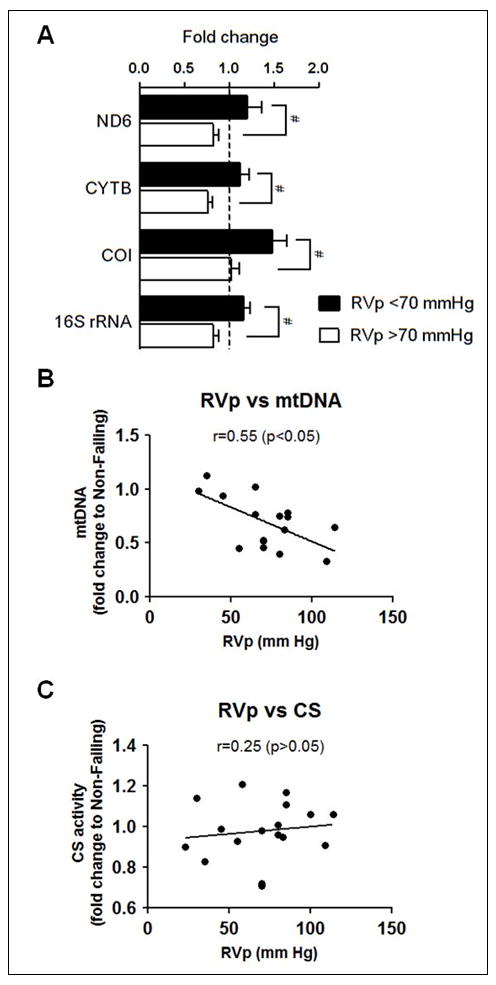
Pressure dependent changes of mtDNA gene expression, mtDNA content and CS activity in the RVH. (A) mRNA levels of ND6, CYTB, COI and 16S rRNA in the RVH group with RV pressure (RVp) <70mmHg (n=7) and RVp≥70mmHg (n=10) compared to Non-Failing RV controls (indicated by the dashed line in (A); n=5). Data are given as the mean of the fold changes ± SEM relative to the Non-Failing RV (* p≤0.05). (B) Correlation coefficient (Spearman’s rank correlation) between RV pressure (RVp) and mtDNA normalized to nDNA, and (C) RV pressure (RVp)-CS activity relationship in the RVH group. Data are given as the mean of the fold changes relative to the Non-Failing RV (n=17).

Comment in

References

    1. Murphy JG, Gersh BJ, Mair DD, Fuster V, McGoon MD, Ilstrup DM, McGoon DC, Kirklin JW, Danielson GK. Long-term outcome in patients undergoing surgical repair of tetralogy of Fallot. N Engl J Med. 1993;329:593–599. - PubMed
    1. Harrild DM, Berul CI, Cecchin F, Geva T, Gauvreau K, Pigula F, Walsh EP. Pulmonary valve replacement in tetralogy of Fallot: impact on survival and ventricular tachycardia. Circulation. 2009;119:445–451. - PMC - PubMed
    1. Bautista-Hernandez V, Hasan BS, Harrild DM, Prakash A, Porras D, Mayer JE, Jr, Del Nido PJ, Pigula FA. Late pulmonary valve replacement in patients with pulmonary atresia and intact ventricular septum: a case-matched study. Ann Thorac Surg. 2011;91:555–560. - PMC - PubMed
    1. Therrien J, Siu SC, McLaughlin PR, Liu PP, Williams WG, Webb GD. Pulmonary valve replacement in adults late after repair of tetralogy of fallot: are we operating too late? J Am Coll Cardiol. 2000;36:1670–1675. - PubMed
    1. Bouzas B, Kilner PJ, Gatzoulis MA. Pulmonary regurgitation: not a benign lesion. Eur Heart J. 2005;26:433–439. - PubMed

Publication types

MeSH terms