


Phenotypic modulation of macrophages in response to plaque lipids
- PMID: 21841486
- PMCID: PMC3979355
- DOI: 10.1097/MOL.0b013e32834a97e4
Phenotypic modulation of macrophages in response to plaque lipids
Abstract
Purpose of review: The accumulation of macrophages in the vascular wall is a hallmark of atherosclerosis. The biological properties of atherosclerotic plaque macrophages determine lesion size, composition, and stability. In atherosclerotic plaques, macrophages encounter a microenvironment that comprises a variety of lipid oxidation products, each of which has diverse biological effects. In this review, we summarize recent advances in our understanding of the effects of plaque lipids on macrophage phenotypic polarization.
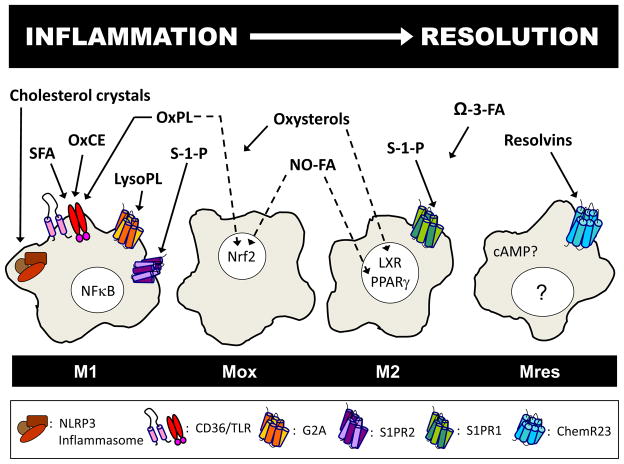
Recent findings: Atherosclerotic lesions in mice and in humans contain various macrophage phenotypes, which play different roles in mediating inflammation, the clearance of dead cells, and possibly resolution. Macrophages alter their phenotype and biological function in response to plaque lipids through the upregulation of specific sets of genes. Interaction of oxidized lipids with pattern recognition receptors and activation of the inflammasome by cholesterol crystals drive macrophages toward an inflammatory M1 phenotype. A new phenotype, Mox, develops when oxidized phospholipids activate stress response genes via Nrf2. Other lipid mediators such as nitrosylated-fatty acids and omega-3 fatty acid-derived products polarize plaque macrophages toward anti-inflammatory and proresolving phenotypes.
Summary: A deeper understanding of how lipids that accumulate in atherosclerotic plaques affect macrophage phenotype and function and thus atherosclerotic lesion development and stability will help to devise novel strategies for intervention.
Figures
References
-
- Martinez FO, Helming L, Gordon S. Alternative activation of macrophages: an immunologic functional perspective. Annu Rev Immunol. 2009;27:451–483. - PubMed
-
- Kadl A, Meher AK, Sharma PR, Lee MY, Doran AC, Johnstone SR, Elliott MR, Gruber F, Han J, Chen W, Kensler T, Ravichandran KS, Isakson BE, Wamhoff BR, Leitinger N. Identification of a novel macrophage phenotype that develops in response to atherogenic phospholipids via Nrf2. Circ Res. 2010;107:737–746. This report established the existence of a novel macrophage phenotype that develops in response to oxidized phospholipids and documented that Mox accounts for about 30% of macrophages present in mouse lesions. - PMC - PubMed
-
- Moore KJ, Tabas I. Macrophages in the pathogenesis of atherosclerosis. Cell. 2011;145:341–355. This review discusses macrophage function throughout the course of atherosclerosis including monocyte entry, inflammatory activation, cholesterol loading, fibrous cap thinning, and plaque necrosis. It includes an interesting discussion on the limitations of current mouse models of the disease. - PMC - PubMed
-
- Mantovani A, Garlanda C, Locati M. Macrophage Diversity and Polarization in Atherosclerosis. A Question of Balance. Arterioscler Thromb Vasc Biol. 2009 - PubMed
Publication types
MeSH terms
Grants and funding
LinkOut - more resources
Full Text Sources
Medical
