


Climate change, crop yields, and undernutrition: development of a model to quantify the impact of climate scenarios on child undernutrition
- PMID: 21844000
- PMCID: PMC3261974
- DOI: 10.1289/ehp.1003311
Climate change, crop yields, and undernutrition: development of a model to quantify the impact of climate scenarios on child undernutrition
Erratum in
-
Erratum: Climate change, crop yields, and undernutrition: development of a model to quantify the impact of climate scenarios on child undernutrition.Environ Health Perspect. 2015 May;123(5):A118. doi: 10.1289/ehp.123-A118. Environ Health Perspect. 2015. PMID: 25932822 Free PMC article. No abstract available.
Abstract
Background: Global climate change is anticipated to reduce future cereal yields and threaten food security, thus potentially increasing the risk of undernutrition. The causation of undernutrition is complex, and there is a need to develop models that better quantify the potential impacts of climate change on population health.
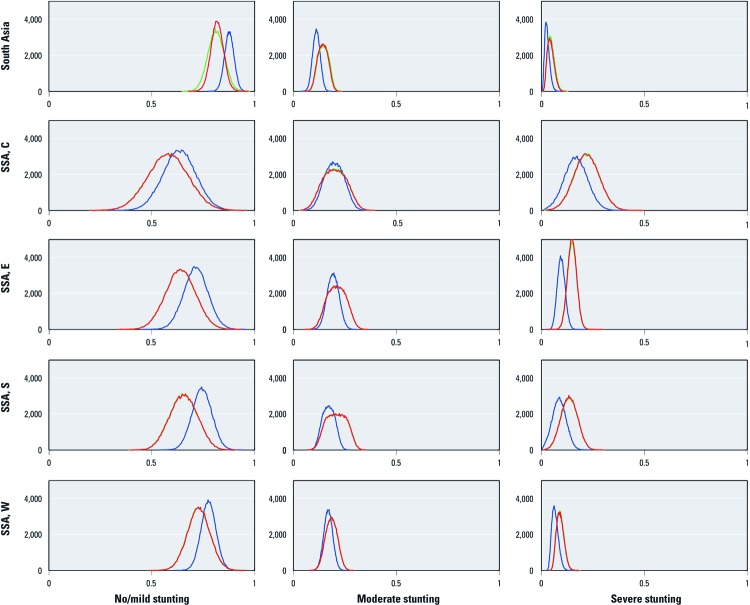
Objectives: We developed a model for estimating future undernutrition that accounts for food and nonfood (socioeconomic) causes and can be linked to available regional scenario data. We estimated child stunting attributable to climate change in five regions in South Asia and sub-Saharan Africa (SSA) in 2050.
Methods: We used current national food availability and undernutrition data to parameterize and validate a global model, using a process-driven approach based on estimations of the physiological relationship between a lack of food and stunting. We estimated stunting in 2050 using published modeled national calorie availability under two climate scenarios and a reference scenario (no climate change).
Results: We estimated that climate change will lead to a relative increase in moderate stunting of 1-29% in 2050 compared with a future without climate change. Climate change will have a greater impact on rates of severe stunting, which we estimated will increase by 23% (central SSA) to 62% (South Asia).
Conclusions: Climate change is likely to impair future efforts to reduce child malnutrition in South Asia and SSA, even when economic growth is taken into account. Our model suggests that to reduce and prevent future undernutrition, it is necessary to both increase food access and improve socioeconomic conditions, as well as reduce greenhouse gas emissions.
Conflict of interest statement
The authors declare they have no actual or potential competing financial interests.
Figures
Comment in
-
More lack in the world: the complex connection between undernutrition and climate change.Environ Health Perspect. 2011 Dec;119(12):A524. doi: 10.1289/ehp.119-a524a. Environ Health Perspect. 2011. PMID: 22133581 Free PMC article. No abstract available.
References
-
- Black RE, Allen LH, Bhutta ZA, Caulfield LE, de Onis M, Ezzati M, et al. Maternal and child undernutrition: global and regional exposures and health consequences. Lancet. 2008;371(9608):243–260. - PubMed
-
- de Onis M, Blossner M. The World Health Organization Global Database on Child Growth and Malnutrition: methodology and applications. Int J Epidemiol. 2003;32(4):518–526. - PubMed
-
- Easterling WE, Aggarwal PK, Batima P, Brander KM, Erda L, Howden SM, et al. Cambridge, UK: Cambridge University Press, 273–313; 2007. Food, fibre and forest products. In: Climate Change 2007: Impacts, Adaptation and Vulnerability. Contribution of Working Group II to the Fourth Assessment Report of the Intergovernmental Panel on Climate Change (Parry ML, Canziani OF, Palutikof JP, van der Linden PJ, Hanson CE, eds)
-
- FAO (Food and Agricultural Organization of the United Nations) Rome: FAO; 1996. The Sixth World Food Survey.
Publication types
MeSH terms
LinkOut - more resources
Full Text Sources
Medical
Research Materials