


Late entry to HIV care among Latinos compared with non-Latinos in a southeastern US cohort
- PMID: 21844031
- PMCID: PMC3156142
- DOI: 10.1093/cid/cir434
Late entry to HIV care among Latinos compared with non-Latinos in a southeastern US cohort
Abstract
Background: Late diagnosis of human immunodeficiency virus (HIV) infection remains common despite advances in therapy and prognosis. The southeastern United States is a rapidly growing Latino settlement area where ethnic disparities may contribute to late presentation to care.
Methods: We assessed demographic and clinical factors between racial/ethnic groups at the time of HIV care initiation in the University of North Carolina Center for AIDS Research Clinical Cohort. We identified independent predictors of late presentation, defined as a CD4(+) T lymphocyte (CD4) count <350 cells/mm(3) or an AIDS-defining event (ADE), using log-linear binomial regression.
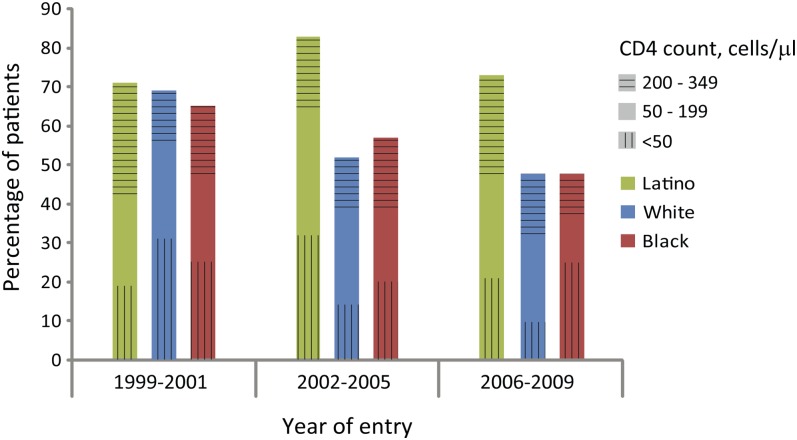
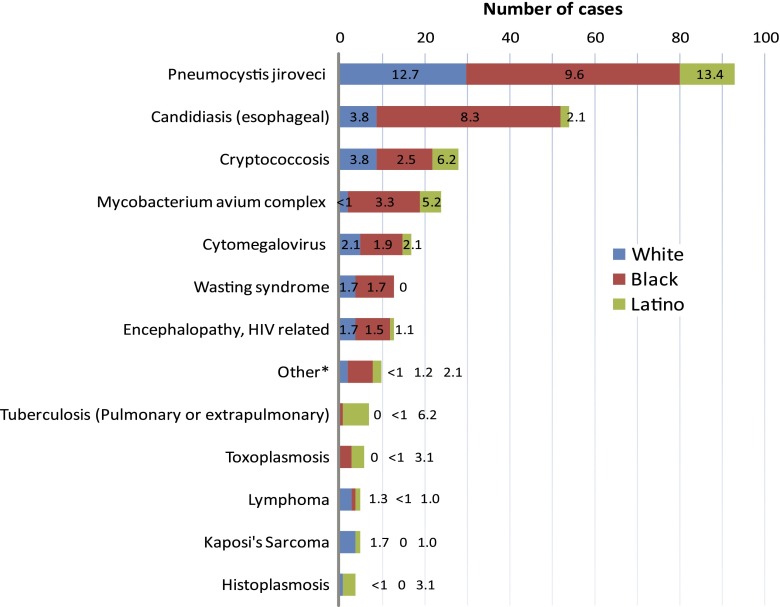
Results: During the period 1999-2009, 853 patients initiated HIV care, of whom 11% were Latino, 28% were white, and 61% were black. Median initial CD4 counts were lower for Latino patients (186 cells/mm(3)) than white patients (292 cells/mm(3); P = .006) and black patients (302 cells/mm(3); P = .02). Latino persons were more likely to be late presenters than white or black persons (76% vs 58%; P < .001) and accounted for 86%, 75%, and 50% of all presenting cases of active tuberculosis, histoplasmosis, and toxoplasmosis, respectively. Latino ethnicity, older age, male sex, and earlier entry year were independently associated with late presentation (P < .05 for all). In multivariable analyses, Latino persons were 1.29 times more likely to present to care late than white or black persons (95% confidence interval, 1.15-1.45).
Conclusions: Latinos are more likely to initiate HIV care later in the course of illness than are black and white persons and account for a majority of several ADEs. Strategies to improve earlier HIV testing among Latinos in new settlement areas are needed.
Figures
Comment in
-
Latinos and HIV care in the Southeastern United States: new challenges complicating longstanding problems.Clin Infect Dis. 2011 Sep;53(5):488-9. doi: 10.1093/cid/cir440. Clin Infect Dis. 2011. PMID: 21844032 No abstract available.
References
-
- Egger M, May M, Chene G, et al. Prognosis of HIV-1-infected patients starting highly active antiretroviral therapy: a collaborative analysis of prospective studies. Lancet. 2002;360:119. - PubMed
-
- Hogg RS, Yip B, Chan KJ, et al. Rates of disease progression by baseline CD4 cell count and viral load after initiating triple-drug therapy. JAMA. 2001;286:2568–77. - PubMed
-
- Centers for Disease Control and Prevention. Late HIV testing—34 states, 1996–2005. MMWR Morb Mortal Wkly Rep. 2009;58:661–5. - PubMed
-
- Espinoza L, Hall HI, Selik R, Hu X. Characteristics of HIV infection among Hispanics, United States 2003–2006. J Acquir Immune Defic Syndr. 2008;49:94–101. - PubMed
Publication types
MeSH terms
Substances
Grants and funding
LinkOut - more resources
Full Text Sources
Medical
Research Materials
