Predictors of survival after cardiac or respiratory arrest in critical care units
- PMID: 21844108
- PMCID: PMC3185075
- DOI: 10.1503/cmaj.100034
Predictors of survival after cardiac or respiratory arrest in critical care units
Abstract
Background: Survival outcomes after cardiac or respiratory arrest occurring outside of intensive care units (ICUs) has been well described. We investigated survival outcomes of adults whose arrest occurred in ICUs and determined predictors of decreased survival.
Methods: We reviewed all records of adults who experienced cardiac or respiratory arrest from Jan. 1, 2000, to Apr. 30, 2005, in ICUs at four hospitals serving Edmonton, Alberta. We evaluated patient and clinical characteristics, as well as survival outcomes during a five-year follow-up period. We determined risk factors for immediate (within 24 hours) and later death.
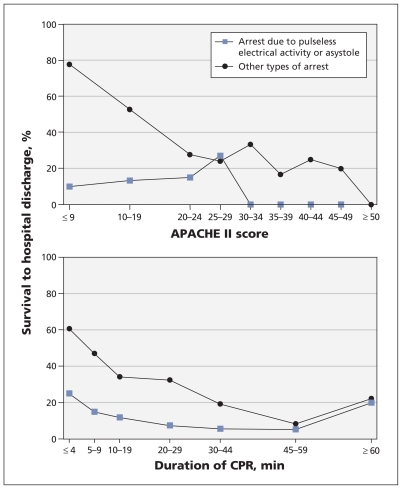
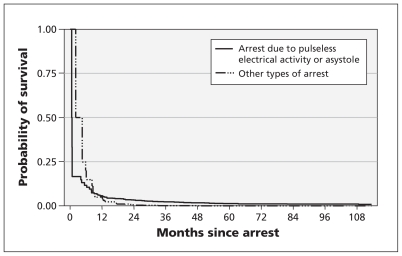
Results: Of the 517 patients included in the study, 59.6% were able to be resuscitated, 30.4% survived to discharge from ICU, 26.9% survived to discharge from hospital, 24.3% survived to one year, and 15.9% survived to five years. Pulseless electrical activity or asystole was the most common rhythm (45.8% of the arrests). Survival was lowest among patients with an arrest due to pulseless electrical activity or asystole: only 10.6% survived to one year, compared with 36.3% who had other arrest rhythms (p < 0.001). Independent predictors of decreased later survival (eight months or more after arrest) were increasing age (adjusted hazard ratio [HR] 1.06, 95% confidence interval [CI] 1.03-1.09) and longer duration of cardiopulmonary resuscitation (CPR) (adjusted HR 1.38, 95% CI 1.03-1.83, per additional logarithm of a minute of CPR).
Interpretation: Our study showed no major improvement in survival following cardiac arrest with pulseless electrical activity or asystole as the presenting rhythm in the ICU despite many advances in critical care over the previous two decades. The independent predictors of death within 24 hours after arrest in an ICU were sex, the presenting rhythm and the duration of CPR. Predictors of later death (eight months or more after arrest) were age and duration of CPR.
Figures
Comment in
-
Not all cardiac arrests are the same.CMAJ. 2011 Oct 4;183(14):1572-3. doi: 10.1503/cmaj.110982. Epub 2011 Aug 15. CMAJ. 2011. PMID: 21844103 Free PMC article. No abstract available.
References
-
- Zheng ZJ, Croft JB, Giles WH, et al. Sudden cardiac death in the United States, 1989 to 1998. Circulation 2001;104:2158–63 - PubMed
-
- Kouwenhoven WB, Jude JR, Knickerbocker GG. Closed-chest cardiac massage. JAMA 1960;173:1064–7 - PubMed
-
- Rosner B. Fundamentals of biostatistics. Belmont (CA): Duxbury Press; 1995
Publication types
MeSH terms
LinkOut - more resources
Full Text Sources
Medical
Miscellaneous